Somalia tells the General Assembly it is not asking the UN to leave, but to work differently
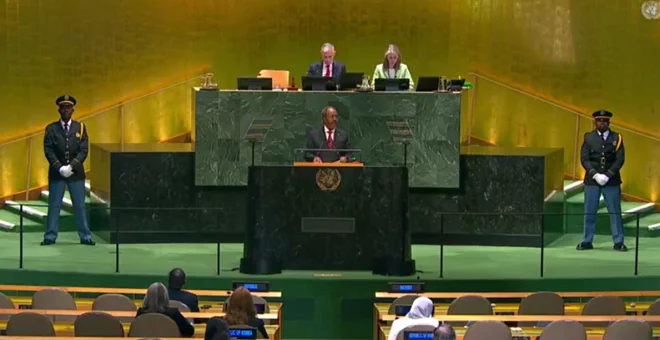
United Nations (AX) — Somalia wants the United Nations to remain engaged in the country—but on terms that place Somali institutions at the center of aid delivery, security planning and political reform, President Hassan Sheikh Mohamud told the U.N. General Assembly on Thursday.
- Advertisement -
Speaking at the 81st session of the U.N. General Assembly, Mohamud also urged a broad overhaul of the Security Council, greater Somali ownership of international assistance and reliable backing for the country’s transition to full national security responsibility.
“Somalia is not calling for the United Nations to leave,” Mohamud said, according to the text of his address. Instead, he said, the partnership should become “more accountable, more strategic and based on results,” with Somali institutions taking the lead in implementation.
After more than three decades of U.N. involvement, Somalia had received significant support, the president said. But he argued that aid managed through stand-alone projects and structures outside the national budget had made it harder for the government to coordinate expenditure, track outcomes and develop durable public institutions.
Mohamud devoted part of his address to the Security Council, saying Africa continued to face an unfair exclusion from permanent membership and insufficient representation among non-permanent members.
Somalia supports the African Union’s common position calling for stronger African representation in both membership categories, he said.
Describing Africa’s absence from the permanent membership as a “historical injustice,” Mohamud said the imbalance affected 54 sovereign states. African countries, he argued, should have full and equal representation in decisions concerning the continent.
Somalia currently occupies a non-permanent seat on the Security Council and is also a member of the African Union Peace and Security Council.
The president likewise reaffirmed Somalia’s position on sovereignty and territorial integrity, saying Mogadishu opposed unilateral steps that weaken the country’s internationally recognized borders. He did not name a specific country or agreement in that portion of the speech.
Turning to Palestine, Mohamud repeated Somalia’s support for Palestinian self-determination and an independent Palestinian state within the 1967 borders. A two-state solution, he said, remained necessary for lasting peace in the Middle East.
“Somalia stands firmly with the Palestinian people and their lawful rights to self-determination and statehood,” he added.
Elections and domestic political reform
Mohamud also presented the government’s drive toward universal suffrage as a bid to hold Somalia’s first democratic elections since 1969.
He said constitutional changes were designed to establish a multi-party system in which voters directly select their representatives and political disagreements are settled through law, dialogue and elections instead of violence.
“The last democratic election held in Somalia was in 1969, and for more than fifty years Somalis have wanted to choose their leaders with their own votes. The country has decided to change that record,” he added.
He invited the United Nations and other international partners to assist with the transition while respecting Somali ownership of the democratic process.
The appeal comes as Somalia continues to face political disagreements over constitutional amendments, the electoral system and the powers and terms of federal institutions. Some opposition leaders and federal member states have rejected elements of the government’s reform program.
On security, Mohamud said Somalia remained determined to defeat militant groups and strengthen national institutions. He stressed, however, that counterterrorism efforts in Somalia carried broader regional and international consequences.
He sought predictable, long-term financing for the security transition, including sufficient funding for the African Union mission. The handover of full security responsibility to Somali forces, he said, could succeed only if it was properly financed.
The president also urged donors to put greater emphasis on prevention instead of repeatedly funding humanitarian responses after disasters have already struck.
Referring to U.N. estimates, he said each dollar invested in anticipatory action, resilient infrastructure or timely intervention could prevent between $3 and $15 in future losses and response costs.
He warned that worsening El Niño conditions could place Somalia under renewed climate pressure. The country should apply lessons from earlier disasters to improve preparations before floods and other shocks hit, he said.
Hormuz disruption hits revenue
Mohamud also highlighted the economic consequences of instability around the Strait of Hormuz, saying Somalia’s reliance on imported food, fuel and other commodities made it especially vulnerable.
Disruptions in the waterway had driven up prices, inflation and insurance costs and were associated with an estimated 40% decline in Somalia’s customs revenue, he said.
Those funds could otherwise be used to support economic reform, growth and poverty reduction, Mohamud said, emphasizing that uninterrupted passage through the strait was vital to vulnerable economies.
Somalia’s economy is projected to expand by 3.1% this year, the president said. He pointed to reforms in public financial management, domestic revenue collection, budget transparency, financial-sector development and the investment climate.
He also cited Somalia’s entry into the East African Community, its ratification of the African Continental Free Trade Area agreement and efforts to join the World Trade Organization as signs of a push for deeper regional and global economic integration.
Mohamud concluded by calling for changes not only to the Security Council but also to the international financial system. Developing countries, he said, need financing that is affordable, accessible and delivered quickly enough to withstand economic and climate shocks.
Restoring trust in multilateral institutions would require “fair representation, accessible financing and measurable results,” he said, pledging that Somalia would continue working with other countries on U.N. reform, stronger U.N.-African Union cooperation and international peace and security.