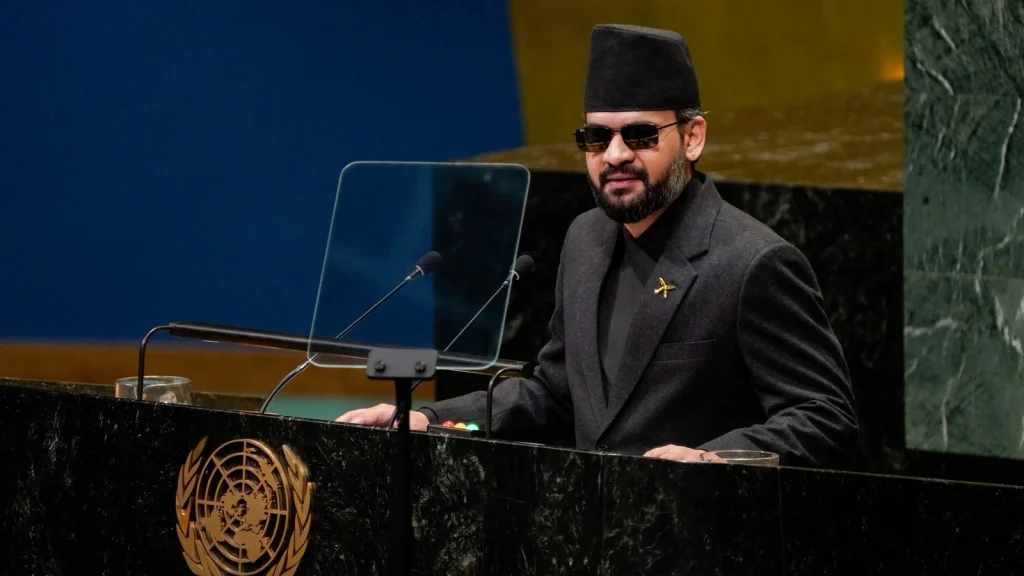
Nepal’s prime minister has urged the international community to provide grants, rather than loans, as the Himalayan nation begins recovering from a glacier flood that killed at least 1,450 people.
Balendra Shah said the disaster had left Nepal facing recovery and reconstruction costs equivalent to about 10% of its gross domestic product. He argued that countries on the front lines of climate change should not be pushed deeper into debt when rebuilding after catastrophic events.
- Advertisement -
“When a climate-driven disaster destroys the infrastructure of a poor country, the answer cannot simply be another mega loan or a patchwork of small grants,” Mr Shah said.
“We need adequate grant-based support from the world,” he added.
More than 1,400 people died and 6,000 are still missing following the glacial floods
Mr Shah described the flood as a stark warning of the escalating dangers linked to climate change, saying it had destroyed roads, bridges, schools, homes and livelihoods while setting back Nepal’s development.
“What we’re trying to convey to the world is this: these issues of climate change are not theoretical anymore,” Nepal’s Minister of Foreign Affairs Shisir Khanal said during the United Nations’ high-level week.
“These are becoming real, and the frequency of such disasters are likely to happen more often over the next few years as the temperature rises, as the glaciers melt,” he said.
Mr Khanal said Nepal had made a negligible contribution to the deterioration of the global climate system.
More than 90% of Nepal’s electricity is generated by hydropower, over 70% of new cars sold in the country are electric and Nepal accounts for just 0.1% of global greenhouse gas emissions.
Minister of Foreign Affairs Shisir Khanal: ‘So why should we, who have not had any contribution to this issue, only bear the burden?’
Scientists from World Weather Attribution have characterised the disaster as a “compound crisis”, with local geological instability combining with long-term warming to drive glacier retreat and permafrost thaw.
A glacier collapsed near the border between Nepal and China’s Tibet Autonomous Region in late August, setting off landslides and a flash flood that swept through valleys downstream.
Search and recovery operations were still continuing weeks later, while more than 6,000 people remained missing in the affected area. Mr Shah said many of those people might never be found.
The World Bank said earlier this week that up to $170 million (€149m) in emergency financing had been made available to help Nepal respond to the disaster and begin its recovery.