Opinion: Somalia’s Balancing Act Between Ethiopia, Egypt and Eritrea
Somalia is seeking to move beyond its traditional role as a venue for regional rivalries and emerge as a geopolitical actor in its own right.
- Advertisement -
The renewed tensions involving Ethiopia, Eritrea and Egypt will provide one of the strongest tests yet of whether Mogadishu can maintain that course.
The conflict in northern Ethiopia can no longer be viewed solely through the lens of Ethiopian domestic politics. Strained relations between Addis Ababa and Asmara, Egypt’s strategic competition with Ethiopia, Sudan’s ongoing war and the contest for access to the Red Sea are combining to create a regional security landscape where events in one arena can quickly reshape another.
Somalia’s immediate challenge is not deciding which side to support in Ethiopia’s conflict. It is staying engaged enough to defend its own interests without being drawn into a war whose outcome and consequences it cannot control.
Meeting that challenge will demand something Somali policy has often found difficult to sustain: strategic consistency.
Ethiopia’s instability presents Somalia with both risks and opportunities
Ethiopia matters too much for Somalia to disregard, yet it is too powerful for Mogadishu to confront lightly.
The neighbours share a lengthy border, deep economic and security connections and a difficult political history. Ethiopian forces have also been central to Somalia’s security arrangements, including through the African Union Support and Stabilization Mission in Somalia.
Any serious crisis inside Ethiopia would therefore carry immediate consequences for Somalia.
Should Addis Ababa have to shift military resources toward Tigray, Amhara, Afar or other internal fronts, its capacity to maintain forces beyond its borders could change. That possibility raises questions about the future shape of AUSSOM, border protection and counterinsurgency efforts in Somalia.
Still, Ethiopia’s weakness would not automatically serve Somalia’s interests.
A less stable Ethiopian state could produce more disorder along the border, new refugee flows, greater trafficking in arms, interruptions to trade and additional openings for Al-Shabaab.
Mogadishu should consequently reject an appealing but hazardous assumption: that Ethiopia’s strategic problems necessarily improve Somalia’s position.
They do not.
The Eritrea factor changes the equation
The worsening relationship between Ethiopia and Eritrea is especially important.
For years, the balance of power in the Horn was heavily influenced by ties between Addis Ababa and Asmara. Their 2018 rapprochement temporarily eased one of the region’s most consequential rivalries.
That détente now looks increasingly vulnerable.
The latest diplomatic breakdown between Ethiopia and Eritrea raises the prospect of a return to competing security blocs across the Horn.
For Somalia, the development creates a difficult diplomatic balancing act.
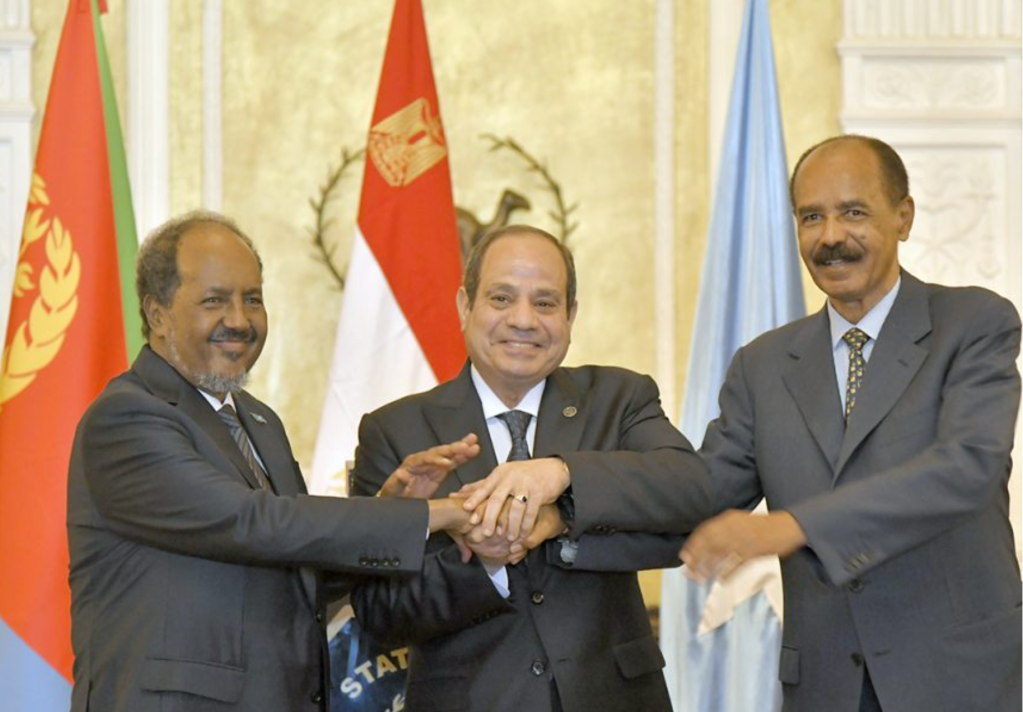
Mogadishu has an interest in productive relations with Eritrea, while also needing to preserve its strategic partnership with Ethiopia. At the same time, it is expanding defence cooperation with Egypt and Türkiye.
Aligning Somalia decisively with one regional camp would therefore come with significant costs.
A more durable policy would keep multiple diplomatic channels open at the same time.
Somalia should be able to engage Addis Ababa, Asmara and Cairo without surrendering control of its foreign policy to any one of them.
Egypt is a partner, but Somalia should not inherit Egypt’s conflict
From Cairo’s standpoint, its deeper engagement with Somalia is understandable.
The dispute with Ethiopia over the Nile, the war in Sudan and the Red Sea’s strategic importance have all encouraged Egypt to strengthen ties with countries on Ethiopia’s eastern flank.
For Somalia, military cooperation with Egypt can offer valuable training, capabilities and institutional assistance.
But Mogadishu must keep a firm boundary between Somali-Egyptian cooperation and Egyptian-Ethiopian rivalry.
Somalia should not permit its territory, military facilities or diplomatic ties to be used as tools in the dispute surrounding the Grand Ethiopian Renaissance Dam.
The same standard should govern every outside partnership.
Somalia’s alliances should build the capacity of the Somali state—not turn the country into a base for another power’s regional agenda.
The Ankara framework is more important than ever
The 2024 Ankara Declaration provides Somalia with a significant diplomatic framework.
The agreement helped ease tensions that followed Ethiopia’s understanding with North Western State of Somalia on maritime access. Its underlying principle—that Ethiopia can secure dependable commercial access to the sea while respecting Somalia’s sovereignty and territorial integrity—continues to matter.
The latest Ethiopian crisis makes that framework even more relevant.
Ethiopia’s need for maritime access is unlikely to vanish as a result of domestic political turmoil. In fact, greater strategic uncertainty could make access to the sea more important for Ethiopian decision-makers.
Somalia therefore has a chance to turn a possible flashpoint into a lasting economic relationship.
Doing so, however, will require discipline.
Mogadishu must draw a clear line between commercial access and sovereign control.
Ethiopia may hold an economic interest in Somali maritime infrastructure without being granted sovereign rights over Somali territory.
That distinction should remain central to Somalia’s policy.
Somalia should prepare for an Ethiopian military redeployment
A broader Ethiopian conflict could have one immediate practical effect: a change in Ethiopia’s military commitments abroad.
If Addis Ababa needs more troops at home, it may review its deployments in Somalia.
Mogadishu should assess the implications now rather than wait for such a decision.
The Federal Government should coordinate with the African Union and AUSSOM partners on contingency plans for multiple possibilities, including a reduction or restructuring of Ethiopian forces.
That does not mean presuming Ethiopia will withdraw.
It means accepting that Somali security policy cannot rest on expectations about another country’s domestic military demands.
Over time, Somalia should build a security architecture able to operate regardless of which external partner can—or chooses to—provide troops.
The maritime dimension may ultimately matter most
Somalia’s geopolitical importance is increasingly tied to the sea.
Its coastline borders the Gulf of Aden and lies close to one of the world’s most vital maritime routes.
Instability involving Ethiopia and Eritrea therefore cannot be considered separately from the wider contest surrounding the Red Sea.
For Somalia, that reality brings both exposure and leverage.
The coastline can draw investment, expand trade and create strategic partnerships. It can also attract foreign military competition, criminal networks and pressure from rival powers.
Somalia’s answer should not be to shut its shores to international partners.
It should be to make sure Somalia sets the terms of engagement.
That means investing in the Somali Navy and Coast Guard, expanding maritime surveillance, strengthening port governance and developing the institutions needed to oversee foreign security and commercial agreements.
The greatest danger is strategic fragmentation
Somalia’s network of foreign relationships is becoming more diverse.
Türkiye is a significant defence partner. Egypt has increased military cooperation. Ethiopia remains a vital neighbour and security player. Gulf states have major economic and strategic interests. The United States and European countries continue to play important roles in security and development.
There is no inherent conflict in maintaining all of these relationships.
The problem arises when outside partnerships begin steering Somali policy in incompatible directions.
The answer is not to select a single partner.
It is to establish a Somali strategic doctrine that defines the purpose of every partnership.
Such a doctrine would rest on several principles:
Somalia will not take part in Ethiopia’s internal war.
Somalia will oppose breaches of its sovereignty and territorial integrity, regardless of who commits them.
Somalia will encourage peaceful regional dialogue.
Somalia will welcome commercial and security cooperation that reinforces national institutions.
Somalia will not allow its territory to serve as a platform for another state’s military confrontation.
And, critically, Somalia will sustain diplomatic ties with competing regional powers at the same time.
The strategic choice
Mogadishu is unlikely to possess the power to shape the direct outcome of Ethiopia’s internal conflict.
It does, however, have substantial influence over whether Somalia becomes collateral damage. That distinction should be at the heart of its policy.
The goal should not be to exploit Ethiopia’s instability or to endorse every decision made in Addis Ababa.
It should be to protect Somalia’s strategic autonomy while stopping instability from spreading across the border.
That calls for a foreign policy built on non-alignment without neutrality toward threats, engagement without entanglement, and partnership without dependency.
The Horn of Africa is entering another period of rapid change, when borders, alliances and security calculations may shift with little warning.
Somalia cannot decide what happens inside Ethiopia. It can decide how to respond. That choice may ultimately be the more important strategic decision.
The author is Abdirahman Jeylani Mohamed, a Somali journalist, communications specialist and foreign policy commentator based in Mogadishu, Somalia. You can reach out to him; jaylaanijr@gmail.com