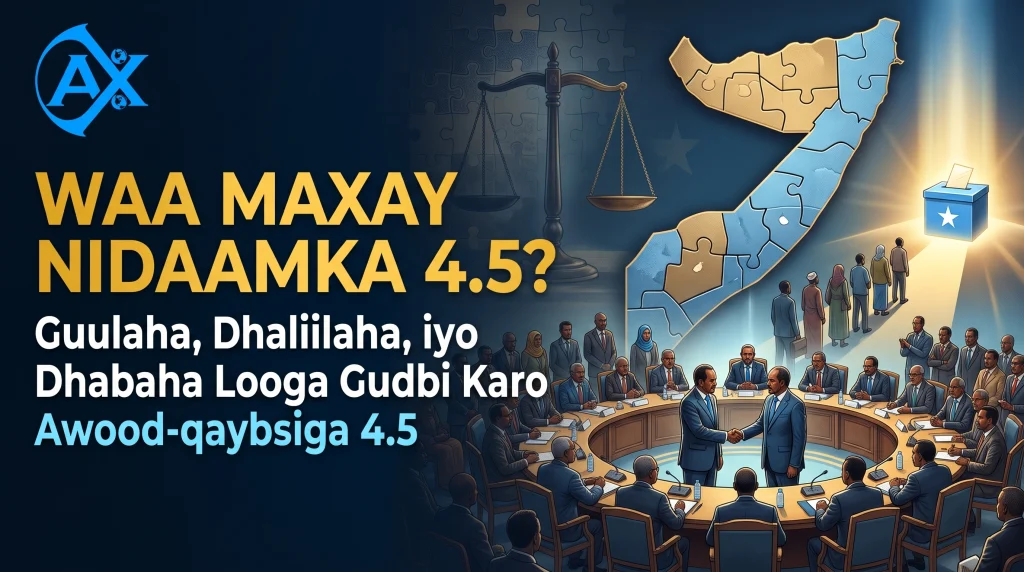
The clan-based power-sharing system known as 4.5 is one of the most important pillars of contemporary Somali politics. Although it was intended as a temporary solution to end the civil conflicts, it has had a profound impact on the structure of governance, elections, and the distribution of national resources.
Understanding this system is key to analyzing the country’s politics, from the capital Mogadishu to other cities such as Kismayo, Baidoa, Jowhar, Garowe, Hargeisa, Bosaso, and Zeila.
- Advertisement -
What Is the 4.5 System?
The 4.5 system is a political formula that distributes power among Somali clans through a clan-based arrangement founded on fixed quotas. The name “4.5” consists of two parts:
-
- The Four Clans (4): This represents four of Somalia’s major clans, which receive equal and full shares of parliamentary seats and government positions.
-
- The Half (.5): This represents clans considered smaller in number or marginalized, which collectively share one half-share.
This system is used in forming the House of the People of the Federal Parliament of Somalia, establishing the Council of Ministers, and distributing the country’s highest offices.
Brief History and Origins of the System
Following the collapse of the central government, Somalia entered a difficult period of conflict and deep mistrust among communities. To find a path toward reconciliation and rebuild state institutions, national reconciliation conferences decided that power should be distributed along clan lines.
The aim was for every clan to feel that it was represented at the decision-making table, removing fears that one group or clan could once again seize control of the country’s leadership. It was a step toward rebuilding the state while seeking to establish political stability in the country.
Importance of the 4.5 System
Although the system has faced considerable criticism, it has performed important functions that have contributed to the existence of the state today:
-
- Political Stability: It helped eliminate major clan conflicts by distributing power through consensus.
-
- Building National Institutions: It made it possible to establish a parliament and government, and to elect a president peacefully.
-
- Maintaining Balance: It prevents government power from tilting toward one side or a single region.
-
- Linking the Regions: It enabled representation from all parts of the country, including Puntland, Jubaland, Galmudug, Hirshabelle, South West State, and the regions of the North Western State of Somalia.
Key Features of the System
Several fundamental provisions define how the 4.5 system operates:
-
- Parliamentary Seats: Somalia’s House of the People consists of 275 members. Each of the four major clans receives 61 seats, while the clans in the half-share category (.5) collectively receive 31 seats.
-
- Top Leadership: The presidency, premiership, and speakership of the House of the People are distributed among the clans so that two key positions do not go to the same clan.
-
- Role of Traditional Elders: The selection of members of parliament is usually led by clan traditional elders, who select or endorse the delegates who choose the lawmakers.
-
- Application at the Federal Level: Although some regional administrations have their own arrangements, the 4.5 system operates fully within the federal government.
Challenges and Criticisms
The 4.5 system is not considered a fully equitable system and is viewed as an obstacle to democratic progress for the following reasons:
-
- National Inequality: The half-share category (.5) has created a perception that some people are treated as second-class citizens because they do not receive a full share.
-
- Population Size Not Taken into Account: There is no official census on which this distribution is based; it is a political agreement founded on estimates.
-
- Neglect of Expertise: Leaders are selected on the basis of clan affiliation rather than knowledge, experience, and professional competence.
-
- Obstacle to One Person, One Vote: It makes it more difficult to transition to political parties based on ideas and effective platforms.
Frequently Asked Questions (FAQ)
1. Why is it called 4.5 instead of simply a clan-based system?
It is named after the mathematical formula used to distribute members and seats. Each of the four major clans receives a share of 1, totaling 4, while the minority clans collectively share a half-share of 0.5.
2. Is this system included in Somalia’s official Constitution?
No. The term 4.5 does not appear in the Provisional Constitution. The Constitution promotes justice, equality, and democracy. Nevertheless, it is used as an unwritten but functioning political agreement until direct elections are achieved.
3. How can the country move beyond this power-sharing arrangement?
The main path beyond it is to introduce direct “one person, one vote” elections, register citizens, establish national political parties, and complete the constitutional process in order to achieve genuine, people-based representation.