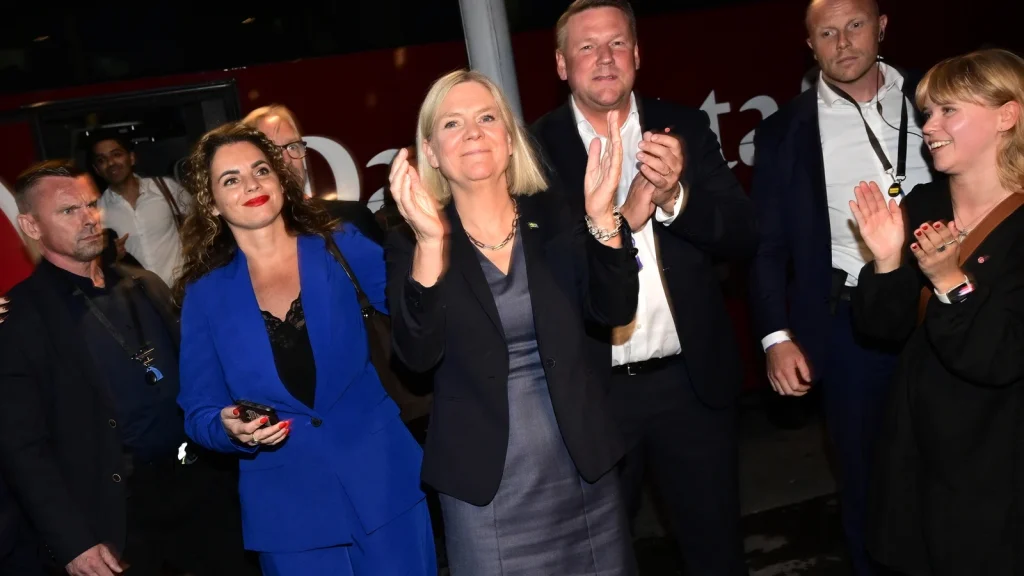
Sweden’s election remained too close to call after a partial count gave the opposition centre-left bloc a narrow three-seat lead, setting the stage for a tense wait over who will govern the Nordic country.
The left-leaning alliance led by Social Democratic leader Magdalena Andersson was on course to win 176 of the 349 seats in the Riksdag, according to the election authority’s count of ballots from 6,195 of Sweden’s 6,312 districts.
- Advertisement -
Prime Minister Ulf Kristersson’s right-wing governing bloc was projected to take 173 seats. Counting was still under way, with final results not expected before Wednesday at the earliest.
The vote is unlikely to alter Sweden’s pro-Western, pro-Ukraine foreign policy. But it could determine whether Mr Kristersson’s drive for tougher migration controls and a broader hard-right agenda is maintained — or intensified.
“It’s a very tight race, it’s going to be a very long night but I think the Social Democrats have done quite a good election,” Adonay Endrias Kidane, a doctor and Social Democrat supporter, said at the party’s post-election gathering in central Stockholm.
Sweden’s Prime Minister Ulf Kristersson has recovered from low opinion polls
Mr Kristersson broke a long-standing political taboo during the campaign by pledging to bring the Sweden Democrats into government as he seeks to form a majority-right coalition.
Many right-wing voters view a victory as an endorsement of policies they credit with reducing immigration sharply and helping curb gang violence.
Yet some of Sweden’s 10.6 million people have voiced concern that the prime minister went too far by inviting the far right into government.
Critics also argue that Mr Kristersson’s migration programme — which combines incentives and penalties to push migrants either to adopt Swedish cultural norms more closely or leave the country — threatens civil liberties.
Mr Kristersson had lagged in opinion polls throughout his four years in office, although he narrowed the gap during the final weeks of the campaign as Ms Andersson and the Social Democrats surrendered some support.
With voting over, Mr Kristersson said he still hoped to assemble a governing majority from the eight political groupings that won seats in the Riksdag. He maintained that voters preferred his party’s economic programme to that of the opposition.
“Even if tonight’s results hold, I will explore whether it’s possible to find a viable government constellation… capable of securing support for the fiscal policy Swedish voters have voted for,” he said.
Ms Andersson’s bloc also faces internal divisions, including over migration, where she supports a tougher approach than some of her allies, as well as proposals for a billionaire tax and the construction of new nuclear reactors.
Any budget she presents could face a difficult path, with the Left Party, Sweden’s former Communist party, and the pro-market Centre Party holding sharply different views on several economic questions.
A strong showing by the Sweden Democrats would be welcomed by Europe’s increasingly confident far-right parties, which drew encouragement from the anti-immigrant Alternative for Germany’s victory in a German state election last week.
Sweden Democrats leader Jimmie Akesson is hoping to enter government for the first time
The far right is also looking toward elections elsewhere in Europe, including the National Rally’s bid for the French presidency next year, which could become its most significant prize.
Voting on Saturday in Rinkeby, a Stockholm suburb with one of Sweden’s largest Swedish-Somali communities, Sweden Democrats leader Jimmie Akesson said the area “doesn’t look like Sweden”.
For decades, Sweden was regarded as one of Europe’s most welcoming destinations for immigrants. That approach shifted after Mr Kristersson came to power four years ago.
His government ended permanent residency for refugees, imposed stricter welfare conditions and increased expulsions of people without the right to remain.
The Sweden Democrats acknowledge that neo-Nazis and white supremacists helped found the party in the 1980s. They say those extremists have since been removed, and the party has apologised for its past.
The party has also said that, if it enters government, it would seek to ban women from wearing face coverings in public and withdraw funding from projects focused on integrating newcomers.
Despite those ambitions, the latest count indicated that the party was heading for its first decline in both parliamentary seats and vote share during Mr Akesson’s more than two decades as leader.