“The water appeared around the corner like smoke.”
That was the first glimpse Gita Devi Kalwar had of the catastrophic floods surging toward her home in Bidur last Wednesday morning.
- Advertisement -
“Everyone started shouting, ‘run away, run away’. I held onto my husband and ran,” she said.
“Those who could run survived. Those who could not were swept away,” she added.
Within minutes, the flood had erased everything the family owned: their home, motorbikes, vital documents and the money they had saved through their small business.
Kate Varley reports from inside the devastated town of Bidur
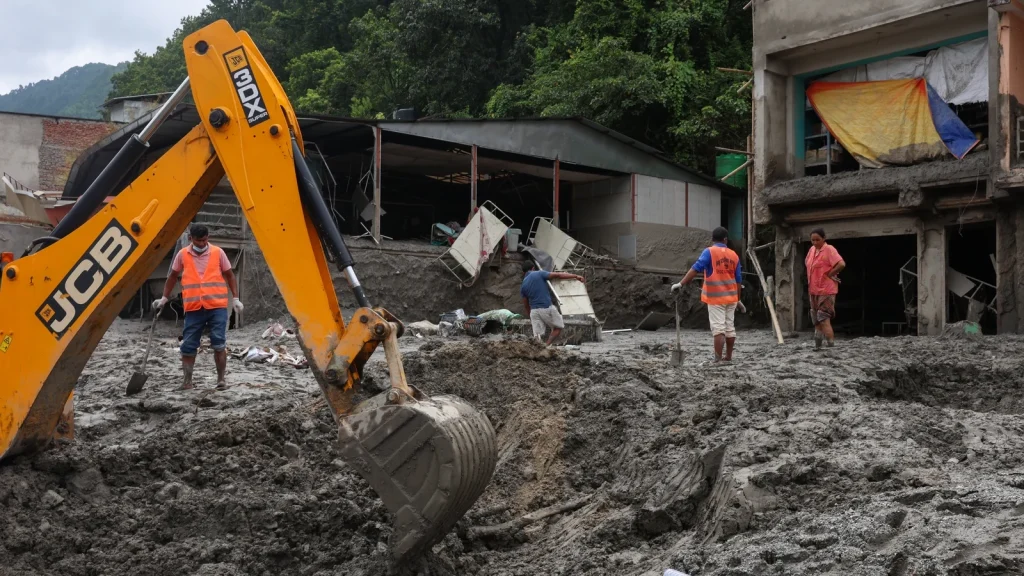
Gita and her husband escaped with only the clothes they were wearing. When they returned, their home had been replaced by mud, sediment and scattered debris.
Her 17-year-old daughter, Rishika, was in Kathmandu when the disaster struck. As soon as she heard what had happened, she travelled back to Bidur.
“The tsunami came and took everything,” she said. “Everything is lost.”
Yet her parents survived, something Rishika says she cannot take for granted.
“The biggest thing for me is that my family is safe,” she said, tightly clasping her mother’s hand.
Gita (R) and her daughter Rishika returned home to ruin
Buildings were completely destroyed in the aftermath of the floods
“The most important things in my life are my father and mother.”
Relief and rescue operations
Across the devastated Trishuli River Valley, the Kalwar family’s experience is being repeated in communities along the waterway.
Ruined homes and businesses stand amid the mud along the riverbed, their broken remains showing the speed and force with which the floodwaters tore through the valley.
Residents sift through the wreckage in search of anything that can be recovered. At the remains of a nearby bank, workers are also trying to retrieve a safe containing money, now buried beneath the mud.
The floods transformed the valley in a matter of minutes. Restoring it, residents fear, could take decades.
Even so, Bidur has escaped some of the devastation suffered by settlements farther upstream.
Because roads still connect the town to the outside world, it has become a crucial entry point for relief supplies and aid destined for communities cut off by the floods.
Much of the rescue and humanitarian response is being organised from the local army barracks, where helicopters have been departing almost continuously.
Suresh Shah has been searching among thousands of names for his missing uncle
The aircraft carry rescue crews and emergency supplies into the mountains before returning with survivors airlifted from isolated communities.
‘We don’t know whether he is dead or alive’
As reports spread that rescued people were being brought to Bidur, the town became a meeting place for families desperate for news of missing relatives.
They gathered outside the barracks, studying lists of survivors posted there.
“I am looking for my uncle,” said Suresh Shah.
“He was working as an engineer on the customs building being constructed on the Chinese border. We have no idea where he is.
“We don’t know whether he is dead or alive. His name is not on the list of rescued people.”
The emergency response has also attracted charities, volunteers and local residents determined to support those affected.
Bishal has been helping to feed hundreds of people
One of them is Bishal, who normally works for a driving union but decided he needed to help in the aftermath.
“After the tragedy, people were struggling to find food. Hotel meals are expensive for them, so we began providing food free of charge.
“Yesterday, we started by feeding about 600 people. Today, we have fed around 1,500 so far.”
Volunteers warn that the demand could rise sharply as the extent of the disaster becomes clearer and more survivors reach Bidur.