
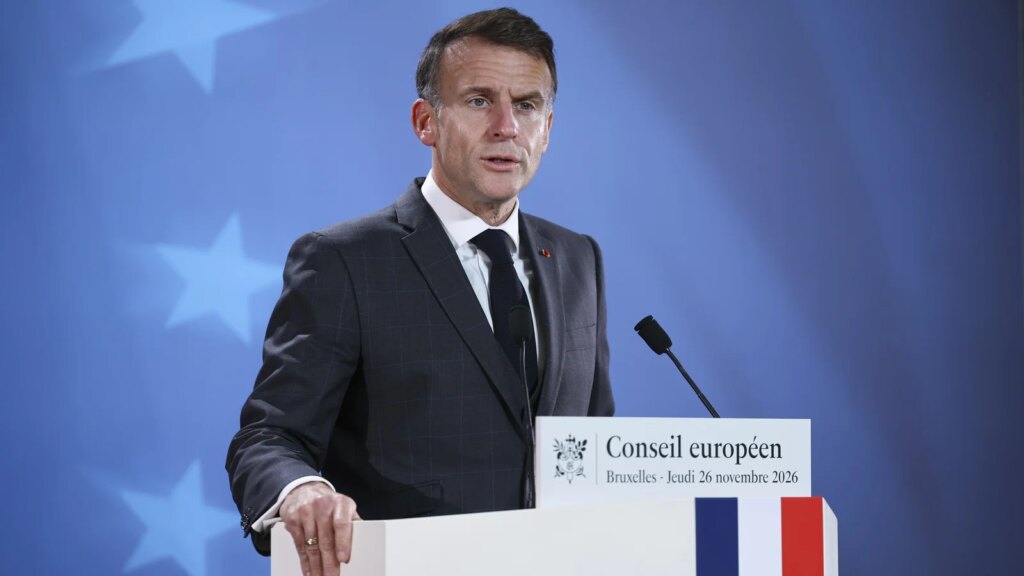
French President Emmanuel Macron has accused far-right leader Marine Le Pen of “arrogance” after she criticised his drive to secure the EU’s next long-term budget before France votes in next year’s presidential election.
EU leaders are holding tense summit negotiations in Brussels as they seek a December agreement on the bloc’s 2028-2034 budget. Reaching a deal this year would prevent the dispute from colliding with an election-heavy period across Europe, above all in France.
Mr Macron heightened the pressure on Thursday by warning that he would abandon the process if an agreement was not reached before 2027. Ms Le Pen responded sharply.
“Our country is on the brink of default and social upheaval. Our leaders should be focusing on setting things right, rather than resorting to underhanded political manoeuvring to thwart the democratic will of the French people,” Ms Le Pen, the frontrunner for the upcoming presidential vote, wrote on X.
Posting on X, Ms Le Pen said France is ‘on the brink of default and social upheaval’
The budget row is only the latest confrontation between the two politicians.
Last month, Mr Macron told Ms Le Pen to “stay humble” after she outlined proposals to reduce France’s aid to Ukraine and cut its contribution to the EU.
‘Not afraid’
France’s looming election cast a long shadow over the Brussels summit, with one senior European diplomat calling it a central concern for leaders.
“The prospect of a potential Ms Le Pen victory – and its consequences – is always in the back of everyone’s mind,” the diplomat said.
Mr Macron said he had until the end of the year to reach an agreement, telling reporters: “After 31 December, I will no longer be in a position, politically or democratically, to reopen discussions on the budget and bring them to a conclusion, as we will be entering a period far too close to the presidential election in France.”
Several leaders rejected the idea that France’s election timetable should dictate the negotiations. Austrian Chancellor Christian Stocker said he was “certainly not afraid of an election in France”.
Italian Prime Minister Giorgia Meloni also said there was “no hard deadline” for reaching a deal.
Read more:Tony Connolly: Next EU budget proving to be a more difficult beast
European Council President Antonio Costa applied further pressure before the budget discussions began. Germany, one of the bloc’s most influential members, is calling for spending reductions while also seeking agreement on financial support for Ukraine.
“Now it is time for all of the leaders to participate in this debate with an open mind, a constructive approach, and a sense of compromise,” Mr Costa said, urging leaders to reach an agreement “by the end of this year”.
For almost all of 2026, EU governments have clashed over the scale of the 2028-2034 budget. The European Commission’s proposed two-trillion-euro spending package has met resistance from most national capitals.
Ukraine link
The already difficult negotiations became even more complicated after German Chancellor Friedrich Merz tied a budget settlement to an agreement among all 27 EU countries on funding for Ukraine.
Member states are being asked to support an additional €45 billion loan to keep Ukraine financed through 2027. Prague, Budapest and Bratislava, however, are seeking an opt-out.
On his arrival, Mr Merz said he regarded such an exemption as unacceptable, warning that “the European Union consists of 27, not 23 or 24”.
The three countries resisting the proposal, which also declined to join a similar large-scale loan last year, are typically net recipients of EU funding.
Czech leader Andrej Babis promised to “fight” to protect EU funds and argued that financing for Ukraine should be handled “separately”.
Mr Macron meets with Czech Prime Minister Andrej Babis at the EU summit in Brussels
The budget battle has divided the EU into several competing camps. A group of so-called “frugal” countries, including Germany and the Netherlands, wants a smaller spending pot and is seeking to rebrand itself as the “Sensible Seven”.
France, meanwhile, is pressing for more money for farmers and arguing that Europe needs greater resources to meet its growing challenges.
Seventeen southern, central and eastern European countries belonging to the “Friends of Cohesion” group are also demanding increased funding for agriculture and regional development.
Mr Costa’s latest proposal attempted to narrow those differences by cutting the budget by 204 billion euros and introducing a tax on digital companies. The proposed reductions, however, have provoked anger among EU leaders.
My message for today: a cheap Europe could turn out to be a very expensive mistake. Security comes at a price. As simple as that.
— Donald Tusk (@donaldtusk) November 26, 2026
“A cheap Europe could turn out to be a very expensive mistake. Security comes at a price,” Poland’s Donald Tusk wrote on X.
Hundreds of farmers, familiar figures at protests held alongside EU leaders’ meetings, demonstrated in Brussels against reductions to agricultural subsidies. They warned that the December summit could bring even larger mobilisations.