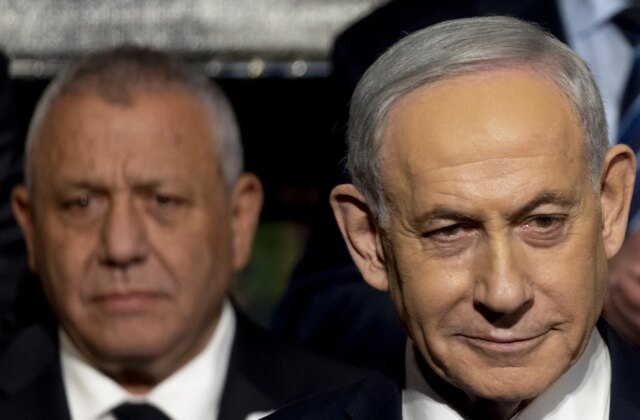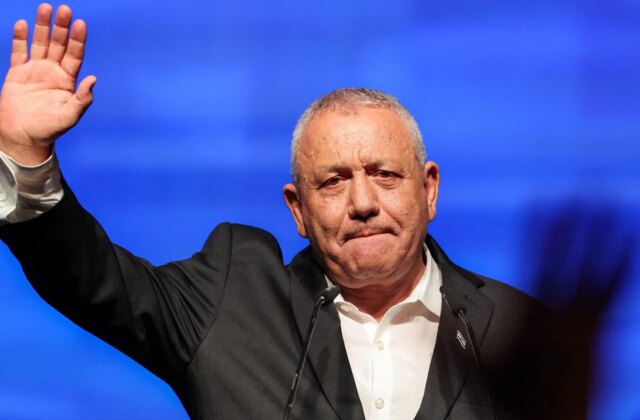

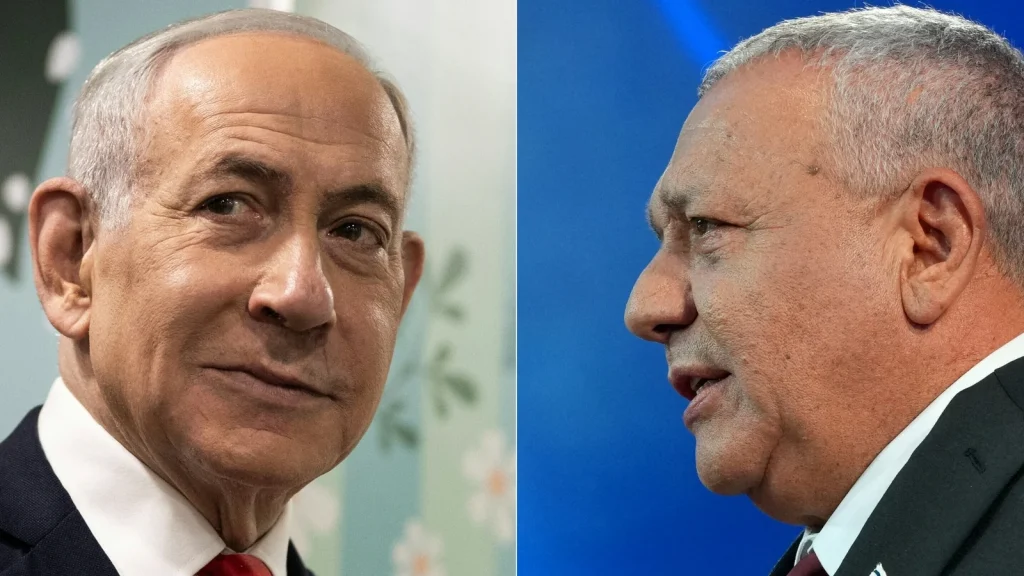
Fresh talks between the parties of caretaker Israeli Prime Minister Benjamin Netanyahu and his rival Gadi Eisenkot ended without a breakthrough, leaving the prospect of a coalition government dependent on concessions from both camps.
Negotiators from Eisenkot’s Yashar party and Netanyahu’s Likud met for four hours at a hotel in Herzliya, near Tel Aviv, after holding their first discussions last Sunday.
“The latest round of coalition talks… has concluded. The two sides outlined their positions on a range of substantive issues and discussed them in detail,” the parties said in a joint statement.
They added that “a follow-up meeting will be held”, but gave no date and offered no further details.
Eisenkot’s 48-member bloc still needs 61 seats in parliament for a majority and remains split over three possible paths: an alliance with ultra-Orthodox parties, cooperation with Arab lawmakers or a national unity government with Likud.
No single party has ever won 61 seats outright in the 120-seat Knesset, making coalition-building the norm
Netanyahu is advocating a national unity government that could see him and Eisenkot rotate through the premiership, an arrangement Israel has used before.
The deal could enable Netanyahu to retain the political protection he has sought amid corruption charges, while allowing him to continue resisting the creation of an independent commission of inquiry into the security failures that preceded Hamas’s attack on 7 October 2023.
That possibility conflicts directly with Eisenkot’s pledge not to serve in a government headed by Netanyahu, the central target of his campaign.
Naftali Bennett, a former prime minister and Eisenkot ally, has likewise repeated that he will not join a coalition with “Netanyahu or his bloc, under any circumstances”.
Coalition hurdles
Yesterday, Yashar described the renewed negotiations as “a genuine commitment to forming the broadest possible government”, saying Eisenkot had instructed his representatives to examine every option.
Likud, however, quickly set out a series of demands for joining a unity government, the model Netanyahu supports.
One condition is an end to “all personal attacks and incitement to hatred” directed at Netanyahu and his government.
The party also called for a coalition of “all the parties that support the existence of the State of Israel as the nation state of the Jewish people”, excluding Arab parties.
Mr Netanyahu has served as prime minister for nearly 19 of the past 30 years
Netanyahu and his allies frequently criticize Arab parties, which won a record 19 seats in the legislature and oppose his continued hold on power.
Likud is also seeking agreement on several major policy issues, including opposition to the establishment of a Palestinian state and continued Israeli control over areas in Syria, Lebanon and the Gaza Strip.
The party is additionally calling for a compromise over the conscription of ultra-Orthodox Jews, one of Israel’s most politically charged questions.
On Friday, Eisenkot said he would not let negotiations continue indefinitely and declared that he was prepared to present an “emergency national government” to parliament.
Though he did not explain the mechanism, his comments point to a possible two-step strategy: quickly forming a minority government around the main opposition parties before seeking to expand its support.
A minority government led by Eisenkot could rely on backing from the 19 Arab lawmakers, but his right-wing ally Avigdor Liberman opposes cooperating with them and instead supports an alliance with ultra-Orthodox Jewish parties.