
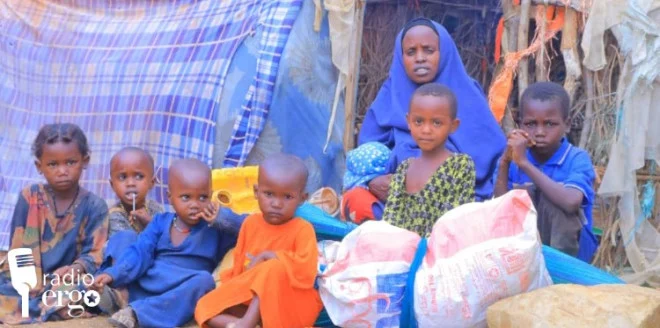
IDP mother and her children find shelter in the camp/File Photo
For hundreds of displaced families in El Jalle, a high-ground refuge outside Beledweyne, the prospect of flooding has brought a second upheaval: homeowners are reclaiming the houses they had allowed them to occupy rent-free.
- Advertisement -
The homeowners normally live in Beledweyne’s cheaper, low-lying neighbourhoods along the Shabelle River, including Kooshin, Bundoweyn, Howlwadag, Radar, Kutiimbo and Laabka. They built homes in El Jalle as emergency accommodation after repeated floods, and are now preparing to move there ahead of forecast heavy El Niño rains.
The displaced families had fled conflict and drought in recent years, with most losing their original livelihoods. As deyr rains begin across the region, many now face life without shelter.
Salado Abdi Osman was told to leave an El Jalle house on 20 September after living there rent-free for a year and a half. The 62-year-old mother of 12 is now sleeping beneath a tree, protected only by plastic sheeting that provides little cover from the rain.
“The situation is very difficult. We were told to leave because flooding was expected. When we see lightning, we wonder where we can go. We live in constant fear and have nowhere to shelter,” she told Radio Ergo.
Families with the means to do so are relocating to higher ground, but Salado’s household is struggling to secure both shelter and food. Her husband works as a casual construction labourer in Beledweyne, six kilometres away, earning up to $5 a day when jobs are available.
“Sometimes I can’t cook for the whole day, and the children eat whatever little food we find. My husband spends more days without work than with it. When he finds nothing, we go to bed hungry,” she said.
Salado fled Inabaal, in Hiran’s Mahas district, after fighting broke out between local forces and Al-Shabaab. The family lost its main source of income when Al-Shabaab seized their 46 goats.
Her children have not attended school since the family was displaced in 2025. Their parents cannot afford fees, books or pens. Three boys and a girl had been enrolled in school, while the younger children attended Koranic classes.
Set away from the river on elevated ground, El Jalle has become a key refuge during Beledweyne’s floods. Flooding in 2018, 2019 and 2023 displaced hundreds of thousands of people, encouraging residents to purchase land and build alternative homes there. The settlement now contains more than 15,000 houses.
Abdiwali Hassan Dir has started repairing his El Jalle home after asking a family that had been living there free of charge to move out. He built the house in 2022 after repeated floods convinced him his family needed somewhere to go in an emergency.
“I built a room and a large veranda so we could move there whenever danger arose. I take special care of the house and sometimes take my children there on Fridays,” he told Radio Ergo.
Abdiwali, 44, teaches at a school and earns $300 a month to provide for his eight children. He worries that leaving Kooshin, where he works, for good would jeopardise his income and interrupt his children’s education. The cost of relocating is also beyond his means.
Yet his past experience tells him that even a temporary move to El Jalle will be challenging, with thousands of people from different backgrounds expected to converge there to escape the floods.
“People displaced by conflict and those fleeing floods will all gather there. There will be many difficulties, and children will lose access to education. Life will become harder for everyone,” he said.
Flooding routinely interrupts education, businesses and employment in Beledweyne. Abdiwali said he had been unable to save for emergencies and that his teaching income could disappear when the floods arrive. He has escaped flooding four times, each time taking refuge in the El Jalle house, which cost $5,000 to build.
“Work is disrupted, and families lose their income and property. We share the suffering of the community,” he said.
Luul Abdullahi Omar was among those evicted from an El Jalle home after its owners returned in September, having left Beledweyne because of fears that floods were imminent.
Luul and her eight children now live in the nearby Teedaan internal displacement camp. They rely on relatives for assistance, but she struggles to secure food, clothing and a safe place to live.
“My son sends us some money each month, but sometimes he has nothing to give. Fifty dollars can’t support a large family for a month,” she said. “If it rains tonight, we have nowhere to go. We have young children and no shelter.”
Luul said this was her fourth displacement since 2022. She previously lived as a pastoralist in a rural area of Mahas, where her family lost 150 goats and two camels during fighting between local forces and Al-Shabaab from 2022 to 2025.