
A fresh political standoff in Hiiraan is testing whether Somalia’s federal leadership has learned the lessons of earlier confrontations with local communities. The dispute between President Hassan Sheikh Mohamud’s government and Hiiraan’s political and traditional leaders has revived longstanding concerns about representation, trust and the future of Hirshabelle.
Tensions have sharpened over the region’s political direction and the distribution of power within the administration. Hawadle political leaders and traditional elders say their role in Hirshabelle’s leadership remains unresolved. On September 11, 2026, Hirshabelle Vice President Yusuf Ahmed Hagar Dabageed publicly accused President Hassan Sheikh Mohamud of failing to honor an understanding regarding Hawadle participation in the regional leadership. Dabageed and other politicians, including members of parliament, have made these allegations.
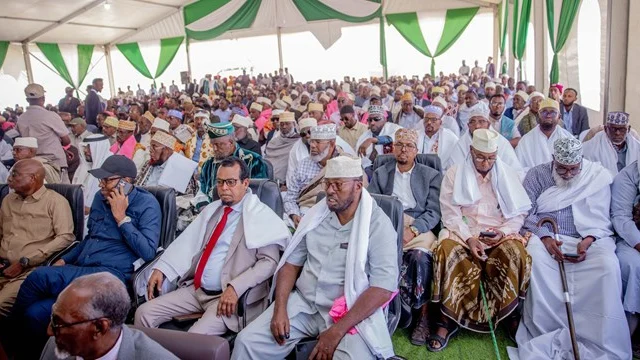
The dispute has now expanded beyond individual political figures. Traditional leaders, the deputy speaker of the upper house, members of parliament and community representatives have convened in Beledweyne to assess the situation. Ugaas Yusuf Ugaas Hassan urged collective consultation, saying the community would decide how to respond. Dabageed, meanwhile, said Hiiraan’s grievances were directed at both the federal government and the Hirshabelle administration, while stressing that the aim was not necessarily to reject the Somali government, whose term expired on May 15, 2026.
That distinction matters. Disagreement with the federal government should not automatically be treated as opposition to the Somali state.
Federalism depends on negotiation, representation, constitutional procedures and political accommodation. When communities believe commitments have been discarded or their interests sidelined, tensions can quickly become harder to contain.
Hiiraan’s latest dispute also carries the weight of history. Successive Somali administrations have struggled to manage relations with the region, where disagreements over representation, federalism and the structure of Hirshabelle have repeatedly fueled frustration. For any president, the risk lies in viewing such grievances merely as barriers to overcome instead of political problems that require sustained dialogue.
Somalia’s recent political experience shows that authority cannot be maintained indefinitely through confrontation. Government institutions may have constitutional powers and security forces, but lasting stability depends on legitimacy and cooperation among the communities they govern.
The developments in Hiiraan therefore extend beyond a dispute over one regional leadership contest. They pose a broader strategic question: will the current administration settle its differences with Hiiraan through negotiation, or repeat the patterns that have driven previous governments into confrontation with the region?
In June 2026, the federal government called for an immediate ceasefire after deadly inter-clan violence in Jalalaqsi district. That appeal underscored the continuing importance of political engagement and community reconciliation in Hiiraan.
President Hassan Sheikh Mohamud remains Somalia’s sitting president, according to the federal government’s official website. Yet the political crisis surrounding his administration has grown increasingly contentious nationwide, with disputes also emerging over constitutional changes and the electoral process.
For Hiiraan, the central question is not simply who occupies Villa Somalia or who leads Hirshabelle. It is whether Somalia’s political leadership can build a relationship with the region founded on consultation, mutual commitments, representation and respect for legitimate local grievances.
History offers a clear warning: if Hassan Sheikh repeatedly confronts the same communities over political representation, a temporary disagreement could harden into a lasting crisis of trust.
The message for the current administration is direct. Political power may compel compliance for a time, but reconciliation and legitimacy are the foundations of durable stability.
Abdiaziz Hassan Giyaajo Amalo