
By: Khadra Yasien AhmedTuesday July 21, 2026
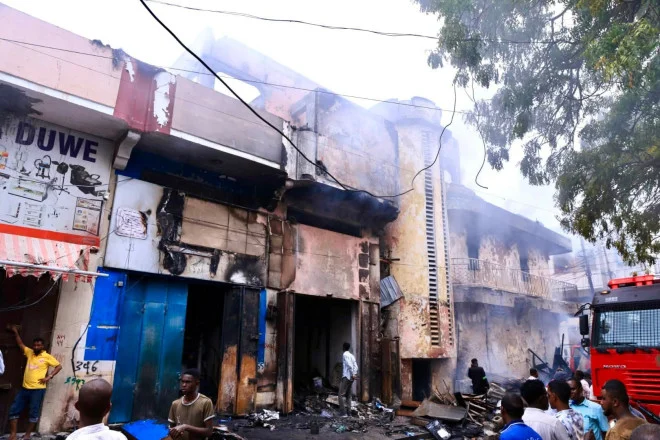
Another fire at Mogadishu’s Bakaara Market has again exposed a devastating pattern in Somalia: one blaze can erase the work of a lifetime. Sections of the country’s most important commercial centre have burned before, and without serious action to prevent future incidents, they could burn again. Each destroyed stall represents more than lost property; it means shattered livelihoods, struggling families, and years of effort gone in hours.
A range of factors may be behind the repeated fires in markets such as Bakaara. Poor electrical infrastructure is among the causes most often cited. Overloaded and informal wiring, illegal power connections, old cables, and limited maintenance all present major hazards. In a densely packed market where hundreds of businesses trade alongside one another, a minor electrical failure can rapidly turn into a large-scale catastrophe. The absence of basic safeguards — including alarms, extinguishers, water access points, and emergency exits — leaves traders and customers even more exposed. Tight passageways and poorly planned market layouts can also slow responders and make firefighting more difficult.
For traders, the damage reaches well beyond the ruins left behind by the flames. A market fire can wipe out an entire investment and a family’s only income in a single night. Many small-scale business owners have no insurance and depend on daily earnings to provide for their households. When stock and premises are destroyed, families may be pushed into debt, financial instability, and uncertainty about what comes next. The emotional toll can be equally severe, with people facing stress, anxiety, and the loss of work built over many years. Even after the fire is put out, lost income can continue to affect the well-being and economic security of families and communities for a long time.
The broader economic fallout is also substantial. As Somalia’s largest commercial hub, Bakaara Market is a crucial pillar of the national economy. Fires interrupt supply chains, limit the availability of goods, drive up prices, and endanger the incomes of thousands who rely directly or indirectly on market trade. Repeated losses can damage business confidence, deter investment, and slow economic growth. Because markets including Bakaara are central to distributing food and other essential supplies, their disruption can carry serious consequences for food security and community welfare.
Preventing these disasters requires government accountability. Public authorities have a fundamental obligation to protect lives, businesses, and property. Bakaara and markets like it are more than commercial spaces: they support employment, generate income, and contribute to social stability. Thousands of families depend on their businesses there, while nearby communities depend on the markets for affordable goods and services. Local, regional, and national authorities therefore must introduce and enforce safety standards, carry out routine inspections, upgrade electrical systems, improve emergency response capacity, and invest in disaster preparedness. When these duties are ignored, ordinary citizens pay the price, losing businesses, incomes, and sometimes their life savings.
The repeated fires at Bakaara Market must be treated as an urgent warning to policymakers, traders, and the wider community. Fire safety cannot continue to be overlooked. Spending on safer infrastructure, effective regulation, public awareness, and emergency readiness protects far more than buildings and merchandise; it protects livelihoods, economic stability, and public welfare. As Somalia advances on its path of recovery and development, market safety must become a national priority. As the well-known public health principle makes clear, prevention is better, and far cheaper, than treatment. Fire-safety investment today is also an investment in public health, economic resilience, food security, and the well-being of Somali society as a whole.
__________________________________
Khadra Yasien AhmedBergen, Norway.