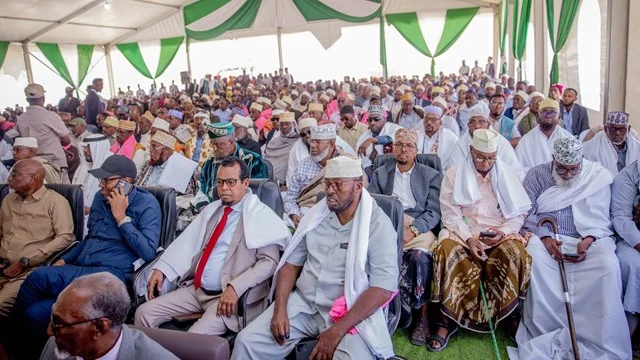

Mogadishu (AX) — Former Somali President Sharif Sheikh Ahmed and other opposition leaders on Thursday accused President Hassan Sheikh Mohamud of undermining the independence of the country’s judiciary after government troops were deployed around the Supreme Court as it issued rulings against the dismissal of the court’s chief justice and the extension of the president’s term.
Sharif, speaking at a press conference in Mogadishu, strongly condemned the president’s decision to remove Supreme Court Chief Justice Baashe Yusuf Ahmed from office, describing it as an unlawful move that violated the separation of powers guaranteed by the constitution.
- Advertisement -
He stressed that the judiciary is one of the three pillars of government, warning that interference in its work would undermine the rule of law and the existence of Somalia’s state institutions.
Sharif also welcomed the Supreme Court’s decision rejecting the application of constitutional amendments extending the terms of the president and parliament to the current administration, arguing that the ruling reinforced the importance of adhering to the constitutional system.
He also criticized the manner in which Baashe was removed, saying the federal government had failed to follow the legally required procedures for dismissing senior judicial officials.
The former president warned against using national institutions for political interests, saying such action could further fuel Somalia’s constitutional crisis and damage public confidence in the justice system.
Meanwhile, opposition lawmaker Abdirahman Abdishakur Warsame accused Hassan Sheikh of aggravating the country’s political and security challenges, citing what he described as unilateral decisions.
Warsame pointed to the conclusion of the United Nations’ political mission in Somalia and plans for foreign forces to leave the country, describing them as signs of the mounting pressures facing the government.
He also referred to reports that some foreign troops supporting Somalia’s security operations would withdraw over the course of a year, arguing that the country was facing a decline in international support.
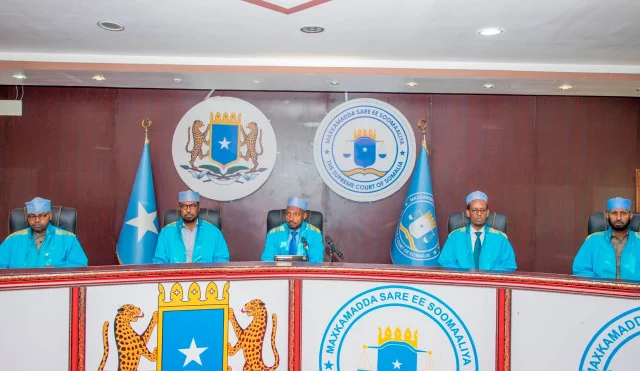
The opposition criticism came amid reports that large numbers of Somali government troops were deployed around the Supreme Court on Thursday, while Chief Justice Baashe was ordered to leave the court building.
A senior Supreme Court judge confirmed to BBC Somali that security forces had been stationed around the court and that its official Facebook page, previously used to publish court rulings and statements, had been deactivated.
The official circumstances surrounding the deployment of troops at the court and the reason for the disappearance of its Facebook page could not be independently verified as of press time.
The developments followed two sensitive rulings issued by the Supreme Court on Thursday that directly affected the powers of the presidency.
In one of the rulings, the court nullified Hassan Sheikh’s dismissal of Baashe, stating that the president lacked the constitutional authority to remove the chief justice without following the procedures established by law.
The president announced on Wednesday that he had removed Baashe from office and reappointed former Supreme Court Chief Justice Ibrahim Idle Suleiman, citing complaints from judges and lawyers regarding the administration of justice.
The Supreme Court rejected the dismissal outright, accusing the presidency of attempting to obstruct a constitutional case brought before the court by Sharif challenging amendments made to Somalia’s Provisional Constitution.
“The dismissal announced in the statement published on the presidency’s Facebook page is null and void,” the court said.
It added that the decision was intended “to obstruct the proper administration of justice in the constitutional case before the Supreme Court.”
In a separate ruling, the court rejected the application to the current government of constitutional amendments extending the terms of the president and parliament to five years from four.
The court said Hassan Sheikh’s term would expire in May 2026 and that amendments approved during his tenure could not be applied retroactively to extend his time in office.
The ruling set aside the federal government’s position that Hassan Sheikh could remain in office until May 2027, based on the constitutional amendments approved by parliament earlier this year.
The government had maintained that the revised constitution provided the legal basis for its electoral timetable, which calls for parliamentary elections to be held on April 15, 2027, and the presidential election on May 15.
Opposition groups, including the Somali Future Council, rejected the electoral timetable and called for a consensus-based agreement on election-related issues.
The confrontation between the presidency and the Supreme Court comes at a sensitive time of political transition, with disputes over constitutional amendments, electoral procedures and presidential powers remaining unresolved.
The presidency has yet to publicly respond to the court’s latest ruling limiting the presidential term, rejecting Baashe’s dismissal and allegations that security forces were deployed at the Supreme Court.