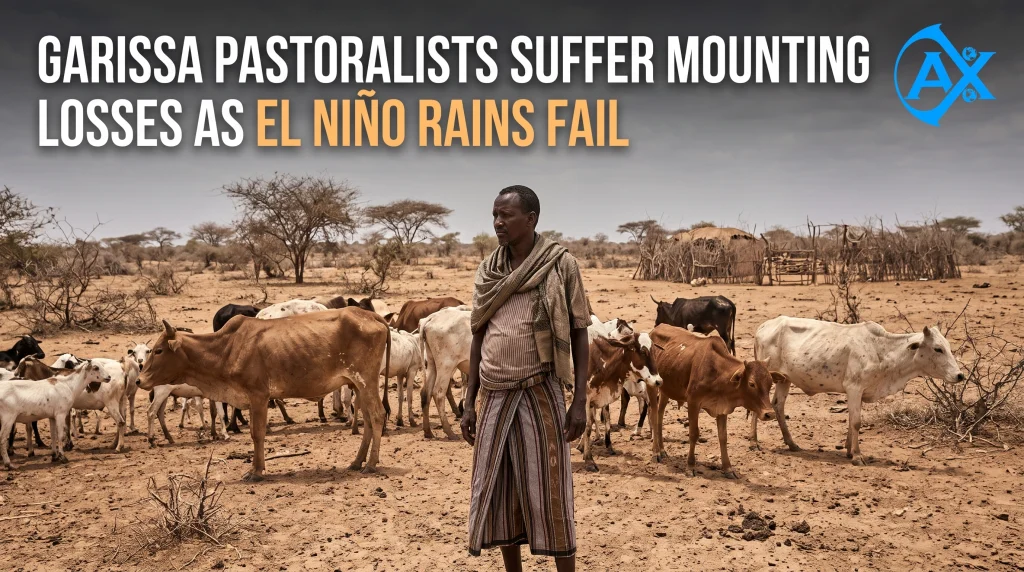
Goats and sheeps taken to a watering point in Afuene, Lagdera sub county.
Dead livestock scattered around the outskirts of Garissa town are a stark sign of the drought’s toll, as pastoralist families struggle to keep their animals—and their livelihoods—alive.
- Advertisement -
Across the arid county, communities that rely on herds are confronting an increasingly uncertain future after a prolonged dry spell.
Livestock are dying, water points are drying up and pasture is becoming harder to find in several sub-counties. The deteriorating conditions have raised fears of extensive animal losses and a deepening food crisis.
The harsh conditions have followed expectations that El Niño rains would bring relief to the region.
Those rains were expected to refill water sources and revive grazing land, but they have not arrived. Instead, pastoralists are facing shrinking water supplies, degraded pasture and the loss of animals that underpin their incomes and household survival.
The worsening drought has renewed demands for immediate government action, with local leaders warning that more families could go hungry unless support reaches them soon.
In Afuene, Baraki MCA Hassan Geley joined other leaders in urging the national and county governments to strengthen relief operations and speed up the delivery of food, livestock feed and water to affected settlements.
Geley said the crisis demanded a swift, coordinated response, cautioning that delays could leave more households without food while causing further livestock deaths.
He called on both levels of government to focus on the worst-affected communities, especially remote settlements where residents are struggling to obtain water, pasture and food.
Garissa Human Rights Network chairman Mukhtar Osman likewise appealed for an accelerated response, saying the government had a duty to shield citizens from severe hardship during crises such as drought.
“I want to call upon the authorities to move with speed and strengthen the delivery of emergency supplies, including livestock feed as well as water and ensure that assistance reaches residents before the situation deteriorates further,” he said.
The appeals underscore the mounting pressure on pastoralist communities, where failed rains are compounding existing hardships and putting at risk families whose survival depends on their animals.
In Shanta Abaq, herder Mohamed Hussein said the continued absence of rain had placed immense strain on his household, which was already finding it difficult to meet its daily needs.
“I want to appeal to the government to move beyond assurances and accelerate the delivery of water and food supplies. The survival of our livestock and families depended on timely intervention,” he said.
Another pastoralist, Hussein Ali, said the crisis threatened to worsen food insecurity, particularly for families already hit hard by livestock deaths and declining access to basic resources.
As animal losses increase and water becomes harder to obtain, pastoralist households are unsure how they will continue supporting their families if the dry spell persists.
Garissa Governor Nathif Jama has recognised the danger posed by the drought and said the county government had started trucking water to villages and settlements facing shortages.
Speaking at this year’s Mashujaa Day celebrations, Jama said the county was working to support communities affected by water shortages as the dry conditions continued.
He said the county would maintain cooperation with the national government, state agencies and non-state organisations to reinforce the response and ensure residents did not face the drought’s impact alone.
The governor said coordination between the various agencies was essential to meeting the immediate needs of affected communities, particularly by delivering water to settlements experiencing shortages.
Garissa County Commissioner John Cheruiyot also assured residents that the national government was ready to respond to the worsening conditions, saying food supplies had been pre-positioned across all sub-counties.
Speaking during the Mashujaa Day celebrations, Cheruiyot said the government was prepared to support residents should the situation worsen, while authorities continued to monitor developments.
He said storing food supplies in advance would allow assistance to be mobilised quickly for communities in need, demonstrating the government’s preparedness to address emerging challenges.
However, pastoralists continue to deal with dying animals, declining water sources and deteriorating pasture, leaving residents increasingly worried about what the prolonged dry spell will mean for their livelihoods.
With the expected rains still absent, leaders are pressing both levels of government to deliver relief food, water and livestock feed to affected settlements before conditions become even more severe.
For families sustained by their herds, the stakes are immediate: prompt assistance is needed to help them endure the drought, preserve the livestock that remain and avoid further hardship in one of the country’s arid regions.
The worsening drought in Garissa highlights the vulnerability of pastoralist communities to extended dry spells and unpredictable rainfall. While national and county officials have issued assurances, mounting livestock deaths and shrinking water supplies point to the need for urgent action. Alongside emergency food and water distribution, authorities must improve long-term drought preparedness, invest in sustainable water infrastructure and help pastoralists safeguard their livelihoods against deeper food insecurity.