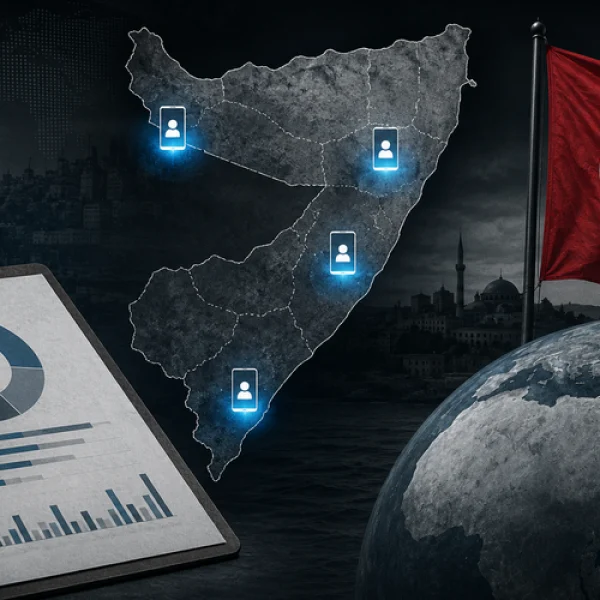
AXADLE, Somalia (Axadle) — A survey billed as a reflection of Somali attitudes toward foreign powers is facing scrutiny over its limited geographic reach, sampling process and the decision to publish its findings months after the interviews were conducted.
The study was carried out by the Sababi Institute, and researcher Partha Moman released the results in August under the title “Somali Public Opinion on External Powers.”
- Advertisement -
Its stated aim is to examine how Somalis perceive countries involved in the nation’s political, security and economic affairs. The analysis, however, draws on telephone interviews with 1,205 people in just four cities: Marka, Jowhar, Adado and Bosaso. Each location accounted for roughly 300 respondents.
The interviews took place in March 2026. Researchers said funding constraints led them to attach their questions to a separate survey that was already in progress. As a result, they did not choose the four cities or oversee the sampling procedures used for the wider study.
That limitation is important. It suggests the exercise was not originally structured to deliver a geographically representative picture of Somali views on foreign countries.
Major population centres excluded
Mogadishu, Somalia’s largest city and the primary hub of Türkiye’s political, economic and military engagement, was not included in the survey.
Garowe, Baidoa and Kismayo were also left out, as was the broader Jubaland region. The study likewise did not reach rural communities, populations affected by conflict or residents in areas outside government control.
Those gaps prevent the findings from capturing Somalia’s full political, social and geographic diversity.
Bosaso is in Puntland State, an administration with security and investment relationships with the United Arab Emirates and one that falls outside the areas where Türkiye’s institutional presence is most concentrated. Marka, Jowhar and Adado, meanwhile, are located in administrations with differing degrees of political engagement with Villa Somalia.
By omitting Mogadishu, the survey excluded communities with the most direct exposure to Türkiye’s projects and activities. The absence of Garowe and Kismayo also means it did not include areas where opposition to Villa Somalia, or unease over Ankara’s role, could be stronger.
The precise effect of the location choices cannot be established. What can be said is that responses from four cities do not provide a national measure of public opinion in Somalia.
Why does the timing matter?
The data were collected in March and released in August, creating a gap of almost five months.
In the intervening period, tensions grew over the federal government’s mandate, proposed constitutional amendments and an electoral process that has not secured broad political agreement.
Puntland State, opposition politicians and other stakeholders have accused President Hassan Sheikh Mohamud of attempting to extend his time in office through a political and electoral process lacking nationwide consent.
Türkiye continues to be Villa Somalia’s closest partner across the political, security and economic spheres. Some opposition groups maintain that Ankara’s backing is reinforcing Villa Somalia’s position in the dispute over the federal leadership’s mandate.
There have also been questions about Türkiye’s military and maritime activities, especially after recent incidents reported along Puntland State’s coast.
Because the interviews were conducted in March, they cannot show whether later events changed public attitudes. The publication date does not prove political intent, but it does make the findings more likely to feature in current political and diplomatic arguments.
Conclusion
Opinion research remains valuable, particularly in Somalia, where dependable information about citizens’ views is scarce. The Sababi Institute and the researchers should also be credited for acknowledging the study’s constraints.
Even so, the results should be presented as the opinions of people interviewed in Marka, Jowhar, Adado and Bosaso in March. They should not be characterized as a nationwide assessment of Somali attitudes toward Türkiye, the United Arab Emirates or other foreign powers.
A broader evaluation would require publication of the complete questionnaire, the sample’s demographic profile, the neighbourhoods from which participants were drawn, the funding source for the original survey and information on whether the results were weighted to reflect each city’s population.
AXADLETM