
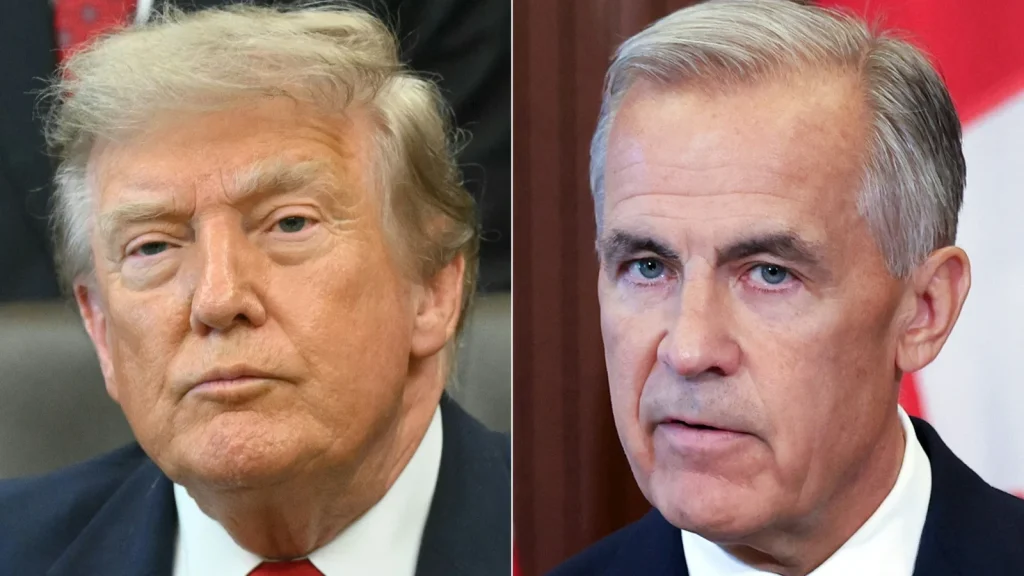
Canada is preparing to impose dollar-for-dollar tariffs on $20 billion in United States goods as the trade dispute between the two neighbors intensifies, while Ottawa rolls out financial assistance for businesses and workers expected to bear the brunt of the confrontation.
The countermeasures will take effect on 8 September, a schedule Prime Minister Mark Carney had announced after US President Donald Trump’s 50% tariffs on Canadian products took effect Saturday.
- Advertisement -
Government officials said Canada’s duties would mirror the levels set by Washington, targeting sectors including steel, dairy and electronics.
Ottawa also unveiled a $5.4 billion support package for affected companies and employees.
Mark Carney said Canada would answer the US tariffs ‘dollar for dollar’
“I think what Canadians can see this morning is that we stand united. We stand united in our response,” he added.
Tit-for-tat
The US measures cover roughly $20 billion in Canadian goods — about 5.5% of Canada’s exports to the United States — after negotiations broke down at the last possible moment.
Under Ottawa’s plan, US steel and aluminum products already facing a 25% duty will be hit with tariffs of 50%.
A 25% tariff will apply to products including appliances, dairy goods such as cheese, and selected steel and aluminum derivatives.
Electric equipment and tools will fall into a smaller category subject to a 15% duty.
Together, the affected products represent about 7.3% of Canada’s imports from the United States.
Analysts, however, are warning that the measures could trigger a cycle of retaliation.
Mr Trump also said yesterday that he planned to double tariffs on Canadian autos next year, raising them to as much as 50% from the current 25% on non-US content.
Ontario Premier Doug Ford condemned the auto tariff threat, telling Mr Trump he could “kiss my ass” and warning that Ontario could impose a surcharge on electricity exports.
During an earlier stage of the dispute, Ontario temporarily added a 25% surcharge to electricity shipments headed to three US states.
Mr Trump responded by warning of “far worse” consequences for Mr Ford. He also called Mr Carney a “governor,” repeating his provocative campaign for Canada to become the 51st US state.
In another escalation, Mr Trump said today that he was considering changing the name of Lake Ontario to “Lake America.” Last year, he made a similar change involving the Gulf of Mexico, which he said should instead be known as the “Gulf of America.”
The new US tariffs do not exclude goods covered by the US-Mexico-Canada free trade agreement, or USMCA. Oxford Economics estimates that they will lift the effective US tariff rate on Canadian exports from 5.1% to 6.9%.
Plastics, electrical machinery, and wood and paper products account for most of that increase.
“Manufacturers in Quebec, New Brunswick, and Ontario will be affected the most,” Oxford Economics said.
Threats to culture
Mr Carney said over the weekend that US negotiators had demanded last-minute limits on Canada’s trade agreements with other countries.
He also said US officials had made unacceptable “threats” involving the French language and “Quebec culture,” referring to Canada’s predominantly French-speaking eastern province.
Coils of steel await shipment at an ArcelorMittal Dofasco plant in Hamilton, Ontario
Mr Trump rejected the accusation, writing on Truth Social that he would “never interfere with Canadians speaking French!”
“This lie was made up by a weak and ineffective Prime Minister in an attempt to gain political support,” Mr Trump charged.
The United States remains Canada’s largest trading partner, accounting for 70% of Canada’s total exports.
Canada is the second-largest US trading partner in goods this year, behind Mexico.
A poll released Sunday by the Angus Reid Institute found broad Canadian support for Carney’s decision to end the negotiations, although some respondents expressed concern about the economic fallout.
The White House had accused Canada of “discriminatory treatment” toward US alcohol, automobile and dairy products as it introduced the new tariffs.
Mr Trump postponed their implementation, but the two governments still failed to reach a deal after hours of negotiations.
In addition to the tariff dispute, Washington and Ottawa must negotiate revisions to the USMCA, which Mr Trump chose not to renew in its existing form.