
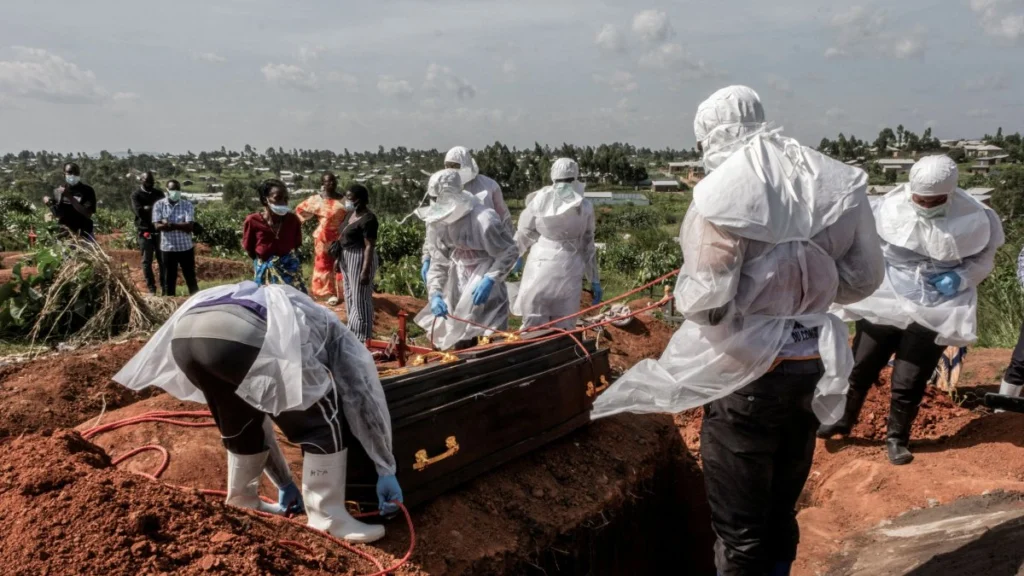
Satellite images of cemeteries in Bunia, eastern Democratic Republic of Congo, reveal a stark disparity between the number of graves being dug and the official Ebola death toll, suggesting that the outbreak has claimed far more lives than authorities have recorded.
Salomon Mugisa, who digs graves at Bunia’s Nyamurongo cemetery, saw the crisis accelerate in real time.
At the start of the year, workers buried no more than two or three people a day. After Ebola began spreading through the city in late April, the pace changed dramatically.
“We were doing 5, 10, 15 burials a day. It kept increasing,” Mugisa said as he stood beside an expansive area filled with newly dug graves.
By July, he estimated that roughly 600 people had been buried at Nyamurongo since the surge began.
At the time, however, official records showed fewer than 200 Ebola deaths in Bunia, the outbreak’s epicenter. Authorities formally declared the epidemic on May 15. Nationwide, the outbreak has since infected more than 11,500 people and killed over 5,500.
A Reuters review of satellite imagery from Nyamurongo and two other major Bunia cemeteries found that newly dug graves substantially outnumbered reported Ebola fatalities. The discrepancy indicates that thousands of deaths may have gone unrecorded across the broader outbreak.
The investigation compared the number of graves dug in 2026 with burial activity during the previous year, before the epidemic began.
That comparison produced an estimate of “excess deaths,” a public health measure used to determine how many more people died than would normally be expected.
Reuters then compared the estimated excess deaths with official Ebola fatality figures.
The gap narrowed as testing and surveillance improved. But by early November, Bunia had recorded more than 1,000 excess deaths — over 50% above the official Ebola death toll of 707 at that point.
The additional deaths cannot all necessarily be attributed to Ebola. Some may have resulted from other illnesses, including among people who avoided hospitals because they feared contracting a virus with no approved treatment or vaccine.
Even so, the findings are the first detailed effort to measure the scale of the undercount in Bunia. They broadly align with a World Health Organization estimate issued in July that the outbreak could be two to four times larger than available data suggested.
The analysis may still understate the toll because it did not include smaller burial grounds scattered throughout the city.
Congo’s health ministry did not respond to Reuters’ requests for comment.
Jean-Jacques Muyembe, who leads the country’s National Institute for Biomedical Research, said the early gap between reported Ebola deaths and the actual toll was understandable because authorities identified the outbreak late. He added, however, that excess-mortality estimates would need to be checked through investigations into the specific causes of death.
Yap Boum, head of emergency preparedness and response at the Africa Centres for Disease Control and Prevention, said the findings appeared broadly credible. Excess mortality is often greatest at the beginning of an epidemic, before testing, surveillance and response systems are fully functioning, he said.
A widening gap in the early months
Comparing excess deaths with official records can show how effectively authorities are detecting infections and fatalities. Undetected cases also leave health workers unable to identify contacts, making it more difficult to break chains of transmission.
Reuters found that the difference between estimated deaths and official Ebola figures was greatest in the first months of the outbreak. The gap then narrowed as officials increased testing and reporting.
“We continue to find evidence that a proportion of cases and deaths were never detected,” said Olivier Le Polain, head of epidemiology and analytics at the WHO’s Health Emergencies Programme.
By late June, Bunia had recorded more than 580 excess deaths, about seven times the official Ebola death toll, according to the analysis.
By September, cumulative excess fatalities had risen to approximately 950, nearly twice the reported number.
Nyamurongo’s burial records offer a measure of how sharply mortality changed. Before the outbreak, workers dug an average of 2.4 graves a day. In June, the daily average exceeded nine before declining to about 4.5 by early November.
Reuters also reviewed the principal cemetery in Mongbwalu, a gold-mining town north of Bunia that health officials believe was the outbreak’s origin.
Official records report more than 750 deaths in Bunia and over 350 in Mongbwalu. Satellite images from both areas, however, showed a similar mismatch between grave counts and reported fatalities.
At the Mongbwalu cemetery examined by Reuters, excess deaths were 25% higher than the official Ebola death toll for the town and surrounding villages by August.
During a July visit, cemetery workers and local officials pointed to several hundred additional graves in seven other burial grounds that they believed contained Ebola victims.
‘We knew there was a problem’
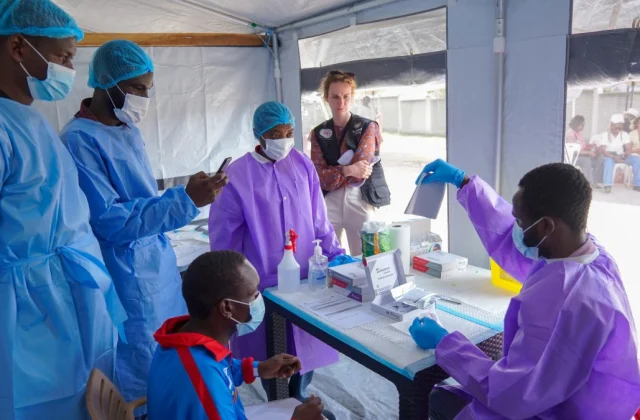
Mongbwalu’s health system was quickly overwhelmed after large numbers of patients began arriving at the local hospital in early May.
Many initially showed symptoms associated with malaria or typhoid fever. But unlike patients with those illnesses, their conditions worsened rapidly and they died.
“We knew there was a problem, but we didn’t know what it was,” said Richard Lokudu, the head doctor at Mongbwalu hospital.
As fatalities rose, some residents blamed a curse said to have descended on the community after the coffin of a prominent pastor was damaged and later burned. Authorities suspect the pastor may have been patient zero or an early super-spreader.
Laboratory testing initially failed to identify the virus, in part because samples were tested for the wrong Ebola species.
The first positive results did not emerge until mid-May, confirming an outbreak of Bundibugyo virus, a rare Ebola strain for which there is no available treatment or vaccine.
“We detected it late,” Lokudu said. “That’s why we had so many deaths.”
By the time the outbreak was formally declared in mid-May, local health officials had already recorded 100 unexplained deaths in Mongbwalu over the previous six weeks. According to a health ministry situation report obtained by Reuters, many victims had shown symptoms linked to Ebola.
Jean-Leonard Binziliese Goite, the town’s civil registrar, said many patients were buried without being tested.
He said official statistics did not reflect the scale of the outbreak in its early stages, partly because Mongbwalu’s gold mines draw migrant workers from across Congo. Some miners die without relatives nearby to report their deaths or complete the required registration.
The epidemic also drove people to move across Ituri province. As fatalities mounted, residents left Mongbwalu for Bunia and other larger towns, potentially carrying the virus into communities with limited ability to detect and contain infections.
Fear and weak surveillance leave deaths unrecorded
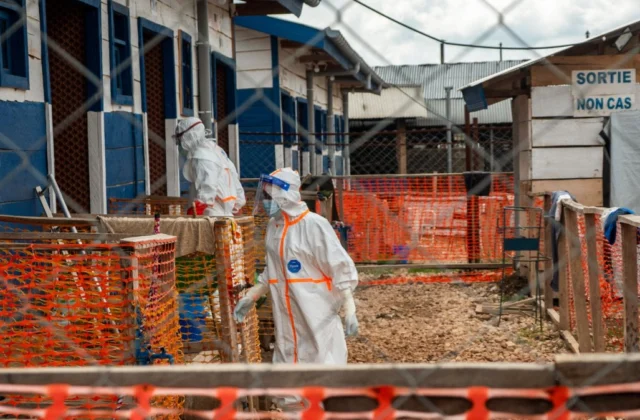
Following the outbreak declaration, the health ministry expanded testing and surveillance. Authorities also strengthened burial procedures in an effort to ensure that fewer deaths escaped official reporting.
But major gaps remained, worsened by limited resources and a withdrawal of U.S. overseas aid.
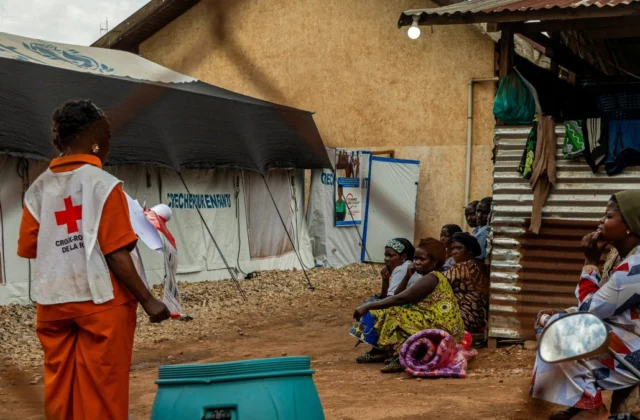
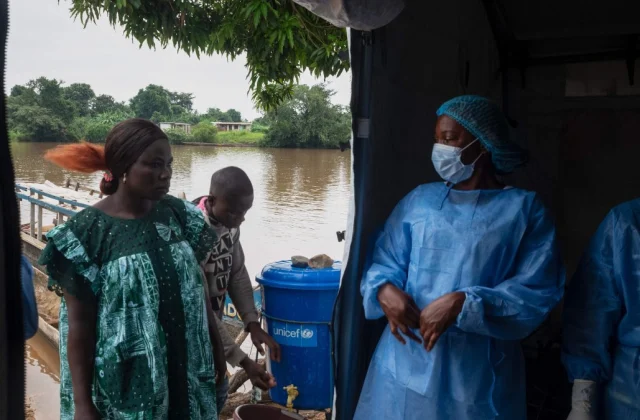
Fear of health facilities posed another challenge. Some residents avoided hospitals after seeing patients arrive and die, while others turned to traditional healers, Lokudu said.
“Many people were scared to go to health facilities because they saw people going there and dying,” said Faustin Ngabu Belo, a local official in Mongbwalu’s Njebi neighborhood.
Health teams have also faced difficulties investigating suspected infections and deaths because of limited vehicles, challenging terrain and persistent misunderstandings about the disease.
The extent of underreporting in other parts of eastern Congo remains unknown. But Le Polain of the WHO warned that detection was likely to be even weaker in remote communities, especially in insecure areas where health workers struggle to reach patients and investigate deaths.
The findings indicate that the outbreak may be considerably larger than official records show, particularly in communities with limited access to medical care.
Data presented by Africa CDC on Nov. 5 also suggested that the epidemic remained uncontrolled six months after it was formally declared.
More than 60% of Ebola deaths were still occurring outside health facilities. At the same time, fewer than 15% of newly confirmed infections involved people already identified through contact tracing. The figures point to serious surveillance gaps and indicate that many transmission chains remain undiscovered.
Even after burial controls were tightened, some deaths continued to go unrecorded.
Richard Larozulo, the official responsible for registering deaths in Mongbwalu’s Saio neighborhood, where another cemetery is located, said authorities still struggled to identify people being buried.
“We don’t even know their names,” he said.