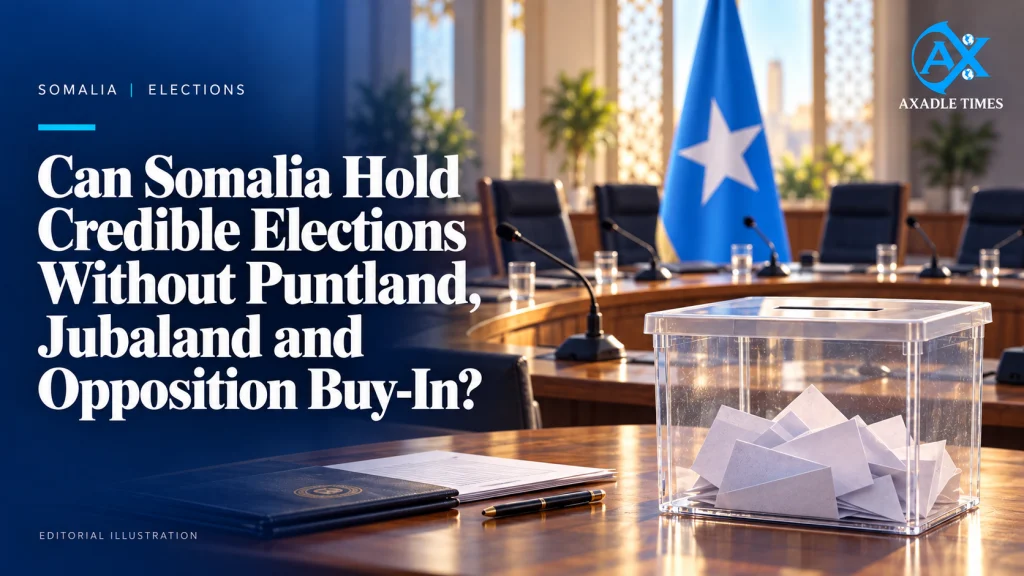
The dispute centers on whether Somalia should move to one-person, one-vote elections, continue with an indirect clan-based model, or adopt a temporary hybrid system. The disagreement has widened mistrust between Mogadishu and some federal member states, especially Puntland and Jubaland, and has raised questions over constitutional authority, political inclusion and the timetable for national elections.
The crisis is not only about election procedures. It is also about who has the authority to set the rules, whether the process has enough political consensus, and whether Somalia can hold credible polls while facing insecurity, weak institutions and unresolved federal disputes.
What Happened
Somalia’s federal government has pushed for a transition from indirect elections to direct universal suffrage, arguing that citizens should be able to vote directly for their representatives and leaders.
In March 2024, Somalia’s federal parliament approved constitutional amendments introducing direct universal suffrage, a multi-party system and a five-year presidential and parliamentary term, according to government documents. The amendments also changed the balance of power between the presidency, parliament and the prime minister’s office.
Opposition figures and some regional leaders rejected the process, saying the changes were not based on broad national consensus. Puntland said it would no longer recognise the federal government until constitutional changes were approved through a nationwide referendum in which Puntland participated.
The political dispute sharpened in 2026 as Somalia approached the end of the four-year mandate under the previous political framework. Opposition leaders and Puntland argued that President Hassan Sheikh Mohamud’s mandate expired in May 2026. Federal authorities and their supporters point to constitutional amendments extending terms to five years.
The result is a contested political environment in which rival sides disagree not only on the election date, but also on the legal foundation of the process itself.
Key Facts
Main issue: Somalia’s election crisis centers on legitimacy, constitutional authority and the electoral model.
Federal government position: Mogadishu supports a move toward one-person, one-vote elections and says direct voting would strengthen democracy.
Opposition position: Critics say the reforms were pushed without enough consensus and could give the incumbent authorities control over the process.
Regional dispute: Puntland and Jubaland have strongly challenged parts of the federal election and constitutional agenda.
Security challenge: Al-Shabaab remains a major threat, complicating voter registration, campaigning, election logistics and polling in some areas.
Historical context: Somalia has relied for years on indirect elections in which clan elders and delegates select lawmakers, who then elect the president.
Core legitimacy question: Whether an election can be accepted nationally if major political actors or federal member states reject the rules.
Why It Matters
The Somalia election legitimacy crisis matters because political acceptance is central to the country’s fragile federal system. A vote that is rejected by key regions or major opposition groups could deepen divisions between Mogadishu and federal member states.
The dispute also affects security. Somalia is still fighting al-Shabaab, and political fragmentation can weaken coordination among federal forces, regional administrations and international partners.
It also matters for state-building. Somalia’s provisional constitutional order has long required agreement among federal institutions, regional authorities and political stakeholders. If election rules are seen as one-sided, the next government could face immediate questions over its authority.
For international partners, the crisis presents a difficult balance: supporting Somalia’s long-term goal of direct elections while encouraging an inclusive process that can be accepted by the main political actors.
The Direct Election Debate
Supporters of one-person, one-vote elections say Somalia should move beyond the indirect system, which has often been criticised for empowering political elites, clan brokers and moneyed interests instead of ordinary citizens.
They argue that direct voting would give citizens a stronger voice, improve accountability and help Somalia build a more modern democratic system.
Opponents do not necessarily reject direct elections in principle. Many say the problem is timing, security and trust. They argue that direct elections require a stable legal framework, reliable voter registration, independent election management, broad political buy-in and security guarantees across the country.
Some critics favour an improved indirect election or a hybrid model as a temporary step until Somalia is technically and politically ready for nationwide direct voting.
Federalism and the Role of Puntland and Jubaland
Puntland and Jubaland are central to the crisis because Somalia’s federal system depends on cooperation between Mogadishu and federal member states.
Puntland has been one of the strongest opponents of the federal constitutional amendments. Its leaders have argued that major constitutional changes should not be adopted without a negotiated national settlement and a public referendum.
Jubaland has also had strained relations with Mogadishu, including disputes over regional elections, federal authority and the broader political roadmap.
Without participation from these administrations, any federal election process risks being viewed as incomplete by its critics. That does not automatically invalidate a vote, but it can weaken national acceptance and complicate implementation.
Background: How Somalia’s Elections Work
Somalia has not held a fully nationwide direct election for decades. Since the collapse of the central state in 1991, the country has rebuilt its institutions through transitional arrangements, clan-based power-sharing and indirect elections.
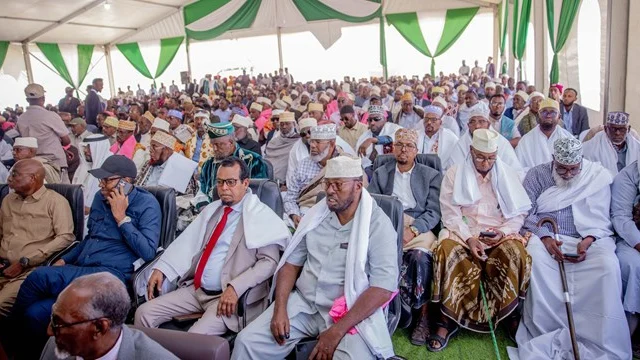
Under the indirect model used in recent federal elections, clan elders and selected delegates choose members of parliament. Lawmakers then elect the president.
Hassan Sheikh Mohamud was elected president by parliament on May 15, 2022. His government has made electoral reform a central political goal, but the reform process has become entangled with broader disputes over the constitution, federalism and executive power.
The 2012 provisional constitution was designed as a temporary framework. Many key questions remain contested, including the division of powers between the federal government and member states, the structure of the executive branch, and the final electoral model.
What Are the Main Risks?
Contested authority: Rival interpretations of presidential and parliamentary mandates could undermine public confidence.
Regional non-participation: If Puntland or Jubaland reject the process, the election could face legitimacy challenges.
Security disruption: Al-Shabaab could target candidates, polling centers, election workers or voters.
Institutional weakness: Election bodies may struggle to manage nationwide registration and polling without full political support.
Public mistrust: Voters may question the fairness of the process if political actors do not agree on the rules.
What Could Reduce the Crisis?
Analysts and diplomats have repeatedly emphasized the need for inclusive dialogue among the federal government, opposition leaders, federal member states and civil society.
A credible way forward would likely require agreement on several practical issues:
the legal basis for the election;
the role and independence of election institutions;
the timetable for voter registration and polling;
security arrangements for candidates and voters;
how Puntland, Jubaland and other regions participate;
whether the next vote is direct, indirect or hybrid.
Somalia’s election dispute is therefore a test of both democracy and federal compromise. The central question is not only whether elections are held, but whether the process is accepted as legitimate by enough of the country’s political and regional actors.
Three Questions to Watch
1. Can Somalia agree on a single election roadmap?
A national roadmap would need buy-in from the federal government, opposition leaders and key federal member states. Without such agreement, disputes over legitimacy are likely to continue.
2. Will Puntland and Jubaland take part?
The participation of Puntland and Jubaland would be important for national credibility. Their continued rejection would deepen questions over whether the process represents the full federal system.
3. Can direct elections be held securely and fairly?
Direct elections remain a major democratic goal for Somalia. But their credibility will depend on security, voter registration, independent administration and political consent.
Outlook
Somalia’s election legitimacy crisis reflects a larger struggle over the country’s political future. The federal government says direct elections are necessary to move beyond elite bargaining. Opponents say elections must be based on consensus, not unilateral constitutional change.
For Somalia, the challenge is to bridge those positions before the dispute further weakens federal institutions. A broadly accepted election process could strengthen the state. A contested one could leave the next government facing legitimacy questions from its first day in office.