Separation of Constitutional Powers: The Roles of the Presidency, the Judicial Service Council and the Federal Parliament
Introduction
The full independence of judicial institutions is an indispensable foundation for building effective governance, upholding the rule of law and protecting citizens’ fundamental rights. Every country that follows a constitutional system has a duty to limit and separate the powers of the various branches of government in order to prevent the executive branch from directly or indirectly interfering in the work of the judiciary.
As Somalia undergoes constitutional reform and the consolidation of state institutions, it has become increasingly necessary to understand the limits of the authority to appoint and remove the country’s highest judicial leadership. This issue has intensified sensitive legal debates following the serious dispute arising from the removal of the former Chief Justice of the Supreme Court, Baashe Yuusuf Axmed, and the appointment of Ibraahim Idle Suleymaan to replace him.
How extensive is the constitutional authority of the President of the Federal Republic of Somalia? Is the president a sole decision-maker who may appoint or dismiss the Chief Justice of the Supreme Court, or has the legal framework divided that authority among constitutionally established institutions that serve as checks and balances?
The Legal Process: Who Has the Authority to Appoint the Chief Justice of the Supreme Court?
If we examine Article 135 of Somalia’s new Constitution (2026), the decision to appoint the Chief Justice of the Supreme Court is not limited to the exclusive authority of the President of the Republic. A strict constitutional process requires a series of steps to be followed before the position can be filled.
This process rests on three constitutionally interconnected institutions:
The Judicial Service Council
The Judicial Service Council (Supreme Judicial Council) formally holds the initial authority to assess and select the candidate who meets the requirements for the position of Chief Justice of the Supreme Court, in accordance with the constitutional procedures and rules.
The principle that the Judicial Service Council should select the candidate reflects the protection of judicial independence, since it would never be appropriate for the leadership of the highest judicial institution to arise from a personal preference or political view emanating from the presidency.
The Federal Parliament
After the Judicial Service Council selects a qualified candidate, both chambers of the Federal Parliament of Somalia must separately approve the appointment:
The House of the People.
The Senate.
Approval of the candidate specifically requires the votes of a simple majority—fifty percent plus one (50% + 1)—of the total members of each chamber, as provided by the constitutional rules governing the appointment process.
This fact demonstrates that the Federal Parliament holds the principal key to oversight, and that the appointment of the Chief Justice of the Supreme Court can never be completed solely through the president’s signature and unilateral decision.
The President of the Republic
Once the Judicial Service Council has completed its selection process and both chambers have approved the candidate by a majority vote, the President of the Republic issues the official appointment decree, thereby completing the constitutional procedure.
As is evident, the president has the authority to provide the final signature, but that authority is not exclusive to the president; rather, it depends fully on the completion and approval of the preceding steps prescribed by the Constitution.
Requirements for Appointment as Chief Justice of the Supreme Court
Article 135(1) of the Constitution sets out in detail the educational qualifications and ethical standards required of anyone selected to lead the Supreme Court, the most important of which are:
Holding at least a postgraduate university degree (Master’s Degree) in law.
Having practised law for at least ten years and possessing relevant experience.
Demonstrating integrity, administrative ability and a high level of professional competence commensurate with the importance of the position.
The strict requirements established by the Constitution ensure that the country’s justice system is entrusted to a person with extensive knowledge, substantial experience and unquestionable professional integrity.
Who Has the Authority to Remove the Chief Justice of the Supreme Court?
From a legal perspective, appointing a person and removing that person from office are two separate matters. The institution entrusted by law with completing an appointment cannot be presumed to automatically possess the authority to carry out a removal.
The procedure for removing the Chief Justice of the Supreme Court is regulated in detail by Article 138 of the new Constitution.
Legal interpretations of this article indicate that removal proceedings begin with the Judicial Service Council, which investigates the case and recommends the appropriate course of action.
The constitutional requirements for this procedure include:
The removal proposal must receive the full support of at least two-thirds (2/3) of the members of the Judicial Service Council.
The Council must formally submit the case and its decision to the leadership of both chambers of the Federal Parliament.
Both chambers of Parliament must make a final decision on the matter in accordance with the law and the number of votes required under the Constitution.
If this is the process established by law for the officeholder, the president has no constitutional authority to turn a unilateral decree or administrative decision into a lawful removal.
This rigorous system is intended to protect the Chief Justice of the Supreme Court from pressure and unlawful removal, ensuring that the executive branch does not infringe on the independence of the judiciary.
Permanent and Acting Chief Justice: Are They Legally Equal?
There is an important legal distinction between the permanent Chief Justice who holds the office and an official temporarily appointed to perform the functions of that office.
The permanent Chief Justice is the person who has completed the full constitutional appointment process and has been sworn in as Chief Justice of the Supreme Court.
By contrast, an acting Chief Justice is a person entrusted with the duties on a limited basis until a formal appointment is made or until the official who previously held the position returns.
This gives rise to a serious legal question:
Does a person temporarily assigned to the position enjoy the constitutional protection afforded to the permanent Chief Justice, or are the person’s duties and removal governed by a specific law?
The answer does not depend solely on the appointment itself, but requires a detailed examination of:
The constitutional provision applicable to acting positions.
The law and legal basis used for the appointment.
The specified period for which the official was appointed to serve.
The institution authorised to formally conclude the acting tenure.
If the acting official falls under the constitutional protection of Article 138, the president does not have the authority to dismiss that person unilaterally. However, if a specific law governs acting positions, that law and its compatibility with the Constitution must be examined closely.
Accordingly, appointing an acting official never means that the president acquires unlimited authority to remove that person from office at will.
The Dispute Arising from the Removal of Baashe Yuusuf Axmed
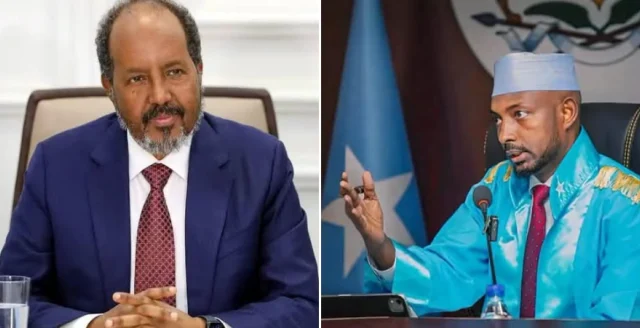
This legal tension escalated significantly after President Xasan Sheekh Maxamuud decided to remove the Chief Justice of the Supreme Court, Baashe Yuusuf Axmed.
According to verified historical facts:
On 5 November 2026, the Supreme Court publicly declared that the removal of Baashe Yuusuf Axmed had been unlawful.
The court directly challenged the decision of the presidency, raising serious questions about the constitutional authority relied upon for the removal.
On 7 November 2026, the president attended the ceremony at which Ibraahim Idle Suleymaan was sworn in after being appointed the new Chief Justice of the Supreme Court.
These actions prompted serious debates concerning the boundaries of the powers of state institutions, the protection of judicial independence and the manner in which decisions