MOGADISHU, Somalia | November 18, 2026| President Hassan Sheikh Mohamud’s televised broadside against the United Arab Emirates landed with force, but it raised a question Abu Dhabi may not need to answer. The UAE had not suddenly shifted course; the president’s political circumstances had, twelve days after the Supreme Court declared that his mandate had expired.
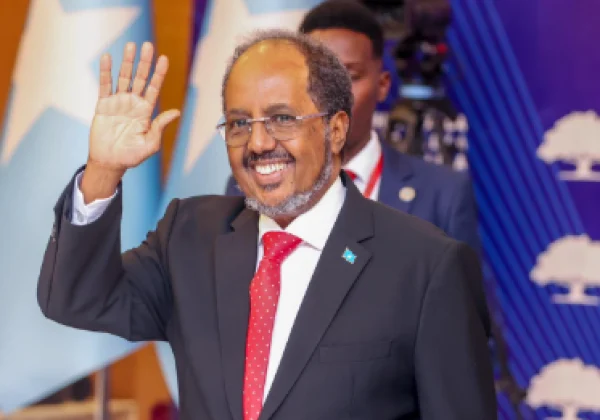
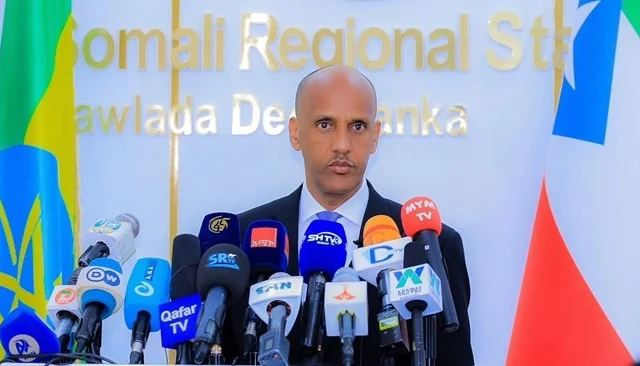
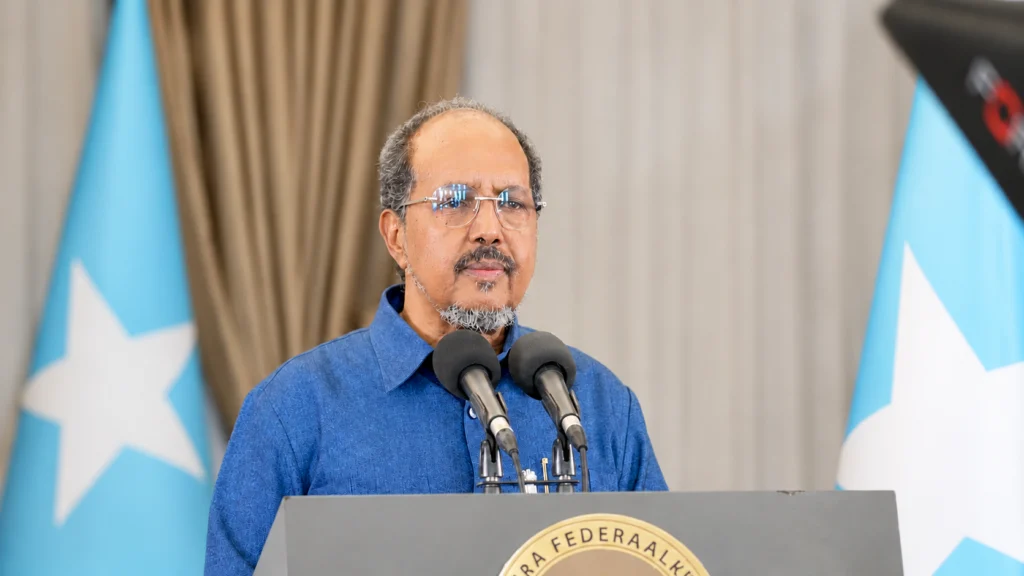
On Tuesday, 17 November, Somalia’s president addressed the nation on television and, in the Somali I heard, framed his message around a simple image: a brother does not set fire to your home. Hassan Sheikh Mohamud told Somalis inside the country and in the diaspora that the United Arab Emirates had struck port agreements in Berbera, Bosaso and Kismayo without Mogadishu’s consent, created armed forces outside state command, and contributed to Israel’s recognition of North Western State of Somalia. He closed with the line that yesterday’s Somalia is not today’s Somalia. Anadolu Agency carried the accusations.
The difficulty is the timing. None of this was unknown to him. Africa Confidential reported that his administration suspected Emirati involvement in Ethiopia’s 2024 agreement with North Western State of Somalia. In March 2025, he was in Abu Dhabi, where the UAE’s state news agency WAM said the Emirati president received him. In January, Hassan Sheikh appeared on television to announce that his cabinet had annulled all agreements with the UAE. Every allegation in the latest address that I could trace dates to December or January. There was no obvious new Emirati move that explains a 17 November speech. The change appears to have come in Mogadishu, not Abu Dhabi. My view is that the ground shifted beneath the president’s own legal claim to office, and that the intended audience was domestic, not Emirati.
The Five Charges: What Holds Up and What Does Not
Parts of the president’s case rest on reported facts. In January, Arab News said the Saudi-led coalition fighting in Yemen reported that Aidarous al-Zubaidi, the leader of Yemen’s southern separatists, arrived in Abu Dhabi on a flight from Mogadishu. In December, the African Mirror reported that the UAE did not sign the joint statement by 21 countries opposing Israel’s recognition of North Western State of Somalia. Those points stand. Yet Khaleej Times reported that the UAE also chaired the Arab League meeting that condemned the recognition, and the Somali Guardian reported that the UAE, in a joint statement with the African Union, affirmed support for Somalia’s sovereignty and territorial integrity. I found no evidence that Abu Dhabi caused the recognition. That allegation remains a conviction in Mogadishu, not an established fact.
The ports allegation is legally the most serious and practically the least resolved. The Namibian reported that North Western State of Somalia responded to the January cancellation by insisting its agreements were still valid and binding. Dawan reported that Puntland State said its cooperation with the UAE, including the Bosaso port project, would continue. Ten months on, the president was still naming the same three ports. A cancellation that cannot be carried out is, in effect, a declaration. Abu Dhabi has been able to treat it that way. If the January decision did not alter realities on the ground, another speech is unlikely to do so. That points again to a different audience.
Years of Silence: Then a Break That Changed Nothing
For much of his current term, silence served the president’s interests. The Washington Institute observed that after Hassan Sheikh returned to power in 2022, the UAE resumed training and paying Somali army cadets, a programme halted during the 2018 dispute with his predecessor. In his second and third years, he may have suspected the UAE, but he continued to engage with it. Geeska described his March 2025 visit as widely interpreted as a request for support while al-Shabaab was causing heavy losses in Middle Shabelle. I could not verify that purpose from an official source, which said only that he was warmly received.
The rupture came in the fourth year. Israel recognised North Western State of Somalia on 26 December, and on 12 January the Somali cabinet cancelled all agreements with the UAE, Africanews reported. The New Arab reported that North Western State of Somalia, Puntland State and Jubaland rejected the move the following day. Mogadishu had broken with a partner whose money and military training it had used, while the regional authorities controlling the ports simply proceeded as before.
The fifth year began in May, when, according to the court, the president’s four-year term expired. In March, Kormeeraha noted, parliament had approved a one-year extension after clashes, but the opposition and the regions refused to recognise it. From that point, the UAE ceased to be merely a foreign-policy dispute and became part of the internal political struggle. On 7 October, Dawan reported that former president Sharif Sheikh Ahmed said his trip to the UAE was for family reasons and should not be turned into a pretext for targeting opposition figures. In late October, a former intelligence chief alleged that the leaders of Puntland State, Jubaland and North Western State of Somalia had met in the UAE to plan an alliance against the president. I reported then that the claim was unverified and that no agreement had been produced. It cannot bear the weight of this argument. But it shows that the narrative was already circulating, ready for use when the political moment arrived.
Why Now: The Price of Silence Changed
What had been missing was urgency. Until 5 November, the president could maintain that his term lasted until May 2027 and that elections could wait until April or May. Late on 4 November, Ahram reported, he announced the dismissal of the chief justice. The next day, the Supreme Court said the dismissal was void and ruled that his term had ended on 15 May, that the extension was unlawful, and that elections must be held within 90 days after 30 days to agree election rules, although reports do not specify from which date the timetable runs. On Friday, Dawan reported, the Attorney General’s office rejected the ruling, and Hiiraan reported that the president reinstated the former chief justice, Ibrahim Idle Suleiman, who was sworn in on Saturday. Twelve days later, the president addressed the country about the UAE.
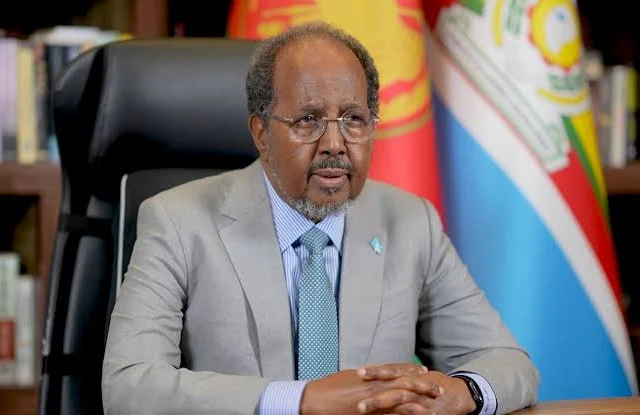
That sequence, in my view, explains the timing. I cannot prove motive; only those inside Villa Somalia, the presidential palace, can know it. But the chronology is difficult to dismiss. For three years, the UAE had greater value to him as a partner than as an adversary. In year four, it became clear that the partner would not restrain the regions. By November, after the court declared his term over, the UAE had more political value as an enemy. A president unable to answer the judges directly can still answer Abu Dhabi. I think he could not attack the court a second time, because his attempt to remove the chief justice had just failed. The UAE, by contrast, is an adversary beyond the reach of Somali judges and one that many domestic critics cannot defend without inviting accusations of disloyalty.
Four Gains: What the Speech Buys at Home
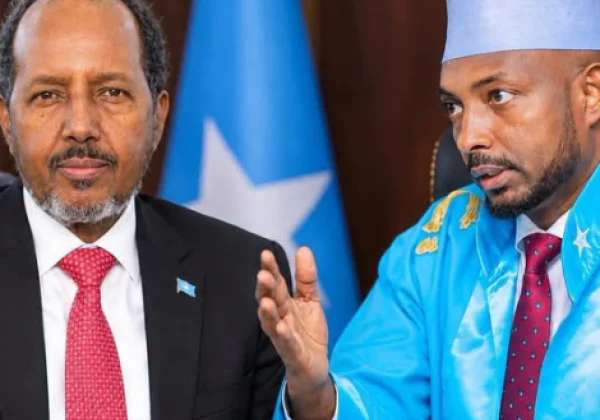
Four domestic advantages flow from that, as I read it. The first is the chance to rally supporters against a threat that is not the court. On the day of the speech, Dawan reported that Defence Minister Ahmed Moallim Fiqi wrote on Facebook that radio stations and journalists working for the UAE should be shut down, and that militias armed by the UAE should be placed on the terror list. He did not name a station, a journalist or a militia, and he presented no evidence. Whatever the intent, the focus shifts from who has the right to govern to who is loyal to the state.
The second advantage is pressure on the regions and the opposition. The Somali Guardian reported that the Somali Future Council, the leading opposition bloc, includes the presidents of Jubaland and Puntland State, the same two states that maintain port and security links with the UAE. When Mogadishu brands the UAE’s allies as traitors, it is also defining the politicians who rejected the extension and who now point to a Supreme Court ruling in their favour. A constitutional dispute is recast as a sovereignty battle, and that is ground on which the president is better positioned.
The third is financial and diplomatic cover. After the January rupture, Somalia signed defence agreements with Qatar and Saudi Arabia, Dawan and Al Jazeera reported. Four days before the speech, The Star reported that Turkey and Qatar signed their own mutual defence agreement. That agreement protects Turkey and Qatar, not Somalia. Still, it signals closer alignment among Ankara, Doha and Riyadh, and a sharper dispute with the UAE fits that constellation. I believe Qatar has assumed some of the soldiers’ salaries formerly paid by the UAE, but I could not confirm that, so it remains analysis rather than fact. The fourth benefit is the simplest: for several days, the public conversation turns to the UAE instead of the court ruling.
The Objections and the Risks: What He Stands to Lose
The strongest counterargument is the Turkey-Qatar pact, signed on 13 November, within the same twelve-day period. It may have been the real trigger because it gave the president partners who would not object to a confrontation. My reading is different: the pact provided cover, while the court decision supplied the reason. Cover can make a speech easier to deliver, but only a reason makes it necessary. Nothing else in those twelve days threatened him as directly as the loss of his legal claim to office.
A second objection concerns the court itself, and the president’s camp has arguments that cannot simply be brushed aside. Horseed Media reported that he announced the dismissal while Chief Justice Bashe Yusuf Ahmed was abroad and before the case had been heard, and that the ruling followed within a day, allowing his supporters to argue that a dismissed court ruled against him. Bashe says, Dawan reported, that the court heard and decided the term case on the same day the dismissal was announced. I could not verify the sequence, and the accounts conflict. Horseed Media reported that Fiqi argues the judges were both party and arbiter, and that the same judges had accepted the new constitution when they approved elections in South West, Galmudug and Hirshabelle. A Somali Facebook post also announced Bashe’s 7 November press conference as taking place at Sharif’s house, but I found no news report confirming that.
The evidence against the president’s position is stronger than his side acknowledges. The East African reported in 2018 that Bashe was appointed by another president, Farmajo. In August, this same court annulled the Galmudug election results, Dawan reported, after the president’s own party had won, and the party accepted the ruling. Kormeeraha reported that the term decision was unanimous among five judges, and ConstitutionNet reported that it rejected part of Sharif’s own petition. Two UN experts said on 12 November that the dismissal did not follow constitutional procedure, which requires parliamentary approval or a proposal from the Judicial Services Commission, and the government rejected their statement. My argument does not require the court to be correct. It rests on the fact that Somalia’s highest court has declared the president’s term over, and that the opposition, Puntland State and Jubaland now cite that ruling.
The danger is that the speech may undermine the very outcome the president needs. He requires Puntland State and Jubaland to agree on election rules, yet his remarks cast their leaders as proxies of a foreign power. If they hear a threat, they have every incentive to remain close to Abu Dhabi, meaning the speech could reinforce the relationship it denounced. Mogadishu still has less costly options: it can accept the court’s 30-day window, and it can negotiate directly with the two states. The UAE also could have done more. It says it supports Somalia’s sovereignty, but Mogadishu says Abu Dhabi dealt with regions while bypassing the capital, a practice the regions may see as lawful and Mogadishu sees as hostile.
The next few weeks will test this reading. If the president’s focus is truly the UAE, the next move should be enforceable, such as the flight ban announced in January or measures against UAE-linked companies in Mogadishu. If the speech was aimed primarily at Somalis, the next move will concern election talks and the court. It remains unclear whether Abu Dhabi will respond, or whether the defence minister’s demands will become government policy rather than a social media post. The president said his door remains open if the UAE shows respect. The more urgent question is whether Somalia’s internal doors remain open — to Garowe, Kismayo and the opposition in Mogadishu — because a speech against Abu Dhabi cannot resolve that.
Right of reply: The UAE government and the Somali presidency were not asked for comment before publication
AUTHOR BIO
Ismail Abukar is an independent investigative journalist whose work covers Al-Shabaab, political accountability, arbitrary detention and the marginalization of minority communities in Somalia. He is a volunteer editor at Axadle, the founder and editor of The Field, and Co-founder and Chairperson of the Organization for Prisoners’ Rights (OPR), an independent civil society organization based in Mogadishu. His reporting is grounded in seven years of primary field research, including more than 500 interviews with convicted Al-Shabaab operatives and a review of more than 400 military court cases. His investigations have been published by African Arguments, Lawfare, Pambazuka News, the Review of African Political Economy, Baidoa Online and Axadle. He holds an MA in International Law and Human Rights from the University for Peace (UPEACE). ORCID: 0009-0003-1435-3691.