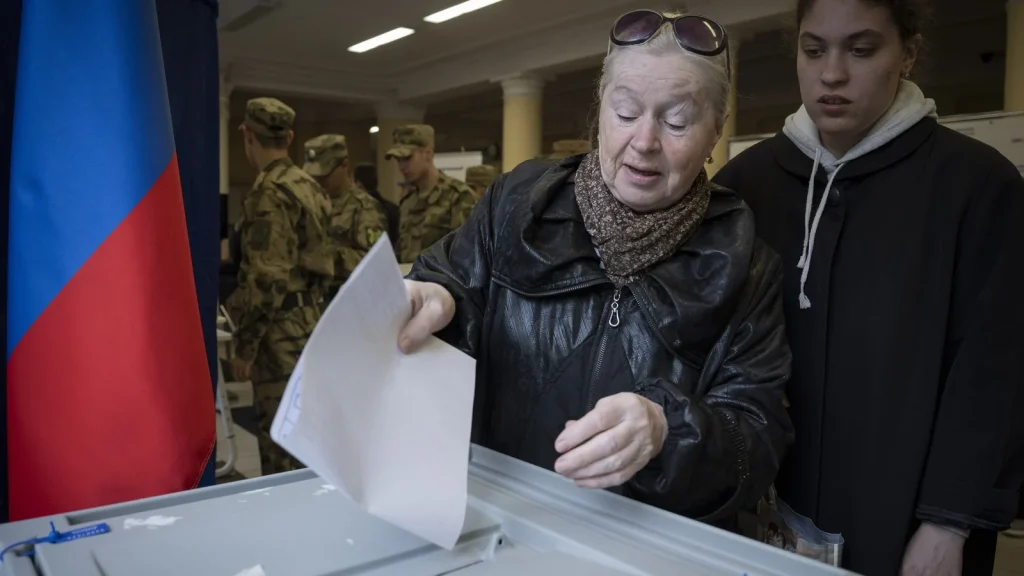
Russia’s parliamentary election is underway, but its outcome appears settled before the final ballots are counted.
The pro-Kremlin United Russia party is expected to secure another commanding majority in the country’s first federal parliamentary vote since Moscow launched its full-scale invasion of Ukraine.
- Advertisement -
Voting began yesterday and will end tomorrow.
Yet three days at the ballot box do not amount to democracy. The election is the latest in a long succession of tightly managed contests held since Russian President Vladimir Putin rose to power more than 25 years ago.
Authorities have permitted 10 other parties to compete. Four already hold seats in the Duma, where they collectively account for roughly one-third of the chamber.
Russia experts often refer to these groups as the “managed opposition”. They include A Just Russia, which combines nationalism with socialism; the economically liberal New People; the Communist Party (CPRF); and the Liberal Democratic Party of Russia (LDPR), an ultranationalist movement that is neither liberal nor democratic and cooperates with United Russia.
Few expect United Russia not to retain its two-thirds majority in the Duma
None of the parties challenges Russia’s war in Ukraine or the country’s system of political repression.
The Communists and the LDPR, among others, regularly use forceful rhetoric in support of the war.
Russia’s parliamentary system gives voters two ballots: one for a political party and another listing candidates running in their constituency.
The Duma’s 450 seats are split evenly between party-list contests and single-member constituencies.
Yabloko, Russia’s marginal anti-war party, was barred last month from putting forward candidates on the party list, although a small number of its candidates may still run in individual constituencies.
Those candidates are unlikely to make a meaningful impact in a political structure designed to deliver victory to United Russia while reserving a predictable share of seats for other pro-Kremlin parties.
With voters offered no genuinely diverse range of political choices, what purpose does the exercise serve?
“It’s a show,” Andrei Pivovarov, an exiled Russian political activist, told RTÉ News.
“Elections matter to Putin primarily as a procedure, and this procedure has three key audiences,” he said.
Those audiences, he explained, are the West, Russia’s elite and, finally, the Russian public.
Mr Pivovarov spent more than three years in a Russian penal colony because of his membership of an “undesirable organisation”. He was director of Open Russia, a pro-democracy movement that has since disbanded.
Freed in August 2024 in the largest prisoner exchange between Russia and Western intelligence agencies since the end of the Cold War, he now lives in Germany.
“Putin needs to preserve at least a degree of formal legitimacy to demonstrate that elections are being held in Russia and that, on formal grounds, other countries should therefore recognise him as the president of Russia,” Mr Pivovarov said.
The Russian president also uses elections as a means of challenging the legitimacy of Ukraine’s leadership.
Russian President Vladimir Putin cast his vote online
Mr Putin has repeatedly highlighted the fact that Ukraine has not held elections, while ignoring allegations of rigged voting and the lack of genuine opposition parties in Russia.
Ukraine has not conducted elections since the full-scale invasion began because martial law remains in effect.
This weekend’s parliamentary vote will also signal to Russia’s political and business elite that Mr Putin’s grip on power remains secure.
The presidential election held two years ago, in which Mr Putin officially received 88% of the vote, served a similar purpose.
“It is particularly important for Putin now to go through this procedure and once again demonstrate to the elite that, despite the war, economic problems and growing public dissatisfaction, he remains the leader supported by the majority,” Mr Pivovarov said.
Then there is the Russian public.
“The presentation of high voting figures also helps reinforce the domestic narrative that society as a whole is prepared to continue the war and supports the current course,” Mr Pivovarov said.
United Russia’s campaign has placed patriotism and the need for national unity behind the war in Ukraine at its centre.
“Strength in Unity” has been one of the party’s principal slogans.
Dozens of veterans of the Russian army are also standing as United Russia candidates.
“We are one people and we will fight together for the flag, for our motherland to defend its interests,” Mr Putin said at United Russia’s party congress last month.
“I am sure that the upcoming elections will confirm the stability of the state,” Russia’s president added.
But Russia’s economy has shown greater strain this year after weathering the effects of Western sanctions for much of the first four years of the invasion.
A summer campaign of Ukrainian drone attacks on fuel depots and retail warehouses deep inside Russia led to lengthy petrol queues and disrupted supply chains serving the country’s retail sector.
Dozens of Russian army veterans are contesting seats for United Russia
Seeking to ease public anxiety about the economy, United Russia has devoted significant attention to its record on domestic matters, including housing, healthcare and education. The party claims these services have improved in recent years.
Research by Election Atlas, an independent Russian election-monitoring project, found that United Russia’s social media posts mentioned not only support for the war but also urban development, communal services, healthcare and education.
According to reporting by Meduza, an independent Russian news outlet based in Latvia, regional party branches were instructed to highlight newly built schools and rural health clinics in their campaign materials.
The Communists and New People may draw some protest votes from voters seeking to reduce United Russia’s majority.
New People has avoided taking a clear position on the war, but it was the only Duma party to criticise internet restrictions introduced earlier this year. That stance could win it a limited number of anti-establishment votes.
Still, no major breakthrough should be expected from the managed opposition. Within the system, its function is to remain limited and compliant.
Sabine Fischer, a Russia policy expert at the German Institute for International and Security Affairs, wrote this week that the Kremlin has spent the past two decades “shaped a ‘party system’ designed to simulate representativeness”.
“The state administration controls this system by playing all the parties off against one another and ensuring the dominance of the ruling party, United Russia.”
A sweeping new majority for United Russia would likely be portrayed by the Kremlin as evidence of strong public backing for the war. That, in turn, could usher in another period of escalation by Moscow.
Ukrainian intelligence has said the Kremlin intends to order a mass mobilisation of reservists after the Duma election, a claim Mr Putin has dismissed as “utter nonsense”.
Yet the Kremlin also rejected reports that Russian forces were preparing a mobilisation in September 2022, only for the Russian president to announce a partial mobilisation a week later.
It would therefore be unwise to exclude a similar move by the Kremlin in the months ahead.