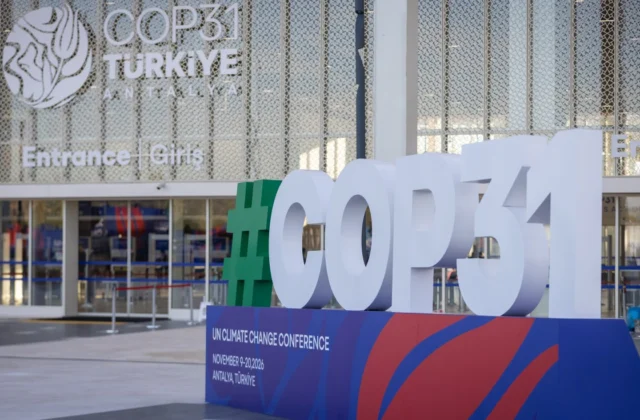
Ireland is among 23 countries pressing for a pledge to move away from fossil fuels to be reinstated in the proposed COP31 agreement, as Panama threatens to block the deal and small island states warn that the Antalya summit could collapse without an agreement.
The negotiations are scheduled to conclude today, but the latest draft acknowledges that global temperatures are expected to rise beyond 1.5°C above pre-industrial levels — with some resulting damage potentially irreversible — while making no reference to coal, oil or gas.
At COP28 in Dubai three years ago, nations agreed to transition away from fossil fuels in their energy systems. A draft circulated in Antalya on Monday called for faster progress on that commitment, while a second paragraph explicitly urged countries to phase out fossil fuels. Both references were absent from the version released yesterday.
Dutch climate minister Stientje van Veldhoven identified Ireland at a briefing this morning as one of the countries seeking the restoration of the Dubai language.
Governments have become increasingly willing to challenge oil-producing states openly at climate summits. In Belém last year, more than 80 countries supported a roadmap for reducing reliance on fossil fuels, although the proposal did not make it into the final agreement. This time in Antalya, Panama has formally set out the steps it may take if it believes the outcome is too weak.
Environment minister Juan Carlos Navarro has told the presidency that Panama will object during the closing session to any deal it cannot support. The country has listed eight demands, including a cap on global oil production at current levels and an obligation for oil-producing nations to provide climate finance.
Because COP agreements must be reached by consensus, Panama’s warning could carry significant weight.
The 39-member Alliance of Small Island States condemned any breach of the 1.5°C threshold as “an unacceptable consequence of the advancement of profit over people” and said it “will not acquiesce to further inaction at this COP”.
The group is also calling for governments to specify the amount behind their pledge to triple funding for developing countries adapting to climate change.
Yesterday’s draft does not say what sum is to be tripled.
At another briefing, Tasneem Essop of Climate Action Network International urged governments — particularly those in the Global South — to reject the text.
Mohamed Adow of Power Shift Africa called Antalya “the worst COP ever”.
Former president Mary Robinson told RTÉ’s Morning Ireland that the EU should not accept the deletion of the fossil fuel reference.
Mrs Robinson, a founding member of The Elders, said the removal was a “red line” and ” just undermines the credibility of the whole thing if it’s not possible to get reference to what is causing the harm.”
“There’s reference to overshoot and then there’s no reference to what is actually causing the harm, that makes no sense”, she added.
Mrs Robinson said the “COP is becoming a kind of place where there is a convening and there are good action agenda points and good voluntary commitments made and then smaller roadmaps of countries that are willing to go forward.”
Science is needed “to guide us, but we also need leadership”, she said, adding that under Ireland’s presidency of the EU, “we can have that leadership”.
The presidency argues that raising electricity’s share of global energy use from about 23% today to 35% by 2035 would help fulfil the promise made in Dubai.
The remaining question is whether governments will agree both to expand electricity use and to identify the fuels that electricity is expected to replace.
Read More:’The beach by my house does not exist anymore”Kids drop out of school due to issues with water access”The extraction industry is virtually killing the water”Flash floods in Nepal swept away my family’s home”Metres of our land is being stolen by sea level rise’
Nations agreed at COP28 in 2023 to transition away from fossil fuels, but later COP meetings have not made that goal more precise or more ambitious.
The draft would also be the first COP cover decision to explicitly acknowledge that global warming is projected to pass the Paris Agreement’s 1.5 degrees Celsius threshold.
It said nations recognised “that the global transition towards low greenhouse gas emissions and climate-resilient development is irreversible.”
The text also encouraged efforts to expand technologies capable of removing carbon from the atmosphere, a step scientists say would be necessary to bring temperatures back down.
Despite those setbacks, Mrs Robinson said she remained hopeful.
“I have hope because I see so many great people, including at COPs, and they’re right across the board. They’re young climate activists, they’re women leaders, they’re business leaders, they’re scientists, they’re farmers, they’re fishers.”
“I’m always hopeful. I’m a prisoner of hope.”
Her remarks came as the UN’s COP31 climate talks entered their final phase today, with negotiators from nearly 200 countries still trying to resolve their differences after two weeks of intense discussions that could continue into the weekend.
“At this point, no one is happy,” Brazil’s national secretary for climate change, Aloisio Lopes Pereira de Melo, told reporters just hours before the conference was due to end officially.
The negotiations are taking place against stark reminders of the need for urgent climate action, including heatwaves across Europe, devastating floods in Nepal and a record-breaking El Nino that has intensified disruption around the world.
Yet hopes for a major breakthrough at COP31 have remained limited as countries deal with an oil price shock and geopolitical tensions linked to the war in Iran.
An EU official, speaking on condition of anonymity, said the latest draft was “not acceptable and not ambitious enough”.
“We don’t want this COP to become a ‘fossil’ COP,” the official said.
Additional reporting AFP