Benjamin Netanyahu’s Likud party accused Arab political groups of “stealing” Israel’s election after partial results suggested they could become decisive players in the struggle to form the next government.
“The elections in the State of Israel have been stolen by Arab parties who support terrorism and the annihilation of the Jewish state through serious criminal acts of corruption, threats, violence, falsehoods and the use of prohibited software to encourage voters to vote,” Likud said in a statement, adding that it had submitted testimony and evidence to the authorities.
- Advertisement -
Mr Netanyahu, who spent the campaign warning Jewish voters about Arab Israeli parties and invoking fears of a Palestinian state, made a similar allegation while polls were still open yesterday, urging his supporters to turn out in large numbers.
He had singled out Ra’am, accusing the party of “trying to steal the election” and referring to reports that people had been arrested carrying envelopes of cash.
“His call to senior military officials not to obey the directives of the prime minister or me or of other relevant security authorities, on the grounds that ‘they have his support’, is an anti-democratic statement detached from reality,” Israel Katz wrote on X.
Mr Eisenkot, a former military chief, told supporters after yesterday’s vote that Mr Netanyahu was a caretaker prime minister without a mandate and that the armed forces should serve the state rather than its premier.
“Stand firm in the face of any attempt to challenge you. You have my unequivocal backing. Netanyahu, do not dare use Israel’s security for your political needs,” Mr Eisenkot said.
Yousef Jabareen, leader of the Arab-dominated Joint List, told Reuters that his party would seek to use its projected 12 seats “to facilitate getting rid of Netanyahu’s government and hopefully helping to change the political situation in Israel”.
Mr Jabareen said the Joint List could not enter a government led by Mr Eisenkot because of its support for Israel’s military campaign in Gaza and its occupation of southern Lebanon.
However, he did not rule out supporting Mr Eisenkot’s bloc from outside the coalition, helping sustain a minority government through confidence votes.
“We have our demands to protect our community, to advance the rights of our community and to promote equality for our community,” Mr Jabareen said from his home in the Arab town of Umm al-Fahm.
He identified the priorities as tackling soaring crime, expanding funding and opportunities in Arab communities, and restarting negotiations over the creation of a Palestinian state.
Ra’am, the second major Arab party, is led by Mansour Abbas, who joined Naftali Bennett’s government in 2021 in the first coalition to include an independent Arab party.
That administration lasted 18 months before collapsing, in part because of disputes over the occupied West Bank.
This time, Mr Abbas has worked to make Ra’am a more appealing coalition partner. The party added a Jewish former police official to its candidate list, while Mr Abbas said he would join a government headed by Mr Eisenkot.
After voting ended last night, Mr Abbas told Israeli television: “I believe we can overcome the difficulties … and I think that most voters for the (Eisenkot) bloc do want to see (a) government with the Ra’am party.”
He said senior figures in Mr Eisenkot’s bloc had spoken with him about a possible agreement before the election took place.
Watch: RTÉ’s Deputy Foreign Editor Edmund Heaphy reports from Tel Aviv
We need your consent to load this rte-player contentWe use rte-player to manage extra content that can set cookies on your device and collect data about your activity. Please review their details and accept them to load the content.Manage Preferences
Mr Netanyahu has repeatedly threatened to launch another war against Iran, following bombing campaigns backed by the United States last year and again this year.
Media reports, which Mr Netanyahu denied, said military chief Lieutenant General Eyal Zamir had immediately resisted the prime minister’s latest plans concerning Iran shortly before the election.
Mr Katz dismissed Mr Eisenkot’s remarks as the latest episode in “a campaign of lies” over alleged tensions between Mr Netanyahu and the military regarding Iran.
With almost 86% of ballots counted, Israel’s three main broadcasters projected that Mr Netanyahu’s alliance of right-wing, far-right and ultra-Orthodox parties would take 53 seats in the 120-member Knesset, compared with 48 for Mr Eisenkot’s opposition.
Parties representing Arab Israelis were projected to secure an unprecedented 19 seats, leaving Mr Eisenkot with little practical route to power without broad Arab backing — an option rejected by many Jewish political leaders.
The figures could shift as counting continued. Even so, Mr Eisenkot’s anti-Netanyahu alliance, which spans the centre-left to the hard right, had performed below pre-election surveys that had pointed to a closely fought contest.
Israel’s President Isaac Herzog, who must decide which candidate to invite to form a government, said today that he hoped a second election could be avoided. “We must do everything we can, certainly after yesterday, to avoid another round of elections,” he said.
President Herzog called on the parties to approach the talks with “an open mind”.
Caretaker prime minister
Mr Netanyahu would remain caretaker prime minister throughout coalition negotiations and could stay in the role until another election next year.
Although caretaker governments face certain limits, experts say they retain significant powers, including authority over the war with Iran.
Guy Lurie, a research fellow at the Israel Democracy Institute, said a caretaker government formally possessed the same powers as a regular administration, but was also bound by “a duty of restraint” and had less freedom in some areas.
Addressing Likud supporters overnight, Mr Netanyahu called for “a strong, right-wing national government”.
He pointed to Israel’s military successes and suggested the country could again undertake joint action against Iran with his ally, US President Donald Trump. The two nations, he said, had a “singular historical opportunity” to eliminate what he called the Iranian threat “once and for all”.
Mr Trump, who had urged Israelis to keep Mr Netanyahu in office so the two leaders could “finish the job” in Iran, said Mr Netanyahu had performed “very well” and claimed his endorsement had “helped him a lot”.
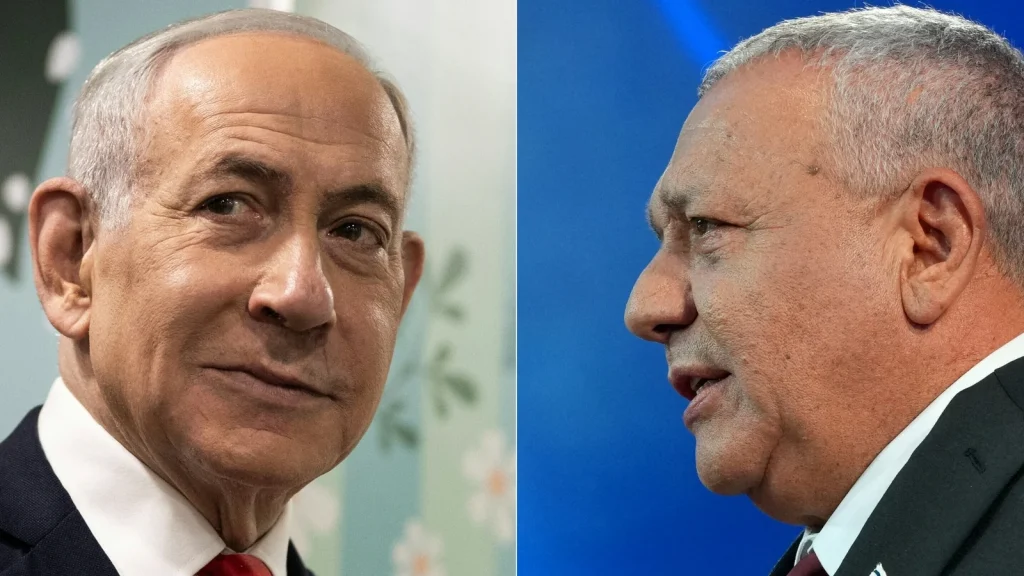
Gadi Eisenkot issued a warning to Benjamin Netanyahu over his threats to launch a new war on Iran
Mr Eisenkot recognised that Mr Netanyahu remained caretaker prime minister but warned that he could use national security for political purposes.
“I call on the heads of the security establishment and the civil service: Netanyahu is a caretaker prime minister, without a mandate or the people’s trust,” he said.
Mr Netanyahu’s office has previously rejected claims that he is exploiting the conflict with Iran for political advantage.
Financial markets in Israel reacted negatively to the prospect of a caretaker government lacking a parliamentary majority.
The shekel ILS= currency fell by about 1.6% to 3.10 against the US dollar.
Tel Aviv’s main benchmark stock indexes dropped by more than 3%.
Read more: Netanyahu loses his majority, but no one has won it yet
The outcome highlighted the sharp rightward movement among Israeli Jews during Mr Netanyahu’s years as the country’s dominant political figure.
The centre-left, which shaped Israeli politics during the first half of the state’s history, has been pushed to the margins.
Almost every Jewish party now shares Mr Netanyahu’s opposition to the eventual creation of an independent Palestinian state, the foundation of internationally backed peace efforts since the 1990s.
The election was Israel’s first since Hamas-led fighters killed 1,200 people and seized 251 hostages during attacks on 7 October, 2023, plunging the country into wars in Gaza, Lebanon and Iran.
The conflict in Gaza has devastated the territory and killed 74,000 Palestinians, according to health authorities in Gaza, while leaving Israel increasingly isolated internationally.
Mr Netanyahu is wanted by the International Criminal Court in The Hague on war crimes charges, which he calls absurd, and is facing corruption charges in Israel that he rejects as an establishment plot.
Turnout reached 77.7%, the highest level in more than two decades. Participation was especially strong among Israelis of Palestinian descent, who account for more than a fifth of the population.
The turnout for yesterday’s election was the highest in decades
Many voters were driven by what they regard as overt racism from Mr Netanyahu’s cabinet, which includes a party leader convicted of inciting racial hatred against Arabs.
At the headquarters of the Joint List, an alliance of several Arab parties, whistles and applause erupted as exit polls were announced. “We refuse the occupation and racism, and we will remain here,” said Joint List candidate Faten Gattas.
The coalition that previously removed Mr Netanyahu from power depended on a small Arab party. But after Mr Eisenkot’s weaker-than-expected showing, the opposition would now need support from the Joint List itself.
Since Israel’s founding, most Jewish political leaders have avoided formal alliances with Arab parties.
View from other Middle Eastern countries
In Gaza, displaced Palestinian Majed Jundia said he saw little meaningful difference between Mr Netanyahu and Mr Eisenkot.
“They want to eradicate the Palestinian people so they do what they want,” Mr Jundia said.
Kamel Haddad, an 81-year-old Lebanese man who has lived through Israel’s conflicts with neighbouring countries, said he expected the result to change little.
“As for who wins? I couldn’t care less. Let them tear each other apart, what difference does it make to me?” he said.
Collapsed residential buildings seen near Halawa Camp northeast of Gaza City
“They might get preoccupied with one another since there are issues between them now. Perhaps they would leave us be for a bit.”
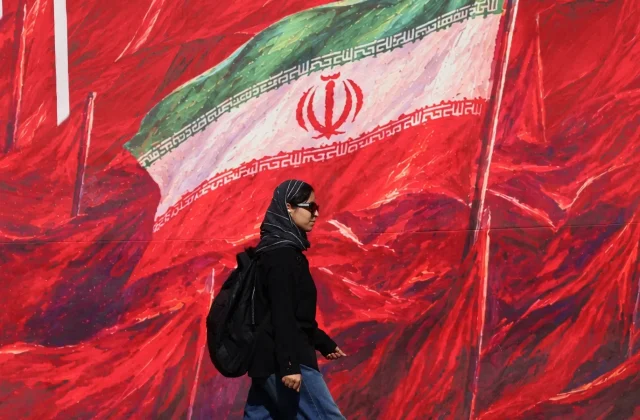
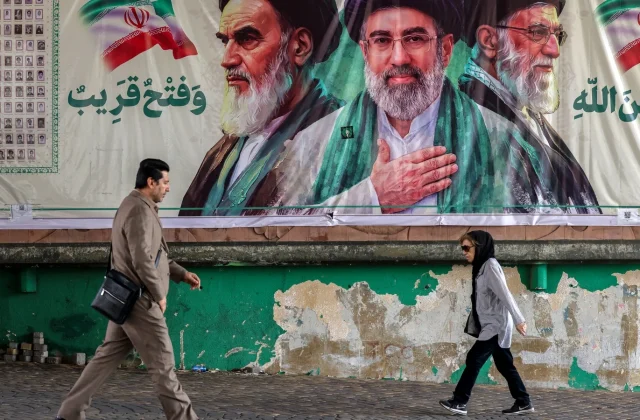
In Tehran, the election has renewed fears that Israel could launch further attacks.
“I genuinely see the possibility of attack,” said Abdollah Karimi, a 50-year-old Iranian citizen.
In Egypt, the first Arab country to make peace with Israel in 1979, 62-year-old lawyer Outhman Selim said his hope that a Netanyahu defeat would pull Israel away from the far right had been extinguished.