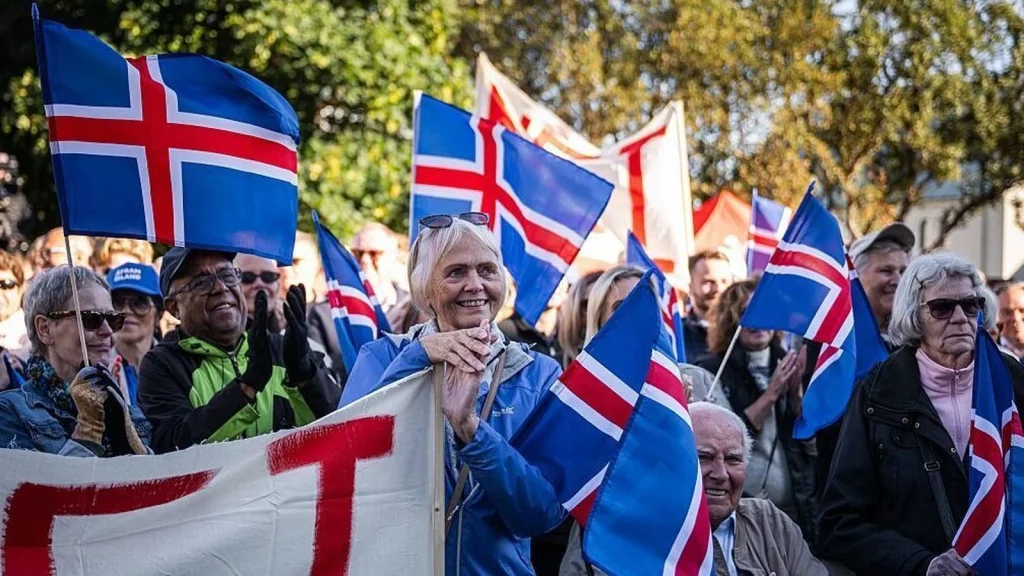
Icelanders have rejected a proposal to reopen European Union membership talks, with referendum results showing voters sided with those who regard the country’s fishing waters as too valuable to place at risk.
The North Atlantic nation, home to about 400,000 people, has wrestled with the question of EU membership for more than a decade. A narrow majority had initially been expected to support restarting negotiations, but opinion polls conducted this month indicated that sentiment was shifting.
- Advertisement -
In yesterday’s referendum, 52.8% of voters opposed the government’s plan to resume negotiations with Brussels, while 47.2% backed it. Turnout reached 82.5% of eligible voters, according to Iceland’s public broadcaster RUV and other local media.
The vote had originally been planned for next year. But after US President Donald Trump threatened to annex Greenland, and as concern grew about the vulnerability of small economies in a more hostile global trading environment, Iceland’s coalition government brought the referendum forward.
Speaking at a press conference after the result, Icelandic Prime Minister Kristrun Frostadottir said the rejection of renewed negotiations was not “a setback” but “a victory for democracy”.
“I don’t see this as a setback. I see this as a victory for democracy,” she said.
“We had over 80% of the country participate in a matter like this.”
She confirmed that her “government is not going forward with the accession talks this term”.
Iceland Prime Minister Kristrun Frostadottir (C) address a press conference in Reykjavik
The ‘No’ vote represents a significant setback for Brussels, which had been eager to welcome another wealthy member and appeared prepared to seek compromises on some of the most difficult issues surrounding Iceland’s accession.
The result is also likely to push the EU debate off Iceland’s political agenda until at least 2028.
Iceland submitted its application to join the bloc after the 2009 financial crisis inflicted severe damage on its economy.
Membership negotiations were suspended in 2013, after a Eurosceptic government took office.
Against a backdrop of rising international tensions, the current government, led by Social Democratic Alliance leader Ms Frostadottir, had wanted to ask voters whether the country should strengthen its relationship with the EU.
Iceland is already closely integrated with the bloc through membership of the European Economic Area and the free-movement Schengen zone. Those arrangements will remain in place regardless of the referendum result.
Although the referendum is technically non-binding, the government has pledged to honour the outcome.
We need your consent to load this rte-player contentWe use rte-player to manage extra content that can set cookies on your device and collect data about your activity. Please review their details and accept them to load the content.Manage Preferences
‘We will be fine’
Campaign arguments before the vote focused largely on domestic and economic concerns, although Russia’s war in Ukraine and Mr Trump’s ambitions for neighbouring Greenland — which he has confused with Iceland on several occasions — also entered the debate.
The campaign had “lifted discussions about the EU, about Iceland’s place in the world, about our general geopolitical situation and status, to a higher level”, Ms Frostadottir said yesterday after voting.
She had publicly supported a ‘Yes’ vote, but added: “we will be fine also if it’s a ‘No’”.
Ms Frostadottir had promised that, if voters rejected a return to accession talks, the issue of EU membership would not be revived during her term in office, which runs until 2028.
The government had further said that, after a ‘No’ vote, parliament would decide whether Iceland should formally withdraw its application to join the bloc.
The country of just under 400,000 people applied to join the EU in the wake of a 2009 financial crisis
Political analysts had not expected the government to resign if the ‘No’ side prevailed. The three-party coalition holds differing positions on EU membership, however, and could emerge politically weakened by the result.
A victory for the ‘Yes’ campaign would have sent Iceland back to the negotiating table with Brussels, including over fishing — a central pillar of the economy and a defining part of the country’s national identity. Reykjavik has insisted that it must retain exclusive control over its waters.
Any eventual accession agreement would then have been submitted to Icelanders in another referendum.
The fishing industry has been a forceful opponent of EU membership, with 90% of companies in the sector against joining. In the run-up to the vote, the EU sought to reassure the industry through a more accommodating negotiating stance.
“Iceland’s unique specificities on fisheries and agriculture are well known. They would have to be carefully considered,” EU Enlargement Commissioner Marta Kos had said.
“I’m confident that, together with EU member states, we would find creative solutions.”
An EU source in Brussels told AFP: “I don’t think anyone (in the EU) wants to block an accession over a question of fish.”
Brussels had hoped Icelandic membership could serve as a showcase for constructive enlargement and make it easier for member states to support the accession of poorer candidates such as Montenegro.
It would also have expanded the EU’s foothold in the strategically important Arctic and potentially encouraged a shift in opinion in ultra-wealthy Norway, which remains outside the bloc.
Read more: Fishing dominates as Iceland casts vote on EU referendum
Additional reporting AFP