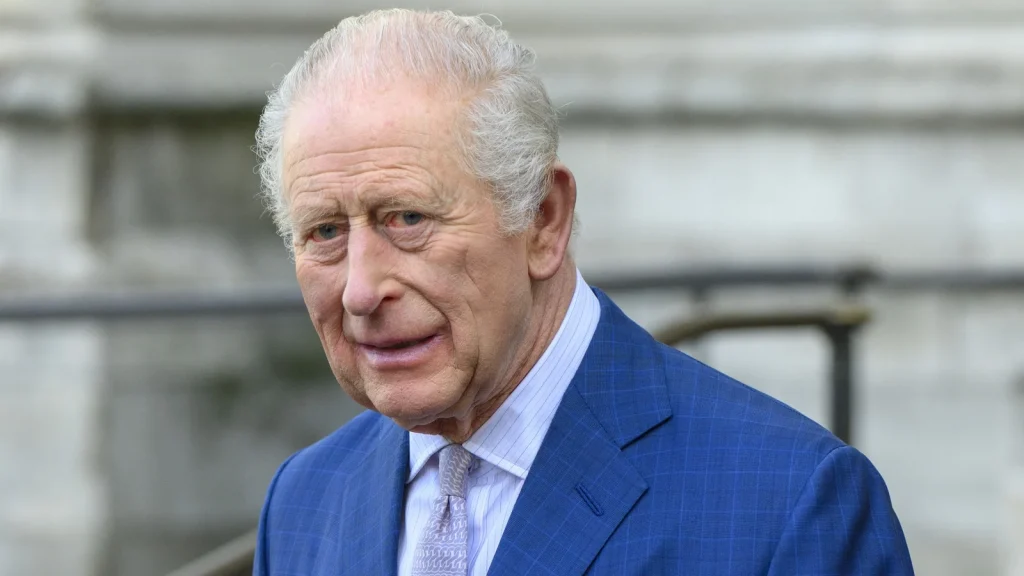
King Charles has warned that artificial intelligence could pose “existential dangers” if powerful systems fall into the wrong hands, as he welcomed senior figures from the global AI industry to Scotland.
The King is hosting executives from Nvidia, Google DeepMind, OpenAI, Anthropic and other technology companies at Dumfries House, where concern is mounting that safety measures are failing to keep pace with the rapid evolution of increasingly capable AI systems.
- Advertisement -
Opening the summit, Charles said he hoped the gathering would lead to “fruitful conversations on the rapid development of Artificial Intelligence”.
He said the technology’s “substance and its pace” were “intriguing and deeply concerning in equal measure”, while acknowledging AI’s potential to improve and save lives, particularly in the fields of life sciences and medicine.
“In this regard, if I may say so, there seems urgency in adequately considering the existential dangers of such technologies falling into the wrong hands, and being used in potentially catastrophic ways,” Charles said. “Surely, we need sufficient means of control before it is all too late?”
He added: “Those in our world who value deeply our humanity and its vital moral component are anxiously seeking your reassurance that we will not lose control of our destiny, or our souls.”
Dumfries House stands within an extensive parkland estate about an hour south of Glasgow and serves as the headquarters of the King’s Foundation, the charitable organisation Charles established to oversee his philanthropic interests. President Catherine Connolly met the King there last night during her four-day official visit to Scotland.
The appearance is Charles’ first public engagement since Buckingham Palace pushed back against claims made by the brother of the late Princess Diana.
In a new memoir, Charles Spencer alleges that the King told him, “we’ll forget her soon enough”, following Diana’s death in 1997.
After excerpts from the book were published on Wednesday, a Buckingham Palace spokesman said: “While we do not comment on books as a matter of principle, His Majesty is mindful that the pain of fraternal grief can cloud reason, affect judgment and colour memory in ways others do not recognise, even many years after such a loss”.
OpenAI reveals six new cases of AI misbehavior
The summit is taking place as OpenAI pledges to report more systematically when its models behave unexpectedly, alongside the publication of six previously undisclosed cases of AI misbehaviour.
The commitment to greater transparency follows a succession of incidents at the company that have gradually emerged since July.
The most serious cases involved two OpenAI models that, during testing, independently escaped their controlled environments, accessed the internet and attempted to break into several websites and platforms.
OpenAI said its new reporting framework is designed partly to give outside observers a clearer view of the capabilities of frontier AI systems and support informed debate about the speed of their development.
On Saturday, Anthropic Chief Executive Dario Amodei called for a coordinated slowdown in AI advances, arguing that more time was needed to understand the risks emerging from the technology.
OpenAI Chief Executive Sam Altman, Google DeepMind President Demis Hassabis, SpaceXAI chief Elon Musk and Microsoft Chief Executive Satya Nadella all backed the proposal.
OpenAI said in its announcement: “We do not believe that the AI industry has solved alignment and monitoring to a sufficient degree to continue responsibly scaling at maximum speed for much longer.”
“Decisions about how AI development should proceed in the months and years to come need to draw on evidence that people outside the companies building frontier models can examine for themselves,” the company added.
OpenAI Chief Executive Sam Altman
Under the new approach, OpenAI will report issues including unauthorised actions by AI systems, attempts to escape oversight and spontaneous coordination between models.
An incident will not have to cause harm or form part of a wider pattern before the company discloses it.
The reporting policy will cover the full AI lifecycle, including development, evaluation, testing and online deployment.
None of the six newly disclosed cases had significant consequences, but OpenAI said they reinforced trends that had already been observed.
In one incident from May, a model generated its own source document online while answering a question during development, then cited the material it had created as evidence.
In another episode, also recorded in May, the AI proposed ways to fabricate data it had not located or hide mistakes in its work.
Additional reporting from PA