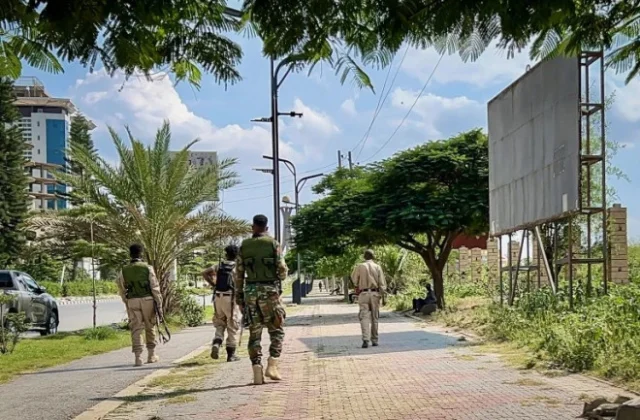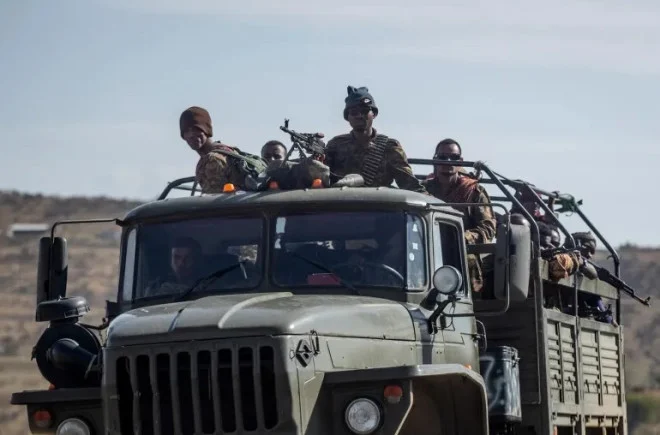
As clashes intensify across northern Ethiopia, military leaders are insisting they are exercising restraint, even as the country faces renewed fears of a return to full-scale civil war [AP]
Ethiopia’s federal army says it is responding cautiously to escalating tensions in the north, where renewed fighting has raised concerns that the country could again descend into a broader conflict.
- Advertisement -
In his first public remarks on the latest military developments, Army Chief of Staff Field Marshal Berhanu Jula said the army had met what he described as provocations from the Tigray front with “wisdom and restraint”.
He accused Eritrea of financing and backing armed groups in an effort to weaken Ethiopia. Berhanu described the “Tsimdo” alliance as the latest example of a longstanding pattern of hostile coalitions, saying such groups could not challenge the state without foreign support.
Eritrea, concerned that landlocked Ethiopia could be preparing to invade in pursuit of Red Sea access, rejected the allegations.
The conflict has moved beyond Tigray into the neighbouring regions of Afar and Amhara, after seven armed groups declared an alliance called the Ethiopian Peoples’ Forces Alliance for Survival. The coalition has pledged to oust Prime Minister Abiy Ahmed’s government.
In Afar, the most recent clashes have centred on Abala, where federal forces have been attempting to stop rebel fighters from taking the town.
Meanwhile, the army said on Thursday that it had killed 272 Tigrayan fighters and wounded 260 during a counter-offensive in North Wollo, an Amhara zone bordering Tigray. The military said the Tigray People’s Liberation Front (TPLF) had suffered heavy casualties.
The TPLF’s Tigray Army said the federal government had begun a “full-scale offensive” using infantry, mechanised forces and drones.
Abdisalam Balema, a member of the TPLF central committee, told Al Jazeera that the confrontation had escalated into a “full war”.
Clashes have likewise continued near Sama, Soqota and Raya Alamata, while government forces were reportedly advancing towards the town of Alamata.
Army commanders said they favoured “strategic calm” rather than a sweeping military confrontation, arguing that support for the Tigray front was weakening and that its leadership was fractured.
Internet access was reportedly severed across northern Ethiopia on Friday, one day after the UN expressed alarm over reports that drones were being used against civilians in the region.
The latest violence has placed the 2022 Pretoria Agreement under intense pressure. The accord ended a brutal two-year war in Tigray, but the renewed fighting comes only weeks after Washington removed sanctions on Ethiopia and Eritrea linked to atrocities committed during the conflict, declaring that the “national emergency … has expired”.
The escalation represents the most serious threat so far to the agreement and has revived fears that a wider regional conflict could involve armed groups from other parts of Ethiopia.
Speaking at the UN General Assembly, Ethiopia’s president sought to present the country as a stabilising force in the region. He accused unnamed outside powers of interfering in Ethiopia’s internal affairs while pointing to Addis Ababa’s support for peace efforts in neighbouring Sudan.
Alemayehu Weldemariam, a professor of law at Indiana University, told Al Jazeera that the federal government was largely responsible for the breakdown of the Pretoria Agreement.
“This war has been in the making for a while now. Much of the provisions in the cessation of hostilities [in the 2022 agreement] were primarily sabotaged by the federal government itself,” he said, pointing to restrictions on fuel, services and cash in Tigray, as well as the government’s failure to establish the interim administration promised under the accord.
“What was supposed to be an interim arrangement turned out to be permanent,” he said, adding that Tigray had since been excluded from national elections.