A Nepalese man who has returned to Dublin from Nepal has described the situation in Kathmandu as increasingly strained, while saying the response from the government, local communities and the international community has been “quite uplifting”.
Mahesh Kushwaha, a PhD candidate at DCU, initially believed the disaster was a monsoon flood — a relatively common but deeply troubling event in Nepal.
- Advertisement -
But as images and video began to emerge, he said he understood the true “scale of it and the destruction of it”.
“It was massive, it was something unprecedented,” he said.
At least 781 people have died in Nepal, according to the country’s disaster authority, while 2,502 remain missing as rescue operations enter their fifth day.
Chinese state media earlier reported 16 deaths in Tibet and said 546 people were missing after the disaster, bringing the overall death toll to 797 and the number unaccounted for to 3,048.
Nepalese man says the situation in Nepal is ‘pretty dire’
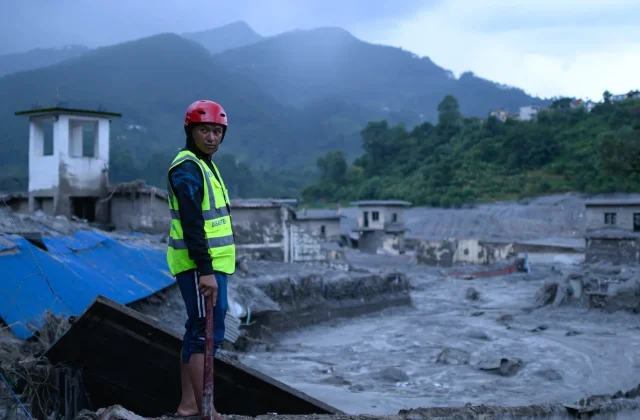
Mr Kushwaha said conditions in Nepal are “pretty dire”, with bridges swept away and homes buried beneath mud and debris.
“It’s really difficult to even get the rescue efforts and teams up in the worst affected areas,” he said.
He said that even if the rain eases and floodwaters fall to safer levels, rescuers will need a “lot of time” to reach people who remain missing or trapped in the hardest-hit locations.
Mr Kushwaha’s family are from the southern part of Nepal, “pretty far” from the areas struck by the floods, he said.
Speaking on RTÉ’s This Week programme, he said: “So, I do not have any of my immediate family or friends directly affected by it.
“But I personally know three to four people who are still missing in the flood from my village, which is quite far from the affected areas.”
He said the border economy means many people travel to flood-hit regions to work, including as truck drivers and civil engineers.
Mr Kushwaha said the new government had moved quickly in response to the disaster, describing that action as “quite uplifting to see”.
He said the prime minister and home minister had been “on the ground”, adding that “they’re working with the people”.
Although some of their appearances have been portrayed as a publicity stunt on social media, he said: “As a whole the government is seen positively right now, especially with regards to the rescue efforts.”
Mahesh Kushwaha said the response to the floods ‘has been quite uplifting’
Those rescued from the floods, along with those who have died, are being taken to hospitals in Kathmandu, Mr Kushwaha said.
“Kathmandu’s infrastructure is already being overwhelmed … especially by the dead bodies,” he said.
“We don’t have specialised storages for those bodies.”
Mr Kushwaha said: “The overwhelming response from the people as well as from the international community has been quite uplifting.
He attributed that response to the fact that “we have seen billions of dollars being pulled in for rescue efforts”.
The Nepali diaspora has also mobilised to support relief operations, Mr Kushwaha said.
“But still, it’s so devastating,” he said.
Mr Kushwaha said Nepal is one of the “smallest contributors in the world when it comes to carbon emissions”.
At the same time, he said, the country is “among the most vulnerable countries when it comes to climate change”.
“People are slowly seeing that these events are not just natural disasters out of nowhere; they’re being linked to climate change,” he added.