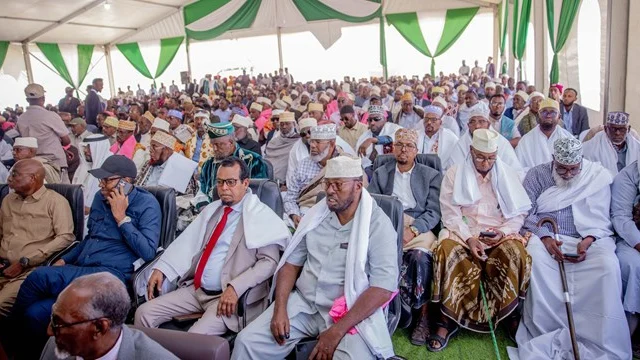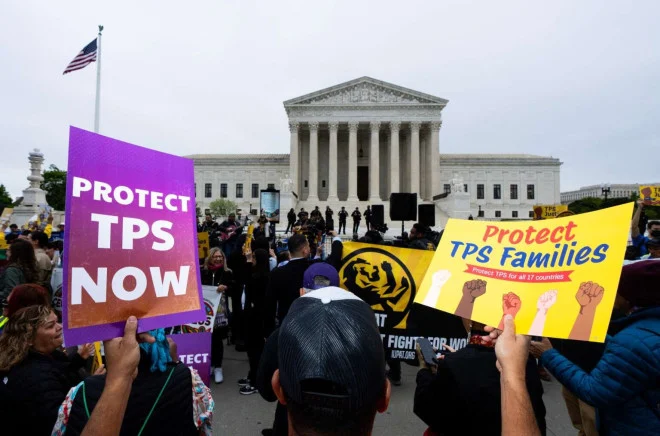
Thousands of Somali immigrants face the possibility of detention, deportation, lost work authorization and family separation after a Massachusetts federal judge cleared the way for the government to end Somalia’s temporary protected status (TPS) designation.
Judge Allison D. Burroughs lifted an administrative stay on August 14, ending a court-ordered pause that had blocked the termination. The decision followed months of litigation and leaves Somali TPS holders with immediate uncertainty about their ability to remain and work legally in the United States.
- Advertisement -
The government first announced the termination on January 13, 2026. Then-Secretary of Homeland Security Kristi Noem allowed only 60 days before the designation was set to expire, arguing that “country conditions in Somalia have improved to the point that it no longer meets the law’s requirement for Temporary Protected Status … allowing Somali nationals to remain temporarily in the United States is contrary to our national interest. We are putting Americans first.”
The announcement came in the middle of winter, after months of racist rhetoric from the Trump administration directed at Somali people and as “Operation Metro Surge” intensified in Minnesota. The sweeping immigration crackdown prompted weeks of protests and confrontations between residents and federal agents and included the agent-perpetrated killings of Renée Good and Alex Pretti.
In March 2026, a class-action lawsuit challenged the government’s decision, arguing that the termination was unlawful and asking the court to preserve TPS while the case moved forward.
On March 13, a federal district court in Boston granted an administrative stay, temporarily preventing the termination from taking effect. That protection did not last. The Supreme Court’s June 2026 ruling in Mullin v. Doe, which addressed the Trump administration’s termination of TPS for Haitian and Syrian nationals, fundamentally altered the legal options available to TPS holders across the country.
In a 6-3 decision, Muslim Advocates said, the court held that federal courts “no longer have the power to review non-constitutional arguments challenging a proper decision to end TPS for a specific country.” The ruling significantly narrowed lower courts’ authority to halt TPS terminations, threatening existing stays, including Somalia’s, and clearing the way for more than 350,000 Haitians and 6,000 Syrians to lose legal status and permission to work in the United States.
The Trump Administration’s Assault on TPS
Congress created TPS under the Immigration Act of 1990 with overwhelming bipartisan backing. The humanitarian program shields nationals of designated countries from deportation and provides work authorization for six- to 18-month periods. It does not, however, create a route to permanent residency or citizenship. A country may receive TPS when it faces continuing armed conflict, an environmental disaster or other extraordinary and temporary conditions. Before each designation period ends, the Department of Homeland Security must assess conditions and decide whether to extend or terminate the protection.
Somalia has held TPS since 1991, after the Somali civil war and the prolonged instability that followed. At the end of 2025, an estimated 1,082 Somali nationals held TPS, while another 1,383 had applications pending. They now face the loss of legal safeguards and little clarity over their next steps.
Sadaf Hasan, an attorney with Muslim Advocates, one of the groups representing the plaintiffs, told Truthout that ending Somalia’s designation fits within the Trump administration’s broader “mass deportation and detention agenda.” The administration has terminated TPS designations for 13 countries, effectively dismantling much of the program and affecting more than a million people.
Hasan said the Somalia case is also marked by racist rhetoric from the highest levels of government. The combination of “anti-Muslim, anti-Black statements” and attacks on the Somali community in Minnesota, she said, points to intentional discrimination in violation of the Fifth Amendment’s Due Process Clause, which bars discrimination by the federal government.
“Painting people from predominantly Muslim-majority countries as a national security threat is a pretext for the true underlying reason — racial animus,” Hasan said. The plaintiffs pointed to the administration’s “hateful, racist, xenophobic rhetoric” about Somalis, its expressed preference for white European immigrants and a series of policies disproportionately affecting African and Muslim-majority nations. Those policies included limits on asylum applications, visa restrictions and expedited deportation proceedings, which the plaintiffs cited as evidence of discrimination based on race and national origin.
In her August 14 decision, Burroughs recognized the administration’s “undisguised racial animus.” She wrote that there was compelling evidence “Somalia and its people are being targeted,” but said the Supreme Court’s ruling in Mullin v. Doe bound her to reject a similar racial discrimination claim in the Haiti TPS case.
The Supreme Court’s conclusion that “the administration’s larger agenda of terminating the TPS program offers an alternative, race-neutral explanation that undercuts claims of racial discrimination” creates a formidable obstacle for the plaintiffs’ equal protection argument, Nargis Aslami, another Muslim Advocates attorney, told Truthout. Because the administration has openly opposed TPS and sought to end designations for several countries, the court reasoned that individual terminations could reflect a broader effort to dismantle the program rather than discriminatory intent.
Hasan said the ruling compounds an ongoing injustice. “[The Somali] community has been smeared by this administration. It has been criminalized … called ‘gang members,’ and ‘animals,’ and ‘pirates’ and every racial stereotype you can think of … Even Trump saying, ‘I don’t want them [Somali people] in our country’ is being called race-neutral when it is clearly and blatantly discriminatory.”
The Stories Behind the Statistics
Nils Kinuani, federal policy manager at African Communities Together (ACT), an organizational plaintiff in the case, said his office has received calls from people who do not know how to respond. “When you’re stripped of TPS status, you’re immediately vulnerable to deportation and lose your work authorization. The impact is significant.”
“There are people who are considering self-deporting,” he told Truthout. “The big question is: How can people support their families? Rent, food, child care — those are the big concerns.”
ACT is advising TPS holders to speak with immigration attorneys who can determine whether they qualify for another form of legal status.
Kinuani said many people hesitate to discuss their circumstances publicly because they already feel targeted. “We all need to understand the impact of these terminations. Just because you’re not hearing much about it doesn’t mean no one’s being impacted.”
“We all need to understand the impact of these terminations. Just because you’re not hearing much about it doesn’t mean no one’s being impacted.”
The stakes extend beyond the legal status of individual immigrants. The four Somali plaintiffs have spent years living and working in the United States. Alexander Doe’s schooling in Somalia was interrupted by armed conflict, and he is now pursuing two associate degrees. Mohamed Doe and his wife are preparing for the birth of their first child. Tyson Doe works as a cherished elementary school teacher. Nina Doe initially arrived in the United States as a foreign exchange student and later returned to build a career in early childhood education, inspired by the opportunities her own education provided.
Somalia’s chronic instability has made its TPS designation one of the program’s longest-running. The label “temporary” fails to capture the enduring lives people have created under its protection or the depth of their ties to the United States.
Layla, a pseudonym she uses to protect her identity, has lived in the United States for more than 20 years. “Somalia may be where my origins are, but this is my home,” she told Truthout. “This is the country where I got married. This is where I had my kids. This is my community.” She spoke of the neighborhood park where her young children play, their elementary school, where she volunteers as a parent, and the grocery store she visits so often that clerks know her by name and ask about her family.
Since learning of the termination, she has not left her home. “I’m too scared to even walk to the mailbox,” Layla said. She fears that no one would be able to care for her children if she were deported. She also questions how she could rebuild her life in a country where she has few memories and even fewer relatives.
The Trump administration says conditions in Somalia have improved enough for TPS holders to return safely. Yet the State Department continues to issue Somalia a Level 4 travel advisory, its highest warning, urging Americans not to travel there because of crime, unrest, kidnapping, terrorism and other security threats.
That contradiction, Hasan said, “shows the dehumanization of the Somali community.”
ACT is working to help affected immigrants “navigate their new day-to-day reality,” Kinuani told Truthout, by sharing updates and connecting people with resources. The group also plans to continue its efforts in court and before Congress. “We are talking to members of Congress and reminding them that the community members who are affected by this decision are their constituents,” Kinuani said.
The word “temporary” obscures the permanence of the lives that have been built under its banner, and just how deep those roots run.
Aslami said Muslim Advocates filed a notice of appeal on the same day the termination decision was issued. Although the legal challenge continues in district and appellate courts, she said, “the law is not the only way to seek justice.” Since the first Trump administration, community activists and grassroots organizations have developed networks of awareness, solidarity and political power. People continue to circulate advice for encounters with federal immigration agents, help families prepare safety plans, urge elected officials to create a permanent solution for TPS holders, promise to defend friends and neighbors, and amplify immigrant and refugee voices over the dehumanizing rhetoric driving the administration’s anti-immigrant agenda.
For now, people like Layla are left to assess their choices while awaiting further action from the courts.
The experience of Haitian TPS holders offers a stark indication of what Somali immigrants could face. Since Haiti’s designation ended in June, more than 300,000 Haitian immigrants have lost protected status. In Springfield, Ohio, some Haitian immigrants were ordered to attend in-person appointments with the Department of Homeland Security and were fitted with ankle monitors. More recently, the first deportation flight since the termination arrived in Cap-Haïtien carrying 160 Haitian nationals.
“The Trump administration is sowing chaos and fear to effectuate its mass deportation agenda,” Hasan told Truthout. “This is cruel.”
As Layla and thousands of other TPS holders around the world wait in uncertainty, the consequences of the policy are becoming impossible to separate from the fear and upheaval it has created.
_______________________________
Jamila OsmanJamila Osman is a Somali writer from Portland, Oregon.