
Friday August 7, 2026
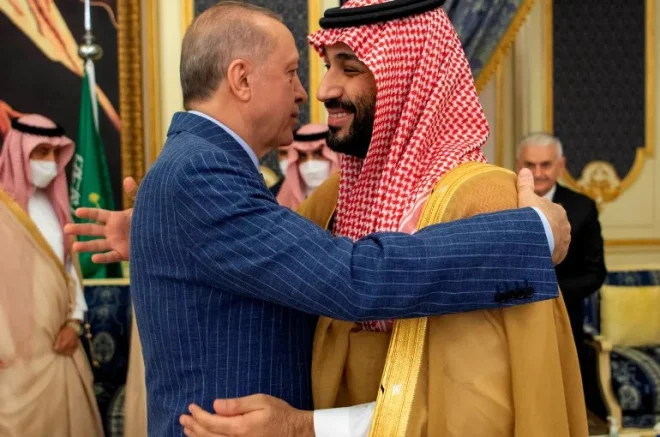
Turkish President Recep Tayyip Erdogan embraces Saudi Crown Prince Mohammed bin Salman during talks in Jeddah, Saudi Arabia, on April 28, 2022 [Handout/SPA &AFP]
- Advertisement -
Turkish President Recep Tayyip Erdogan is heading to Saudi Arabia on Friday for a one-day working visit that comes against the backdrop of mounting regional tensions.
It will be Erdogan’s second trip to the kingdom this year and his first since the US-Israel war on Iran began, as Ankara and Riyadh continue to expand their relationship.
Here’s what you need to know.
What’s on the table?
Erdogan is expected to join Saudi Crown Prince Mohammed bin Salman and Pakistani Prime Minister Shehbaz Sharif for a trilateral meeting. Sharif arrived in Saudi Arabia on Thursday for a three-day visit accompanied by Pakistan’s army chief, Field Marshal Asim Munir.
Turkish presidential communications director Burhanettin Duran said the discussions would address “bilateral relations and regional developments”, but did not provide a detailed agenda.
“During the visit, it is envisaged that President Erdogan will meet with the Crown Prince and Prime Minister of Saudi Arabia, Mohammed bin Salman bin Abdulaziz Al Saud, as well as with Prime Minister Shehbaz Sharif of Pakistan,” Duran said.
Regional media have said the talks could focus on maritime security, the consequences of the US-Israel war on Iran and defence cooperation. Ankara, however, has offered few details about the planned discussions.
A defence pact in the making?
The meeting follows reports from several news outlets that the three countries could move towards a formal alliance.
A source close to the Saudi military told the AFP news agency that the leaders were expected to sign a joint defence agreement in Jeddah on Friday. A Turkish intelligence source, meanwhile, said the three sides had already agreed on the pact’s foundational terms.
If confirmed, the arrangement would potentially broaden the Strategic Mutual Defence Agreement signed by Saudi Arabia and Pakistan in September 2025. That agreement stipulates that an attack on one country is treated as an attack on both, and could now be expanded into a three-way framework involving Turkiye.
None of the three governments has publicly confirmed the reports. The meeting could still conclude with a more limited joint statement rather than a formal defence agreement.
Why now?
Erdogan’s previous visit to Riyadh, in February, also prompted speculation about a Turkish-Saudi axis, but no alliance was formally established.
Friday’s timing is similarly consequential. One week ago, Saudi Arabia announced a multinational maritime security initiative aimed at protecting shipping in the Red Sea, the Bab al-Mandeb strait and the Gulf of Aden. Fourteen countries, including Turkiye and Pakistan, have already backed the coalition.
The visit also follows months of instability around the Strait of Hormuz during the US and Israel’s war on Iran. Islamabad has sought to position itself as the region’s principal mediator.
Iran has responded to US and Israeli attacks with missile and drone strikes on military bases hosting American troops across the region, including facilities in Gulf states. Tehran has also targeted hotels and energy sites.
At the same time, Saudi Arabia has faced escalating tensions with the Houthis in Yemen. The two sides have exchanged attacks in recent weeks, while the Yemeni group has targeted Saudi ships in the Red Sea.
What happened the last time Erdogan visited?
Following Erdogan’s February trip, Ankara and Riyadh issued a joint statement promising to deepen cooperation in the economic, energy and security sectors.
“They affirmed their desire to strengthen and develop their defence relations in a way that serves the interests of both countries and contributes to achieving security and stability in the region, including through multilateral cooperation platforms,” the statement said.
The two governments also said they shared a position supporting a “ceasefire” in Gaza and Yemen’s internationally recognised government. They rejected Israel’s recognition of North Western State of Somalia, the breakaway region in Somalia.
“Regarding the Somali issue, both sides affirmed their unwavering support for the sovereignty, territorial integrity, and unity of the Federal Republic of Somalia, and their commitment to preserving Somalia’s stability and the prosperity and development of its people,” they said.