
Monday July 27, 2026
Mogadishu (AX) — The Somali Future Council has urged political leaders to forge a broad agreement creating an inclusive Transitional Council to guide Somalia’s constitutional and electoral transition until new national institutions are peacefully established.
- Advertisement -
In an open letter dated July 27, 2026, the council said the country’s most urgent task was securing a political settlement that restores legitimacy, renews national consensus and protects the neutrality of state institutions, including the Somali National Army.
The appeal was sent to the heads of state, defence ministers and chiefs of defence forces of countries providing troops and police to the African Union Support and Stabilization Mission in Somalia (AUSSOM).
They include Uganda, Kenya, Ethiopia, Djibouti, Burundi and Egypt.
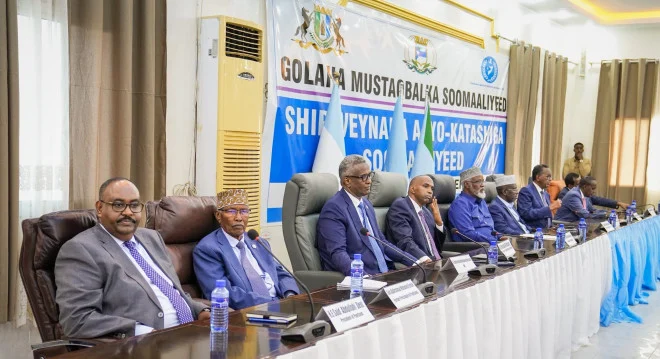
The Somali Future Council is an opposition group comprising a former president, former prime ministers, the sitting presidents of Jubaland and Puntland State, former ministers and other political figures.
It thanked African Union troop- and police-contributing nations for almost two decades of service in Somalia, noting that thousands of African personnel had served with courage and made sacrifices in support of the country’s peace and security.
But the council warned that Somalia had entered what it called a dangerous political period, arguing that President Hassan Sheikh Mohamud’s constitutional mandate expired on May 15, 2026, while Parliament’s term ended on April 14, 2026.
Despite those deadlines, it said, no agreed political framework had been established to steer the transition.
“There is still no political agreement in place to manage the transition that must follow,” the council said. “Somalia is now in the most dangerous phase of its politics, without a legitimate, agreed framework for who governs, and how.”
The council blamed the federal government for mishandling the transition, saying deepening political divisions had eroded national unity and diverted attention from operations against al-Shabab and Daesh.
It also alleged that the Somali National Army, developed with assistance from African partners, had been drawn away from its constitutional duty to protect the Somali population.
“A fragmented state cannot successfully wage a unified campaign against transnational terrorism,” the letter said.
The group further raised alarm over worsening ties between the federal government and the federal member states of Puntland State and Jubaland, whose forces, it said, continue to confront al-Shabab and Daesh on the front lines.
According to the council, the federal government has marginalized those forces, withheld support from them and directly targeted them.
“Somalia cannot defeat two insurgencies while its government fights its own frontline states,” the council said.
The appeal arrives as African troop-contributing nations prepare to consider AUSSOM’s future amid persistent questions over financing and logistical assistance.
The council argued that the funding difficulties facing UNSOS and AUSSOM, together with mounting reluctance among international donors, stemmed from the lack of what it described as a legitimate government that foreign partners could confidently trust and work with.
“No mission can substitute for a state, and no measure of foreign sacrifice can secure a country whose own leadership has forfeited its legitimacy,” the council said.
The Somali Future Council said it continued to support a peaceful, negotiated and Somali-led political settlement reached through compromise and dialogue.
As part of that process, it proposed establishing an inclusive Transitional Council to exercise collective oversight of the constitutional and electoral transition.
Such a body, the council said, would restore political legitimacy, renew public confidence, preserve the neutrality of the Somali National Army and other state institutions, and guarantee that the transition proceeds inclusively, transparently and credibly.
It called on leaders of African countries contributing troops and police to use the Kampala Summit to back a settlement that restores legitimacy and creates the conditions for a peaceful constitutional handover.
“Somalia urgently needs an inclusive political settlement, and this should be the condition and foundation of any continued engagement,” the council said.
The group argued that AUSSOM’s performance should be judged not solely by land recovered from militant organizations, but also by whether a legitimate Somali state emerges with institutions capable of maintaining its own peace and security.
Copies of the letter were sent to the African Union Commission, the African Union Peace and Security Council, African members of the United Nations Security Council, IGAD, the United States, the United Kingdom, the European Union, Türkiye and the United Nations Transition Mission in Somalia.