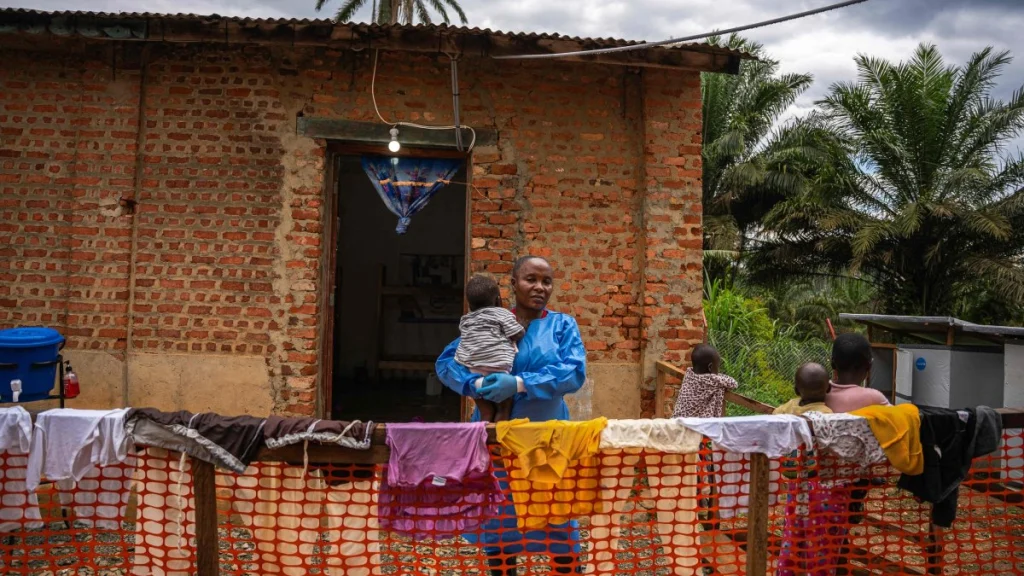
A baby fed by bottle in the arms of a caregiver in a protective gown and gloves is among hundreds of children orphaned by the Democratic Republic of Congo’s Ebola epidemic.
Five months after the outbreak began, the virus is still spreading. In the country’s remote east, the UNICEF-supported nursery in Mongbwalu is one of 12 facilities caring for children whose parents have died from the highly contagious disease.
- Advertisement -
“Many children have lost both their father and mother because of Ebola,” Marie Bakikula, a caregiver at the nursery, told Agence France-Presse (AFP).
Mongbwalu, a mining town in Ituri province near the Ugandan border, is regarded as the epicenter of the outbreak.
Children represent roughly one-third of the deaths and more than a quarter of infections recorded in the crisis, which has surpassed 2,000 cases, according to UNICEF.
Not far from the nursery, workers dressed in white protective suits placed a child-sized coffin in the back of a pickup truck.
Some children survive the disease but are left without their families. Those brought to emergency nurseries have often watched their parents die and seen burial teams in protective clothing remove their bodies.
Others were separated from their families when infected parents were taken to Ebola treatment centers.
“They all believe that by coming here they will never see their parents again,” said Monique Ndjangosi, a psychologist at the Mongbwalu nursery.
Disinfected toys
Inside a nearby room, a young girl and three boys played with stuffed animals that had recently been disinfected with chlorine. Their mothers had tested positive for Ebola.
The children must remain under observation for 21 days — the disease’s incubation period — to determine whether they develop symptoms.
“One of them showed symptoms seven days after arriving and was admitted to the Ebola treatment center,” said Bakikula, who volunteered at the facility after surviving Ebola herself.
Marie Bakikula, a caregiver at a UNICEF-supported nursery in Mongbwalu, poses for a photograph, Mongbwalu, DRC, Oct. 10, 2026. (AFP Photo)
For many of the children, photographs and videos recorded by health care workers are the only way to maintain contact with infected parents.
“We cannot take them inside the treatment center to visit their parents. It’s too risky,” Ndjangosi said.
Unidentified children
Child protection teams sometimes manage to locate relatives — including members of a child’s extended family — willing to take in children orphaned by Ebola. In other cases, no relatives can be found.
“We still have children we have not been able to identify because they are too young and their parents arrived in a coma,” said Celine Lusinde, head of provincial child protection services.
Her office has recorded 8,200 newly orphaned children since the outbreak began.
Marie-Therese Tsesi, a 63-year-old nurse, has opened her modest mud-brick home near Mongbwalu hospital to five children orphaned by Ebola.
“Their father was the only parent they had left. He died of Ebola,” she said.
“They were sleeping outside and showing signs of malnutrition.”
Thousands killed
The current epidemic is the Democratic Republic of Congo’s 17th Ebola outbreak. It quickly became the country’s deadliest on record and remains uncontrolled despite months of efforts to contain it. Cases have also been reported in Uganda, Kenya and Nigeria.
Ebola spreads through contact with bodily fluids and can cause severe hemorrhagic fever. According to the latest health authority figures, the outbreak has infected 9,704 people and killed 4,687 in the DRC, producing a fatality rate of nearly 50%.
A clinical trial is in progress, but no vaccine or specific treatment has been approved for the Bundibugyo strain responsible for the outbreak.
Health authorities continue to struggle with shortages of resources. Insecurity caused by armed groups in Ituri province, the region hardest hit by the epidemic, has also made some communities inaccessible.
Many deaths that occur outside medical facilities are believed to go unreported.