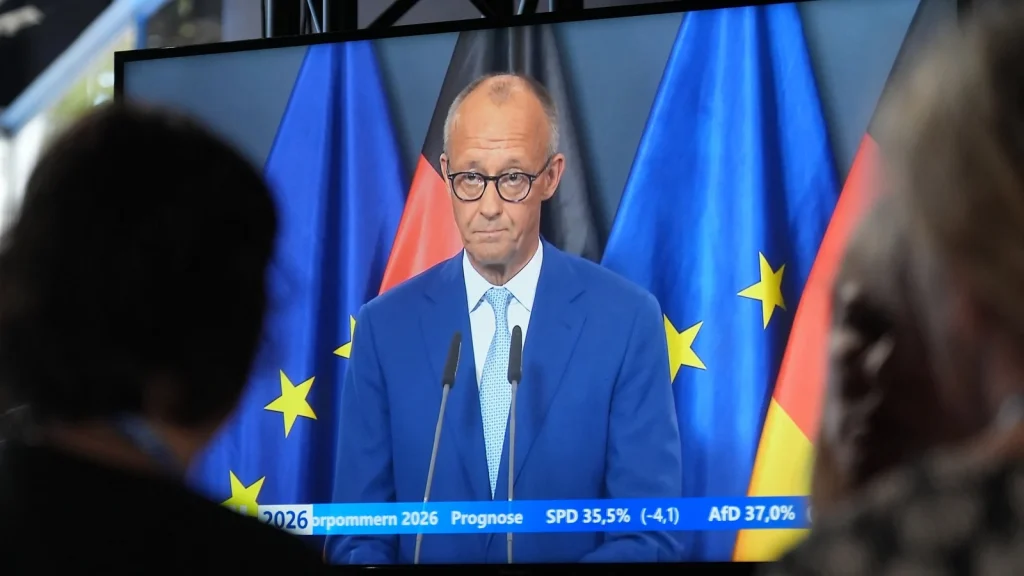
Germany’s far-right Alternative for Germany (AfD) finished first in state elections in the country’s northeast, exit polls showed, handing Chancellor Friedrich Merz’s conservative party its worst result since 1949.
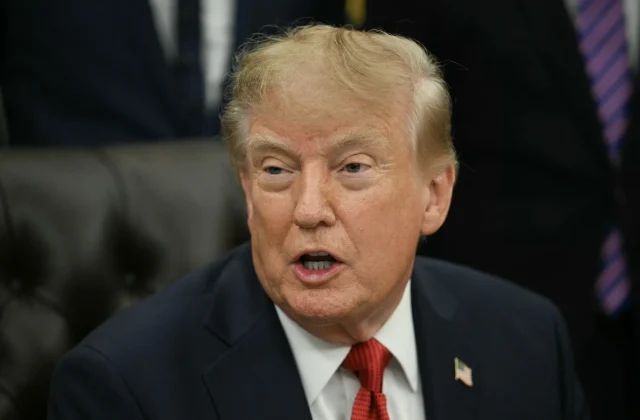
“It’s a disaster,” Mr Merz said after the projections were released. He nevertheless signalled that he would remain in office and press ahead with his reform programme, seeking to quell speculation that a poor showing could force his resignation.
- Advertisement -
The AfD was projected to take 37% of the vote in Mecklenburg-Western Pomerania, narrowly ahead of the centre-left Social Democrats (SPD) on 35.5%. Mr Merz’s conservatives secured just 5.5%, barely clearing the threshold for representation in the state parliament, according to exit polls broadcast by public broadcaster ARD.
The result appeared likely to give the AfD another first-place finish at state level within a month. The party leads national opinion polls but remains shut out of government because Germany’s other major parties refuse to cooperate with it.
Co-leader of AfD Alice Weidel (C) and AfD top candidate for Berlin Kristin Brinker (L) celebrate results
The AfD also strengthened its position in Berlin, where it reached 16%.
For the first time, the Linke, or Left party, topped the polls in the state. It campaigned on nationalising homes owned by corporate landlords and placing a cap on rents.
Merz vows to continue with reforms
The results may not deliver a decisive blow to Mr Merz.
Yet his weak approval ratings, contentious reforms and the AfD’s victory in the earlier state election in Saxony-Anhalt have intensified questions about his political future.
Manuela Schwesig, the popular SPD premier of Mecklenburg-Western Pomerania, had improved her standing in the polls before voting by directly attacking both the AfD and reforms introduced by the Merz-led federal government.
Ms Schwesig also said the AfD had benefited from opposition to Germany’s backing for Ukraine.
She had previously supported the Nord Stream pipeline, which carried Russian gas through her state into Germany, before the infrastructure was destroyed in explosions in 2022. She later reversed her position.
“First, in my state, many people oppose support for Ukraine, both financial and military,” she said.
“And a second point: many people also wish to see energy flowing through Nord Stream again.”
Vice Chancellor Lars Klingbeil, who also leads the SPD, suggested the government needed to adjust course and highlighted voters’ concerns about pension reforms.
Manuela Schwesig said the AfD had won votes by criticising Germany’s support for Ukraine
“As the federal government, we need to analyse why there is such great uncertainty in the country,” Mr Klingbeil told the ARD.
Mr Merz, however, defended his reform agenda, arguing that it is needed to revive growth in Europe’s largest economy after years of stagnation.
“What needs to be done now requires backbone, steadfastness, and patience,” he said.
“I would go so far as to say that these reforms are the antidote to the authoritarian poison that is penetrating ever deeper into our society, driven by the allure of authoritarianism.”
The votes in Mecklenburg-Western Pomerania, a largely rural former communist state, and Berlin’s capital city came after the 6 September election in Saxony-Anhalt. There, the AfD came close to achieving the rare feat of winning an absolute majority.
State elections in the two regions would normally attract limited attention beyond Germany. But the AfD’s performance in Saxony-Anhalt — which the party regards as an early step towards victory in the federal election scheduled for 2029 — has reverberated across Europe.
In little more than a decade, the party has moved from the margins of German politics to become the country’s most popular political force. It calls for tougher action to deport foreigners without the right to remain, restoring energy ties with Russia and abandoning the euro.
The exit polls highlight the AfD’s rapid gains and renew debate over Germany’s political “firewall”, the policy under which the other main parties refuse to form coalition agreements with it.
Merz has struggled
Mr Merz was elected last year after promising reforms to bring Germany’s stagnant economy back to growth. Since then, he has struggled to win public support, with unpopular pension, tax and healthcare measures compounded by a series of communication missteps.
Discontent with his government shaped campaigning in both Mecklenburg-Western Pomerania and Berlin, where voters focused heavily on rising energy bills and housing costs.
On Friday, Mr Merz unveiled a package aimed at easing pressure on consumers, including tax reductions on gas and diesel.
Several voters in Mecklenburg-Western Pomerania said the cost of living was among their main concerns.
“Here in Schwerin, with these wages, you can hardly afford anything anymore,” Carlotta Heick, a voter in the state capital, told Reuters.
An elderly man criticised spending on foreign aid. “We need our money here, for our country, for children and pensioners,” he said, declining to give his name.