
OP-ED | Southwest Somalia: A Political Crisis Sliding Toward Civil War
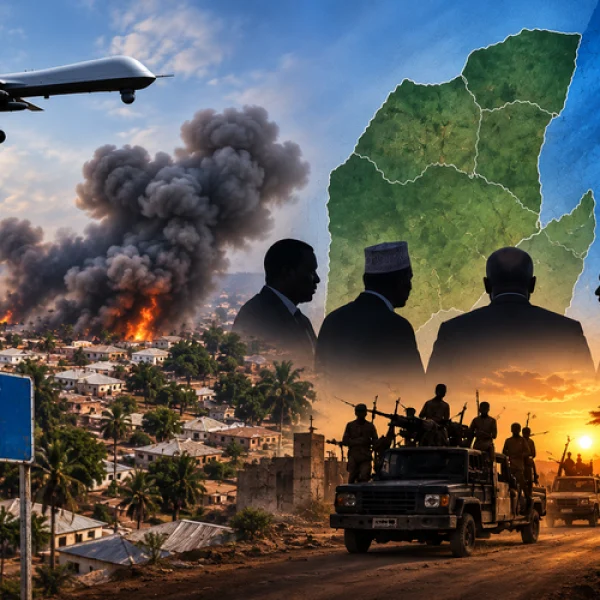
OP-ED | The drone strike in Dolow has exposed how quickly political rivalry in Southwest Somalia is becoming an armed conflict with consequences far beyond one target or one town.
- Advertisement -
Four points demand attention. First, political competition is moving toward a manufactured civil war. Second, successive federal leaders have weakened both Southwest and Somalia’s federal system by manipulating the state for short-term political advantage. Third, Dolow represents a perilous escalation: military force, apparently provided by an outside partner, has entered an internal political struggle. Finally, responsible voices in Southwest must recognize the danger — their communities are being divided, armed and used as instruments in battles driven by others.
Southwest entered this crisis already vulnerable. Al-Shabaab controls or contests large parts of the countryside, while the state’s lack of independent revenue leaves it heavily reliant on Mogadishu. Rather than strengthen institutions capable of preserving the state’s cohesion, successive federal presidents have exploited that dependence.
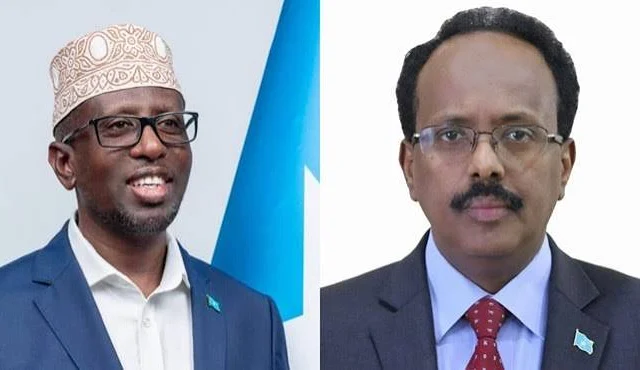
In 2018, the government of President Farmaajo removed Sharif Hassan Sheikh Aden, detained presidential candidate Mukhtar Robow and, with backing from the Ethiopian military, effectively installed Abdiaziz Laftagareen.
Seven years on, the pattern is returning with the alliances reversed. President Hassan Sheikh Mohamud initially allowed Laftagareen to remain in office beyond the end of his term, but later turned against him. Former speaker Aden Madobe — a key figure in securing Mohamud’s term extension and constitutional changes — has now become Mogadishu’s preferred candidate.
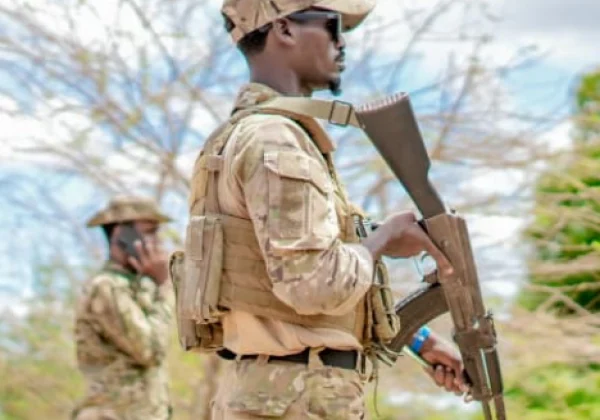
Laftagareen has shown no willingness to depart quietly. Forces linked to his camp have attacked Baidoa, while clans are increasingly being pulled into the confrontation. At that point, federal political maneuvering ceases to be a political game: it fractures a federal state and damages the federation as a whole.
Then came Dolow.
A drone struck the residence of Gen. Mahad Abdirahman Aden, known as Gen. Shub, an ally of Laftagareen, injuring him. Shub, who is Laftagareen’s father-in-law, had pledged to block Madobe from governing Southwest.
The central questions now are who operated the drone and, more importantly, who requested and authorized the strike.
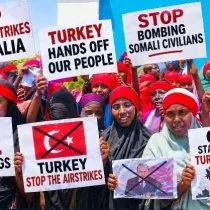
Somalia, Türkiye and the United States operate armed drones in Somalia. Supporters of Laftagareen and opposition figures have accused Türkiye of being used in an attempt to eliminate Hassan Sheikh Mohamud’s political rival, although Türkiye has not commented publicly. The federal government says explosives were being manufactured at the residence. The debris may provide further answers.
Even if the government believed Shub was directing an armed insurgency, it had other options: he could have been charged and authorities could have sought his arrest. Sending a drone into a residence, as appears to have happened, accepts the risk of killing anyone nearby — relatives, guards, neighbours or other civilians.
That disregard for human life is the hallmark of what Al-Shabaab does when it bombs a location indiscriminately because a wanted target might be present. Those responsible for the Dolow attack must be identified and held accountable.
This is the moment for Southwest to think clearly, especially its responsible politicians, elders, academics, business leaders and civil society representatives.
The Digil and Mirifle, historically among Somalia’s most cohesive clan families, are being split into armed factions that will leave all sides weaker, regardless of who prevails. No sub-clan can defeat the others, and no politician can build a stable Southwest by asking outsiders to send money, troops or drones against fellow Somalis.
Bay and Bakool have already endured too much — famine, displacement and Al-Shabaab’s violence. Their communities must remain united, and their disputes must be brought back into the political arena before the conflict develops a momentum of its own.
Somalia has seen the consequences of such shortcuts before. In 1991, a struggle for power became a civil war; outside assistance was invited in, and Somalia was subsequently left without a functioning government for more than a decade. More than three decades later, the state remains fragile.
Politicians pursuing narrow, short-term solutions should remember that those who open the door to civil war rarely control how far it spreads — or the cost they and everyone else will ultimately bear.
By: Abdirashid Hashi | Analyst, Researcher and Former Minister
Abdirashid Hashi is an analyst and researcher. The views expressed in this article are those of the author.