
South West Conflict: Baidoa Fighting Puts President Hassan Sheikh’s Political Responsibility Under Scrutiny
Analysis
- Advertisement -
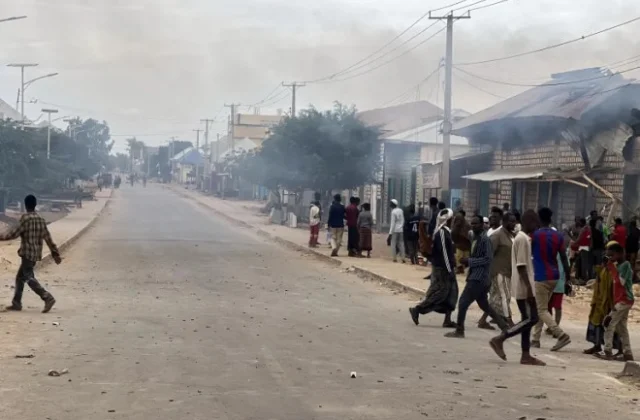
BAIDOA, Somalia — The latest violence in Baidoa has turned Somalia’s political confrontation with South West State into an armed crisis, putting civilians at risk while threatening the country’s federal arrangement and its struggle against Al-Shabaab.
At least four civilians died in the most recent clashes and 98 others were injured, an official at Bay Regional Hospital said. The wounded included 28 women and an elderly man hit by a stray bullet. The Federal Government claimed that nearly 30 members of the forces that attacked the city were killed, though that figure has not been independently confirmed.
The bloodshed was not a stand-alone security incident. It followed Villa Somalia’s decision to use military force in a political and electoral dispute that, at least initially, could have been addressed through negotiations.
Federal forces seized Baidoa on March 30, prompting Abdiaziz Hassan Mohamed Laftagareen to announce his resignation before leaving the city. He later insisted that he remained the lawful president of South West State.
The Federal Government, whose mandate has expired under the four-year timetable set by the 2012 Provisional Constitution, described the takeover as a restoration of constitutional order. Laftagareen and his allies called it a coup that overthrew an elected administration.
After the takeover, Sheikh Aden Mohamed Nur Madobe was declared president of South West State on June 10, having won 88 of the 90 votes cast.
President Hassan Sheikh Mohamud and his political allies portrayed the election as part of a move towards universal suffrage under Somalia’s controversially amended Constitution. Opponents of Aden Madobe, however, said the vote had been structured to deliver a predetermined result.
Villa Somalia consequently achieved its immediate objectives: it captured Baidoa, removed Laftagareen and installed an administration it supports. It did not, however, produce a political agreement accepted by South West State’s rival factions.
An electoral and constitutional dispute has therefore escalated into a conflict in which both civilians and soldiers are losing their lives.
Baidoa’s past returns to the political battlefield
The current confrontation echoes the events of 1995, when the Rahanweyn Resistance Army, or RRA, was created.
After Somalia’s central government collapsed in 1991, armed factions battled for control of the agricultural areas between the Jubba and Shabelle rivers. Farms were looted, livestock was seized, food supplies were interrupted and entire communities were displaced.
Human rights organisations said the destruction and plunder of farming communities played a significant role in the devastating famine that later struck southern Somalia. Baidoa became known internationally as the “City of Death.”
In March 1995, Digil and Mirifle leaders formed a local administration called the Digil–Mirifle Supreme Governing Council.
On September 17, 1995, forces loyal to warlord General Mohamed Farah Aidid captured Baidoa and ousted the local administration. Aidid’s forces were the area’s dominant military power, and they used that advantage to decide who would govern the city.
On October 13, 1995, less than a month later, elders, politicians, intellectuals and former military officers met at Jhaffey, west of Baidoa, to establish the Rahanweyn Resistance Army.
Colonel Hassan Mohamed Nur Shatigadud became its chairman. Sheikh Aden Madobe and Mohamed Ibrahim Habsade joined the organisation’s senior leadership.
The RRA’s founding principle was resistance to the idea that a force with superior military strength could occupy local territory, remove its administration and dictate its political future.
The organisation recaptured Hudur in 1998 and Baidoa on June 6, 1999. General Aidid had been killed in 1996, and the forces driven from the city were then under the command of his son, Hussein Mohamed Farah Aidid.
The RRA’s victory ultimately paved the way for the creation of an autonomous South West administration in 2002, with Baidoa as its capital.
That history carried a clear warning: military control of Baidoa did not by itself confer political legitimacy. Instead, it generated resistance.
A familiar political method under new conditions
The circumstances in 1995 and 2026 are different. Aidid was then a factional leader in a country without an effective central government. The forces now deployed in Baidoa formally serve in the Somali National Army and receive orders from a Federal Government whose mandate and constitutional legitimacy are themselves contested.
Yet the methods have troubling parallels. In both cases, a militarily stronger force entered Baidoa, displaced the existing leadership, took over state institutions and then organised a political process intended to legitimise the new order.
Whether a government is sustained by legitimacy or by coercion is ultimately determined by public acceptance, not by the number of soldiers guarding the presidential compound.
Aden Madobe and the irony of the RRA’s legacy
Aden Madobe’s involvement gives the present crisis an especially painful historical dimension.
He was one of the RRA figures who opposed an earlier seizure of Baidoa by a stronger military force that had removed the city’s administration. Three decades later, he became the principal political beneficiary of another military takeover of Baidoa.
The RRA itself split in 2002, with one faction led by Shatigadud and another controlled by his deputies, Aden Madobe and Mohamed Ibrahim Habsade.
Baidoa then became the scene of renewed fighting and changed hands repeatedly. Once again, civilians bore the cost of a power struggle among leaders of the former resistance movement.
That experience showed how swiftly a united organisation or community can divide into armed factions once its political consensus breaks down.
South West State now faces a comparable threat.
Where President Hassan Sheikh bears responsibility
The party that launches an attack, kills civilians or breaches the laws of war bears primary responsibility for those acts. But political responsibility for creating the conditions in which violence becomes possible does not belong only to whoever fires the first shot.
President Hassan Sheikh Mohamud was commander-in-chief of Somalia’s armed forces, head of the Federal Government and the leading proponent of the constitutional and electoral policies at the heart of the South West State dispute.
His administration could have pursued dialogue, mediation and an electoral arrangement accepted by the competing sides. Instead, it deployed federal forces to seize the capital of a federal member state locked in a political dispute with Villa Somalia.
President Hassan Sheikh cannot separate himself from the consequences of that decision.
If the violence spreads throughout South West State, if communities in Bay and Bakool arm themselves, if the civilian death toll rises or if Al-Shabaab exploits the divisions, the President will face questions about why military force was selected to settle a political disagreement.
He will also be asked why federal troops were dispatched to Baidoa while large parts of Somalia remain under Al-Shabaab’s control.
The Somali National Army was created to defend the Somali people and fight armed groups that threaten the country. Using it to shape an election in a federal member state risks eroding the trust of the very population the army is meant to protect.
The Federal Government alleged that Al-Shabaab members accompanied forces aligned with Laftagareen during the latest clashes. Officials from the South West administration led by Aden Madobe said they had recovered bodies and captured prisoners belonging to the group.
Those claims have not been independently verified. Even if Al-Shabaab fighters took advantage of the attack, however, the central political issue remains: who created the vacuum and divisions that enabled the organisation to enter the conflict?
“When leadership disputes are settled through military force, they create conditions that terrorist groups can exploit,” security analyst Samira Gaid told the Associated Press. “Somali civilians ultimately pay the price.”
Humanitarian consequences could deepen
Baidoa is home to a large population of internally displaced people who have fled drought, conflict and poverty. Its health facilities were already under pressure, facing shortages of beds, medicines and staff.
A Médecins Sans Frontières report issued in July found that acute malnutrition affected one in four children living in Baidoa’s displacement camps.
A drawn-out conflict could block humanitarian deliveries, cut supply routes, disrupt medical services and drive more families from their homes.
According to the United Nations refugee agency, political tensions and fears of violence had already displaced more than 50,000 people during March and early April.
The risks extend beyond Baidoa. If the confrontation develops into the mobilisation of armed communities, it could spread through other districts in Bay and Bakool before reaching Lower Shabelle and surrounding areas.
How a constitutional dispute became an armed conflict
The crisis in South West State forms part of a broader national dispute over Somalia’s Constitution and the mandates of federal institutions.
The four-year timetable in the 2012 Provisional Constitution indicated that President Hassan Sheikh’s mandate would end on May 15, 2026.
Villa Somalia maintains that constitutional amendments extending presidential and parliamentary terms to five years allow the current institutions to remain in office. Opposition groups, Puntland State, Jubaland and other political actors reject that position. They argue that the amendments were adopted without national consensus and cannot retroactively extend a mandate issued under the former constitutional framework.
Whatever the merits of those competing arguments, the Federal Government cannot derive legitimacy to deploy national forces to choose or remove the leaders of federal member states.
Villa Somalia says it is guiding Somalia towards universal suffrage. Yet the people of South West State were not given the opportunity to choose directly among Laftagareen, Aden Madobe and the other candidates.
Aden Madobe was chosen by a regional parliament functioning in a city occupied by federal troops after the previous administration had been removed. That sequence has strengthened suspicions that the electoral process was designed to validate an outcome first secured through military action.
The warning embedded in Baidoa’s history
The significance of 1995 is not that Aidid and today’s Federal Government operate in precisely the same circumstances. It is that the strongest military actor may seize Baidoa without winning the public acceptance needed to govern it.
Aidid captured the city, but his occupation helped produce the RRA, which eventually drove his forces out.
Villa Somalia captured Baidoa, removed Laftagareen and backed Aden Madobe’s election. Instead of stability, the takeover has been followed by armed resistance, civilian deaths, divisions among security forces and an opening for Al-Shabaab to exploit.
Another military offensive will not resolve the crisis. The immediate requirements are a ceasefire, an end to the use of federal forces in political contests, independent mediation led by South West elders and an inclusive political process.
Former Somali President Hassan Sheikh still has an opportunity to prevent the violence from spreading. But if he continues to replace political compromise with military force, accountability for the consequences will not stop with the commanders fighting in Baidoa.
It will reach Villa Somalia and the President who chose to use the national army to settle a political dispute.
GaROWE ONLINE