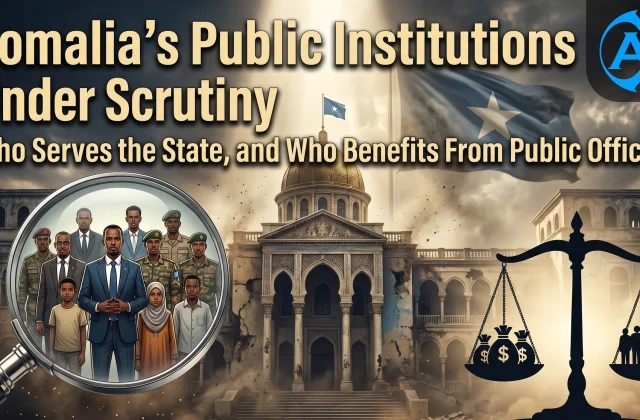

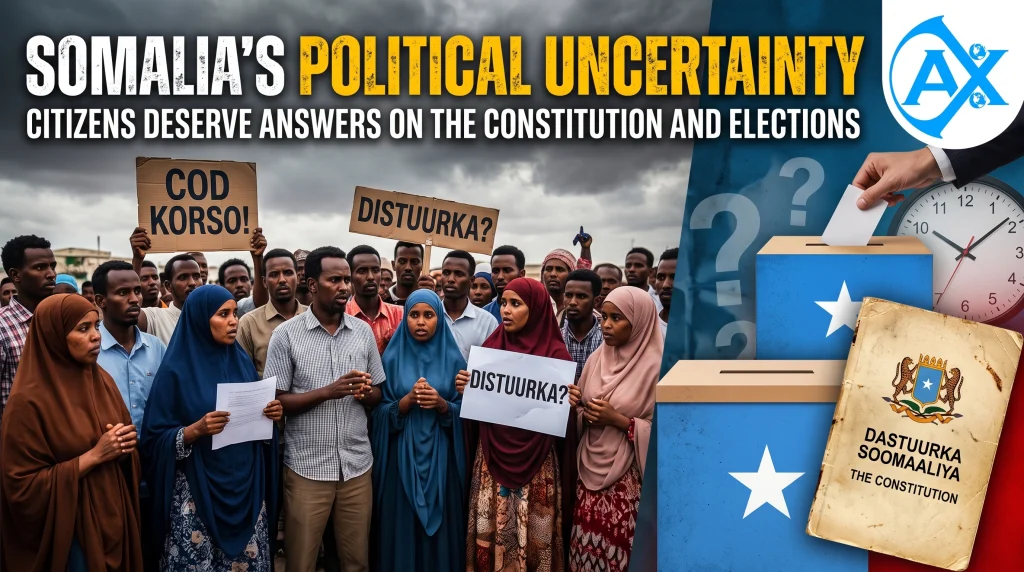
Constitutional disagreements, the 2027 election timetable and tensions between federal and regional leaders are raising important questions about transparency, political stability and accountability in Somalia.
Somalia’s political future depends not only on constitutional decisions and election announcements but also on the public’s ability to understand how those decisions are made. As disagreements continue over constitutional changes, electoral arrangements and relations between federal and regional authorities, citizens deserve clear explanations, transparent procedures and a credible path towards political stability.
- Advertisement -
For many Somalis, the central concern is straightforward: who is making decisions about the country’s future, how are those decisions being reached, and what do they mean for ordinary people?
These questions should not automatically be interpreted as evidence of wrongdoing. Rather, they reflect the importance of transparency and public accountability in a country working to strengthen its political institutions.
Constitutional reform and the challenge of political consensus
Constitutional reform remains one of the most consequential issues in Somali politics.
On 4 March 2026, Somalia’s parliament approved constitutional changes that prompted disagreement over their implications for institutional mandates and the electoral calendar. The government presented constitutional reform as part of its efforts to advance the country’s political and electoral development, while opposition figures questioned aspects of the changes and their potential consequences.
The disagreement highlights a fundamental challenge: constitutional reform requires more than parliamentary decisions. It also requires public understanding, clear legal procedures and sufficient political consensus to ensure that the resulting framework commands confidence.
Supporters and critics may disagree over the direction of reform. However, those disagreements should be addressed through constitutional processes, legal interpretation and political dialogue rather than confrontation.
The public should be able to access the relevant constitutional provisions, understand how they affect political institutions and establish which procedures will govern the country’s next elections.
Without clear explanations, even decisions presented as progress can become sources of mistrust.
The 2027 elections: Announcements must be followed by credible procedures
On 15 October 2026, Somalia’s electoral authorities announced a timetable under which parliamentary elections are scheduled for 15 April 2027 and the presidential election for 15 May 2027, according to Reuters.
The announcement provides a proposed timeline, but setting dates is only one part of organising a credible election.
Important questions remain about the electoral framework, participation, implementation and oversight. Political stakeholders must have a clear understanding of the applicable rules, while the public needs confidence that the process will be conducted transparently.
An election timetable can help reduce uncertainty, but its effectiveness depends on whether the institutions involved can implement it and whether political disagreements can be managed peacefully.
Federal authorities, opposition leaders and representatives of Somalia’s federal member states all have responsibilities in this process.
The government must explain its decisions and demonstrate how electoral arrangements will operate. Opposition groups should articulate their concerns and propose workable alternatives. Regional leaders should participate in efforts to resolve disputes through dialogue.
Ultimately, electoral legitimacy depends not simply on announcing a date but on establishing a process that citizens and political stakeholders can understand and scrutinise.
Political disputes must not come at the expense of civilians
Political disagreements have consequences beyond parliamentary debates and negotiations between political leaders.
The clashes reported in Baidoa on 17 August 2026 illustrated how political tensions can escalate into armed confrontation, with deaths and civilian injuries reported by Reuters.
Such incidents underline the importance of preventing political competition from becoming a threat to public safety.
Citizens need security, functioning schools, access to healthcare and reliable public services regardless of which political actors are in disagreement.
When political disputes disrupt daily life, ordinary people bear consequences they often have little power to influence.
All parties with political or military responsibilities must prioritise civilian protection, avoid unnecessary escalation and pursue peaceful mechanisms for resolving disputes.
Political differences are an unavoidable feature of public life. Violence, however, should not become an accepted means of settling them.
Regional rivalries and Somalia’s national interests
Somalia’s internal political challenges also exist within a wider regional environment.
In an analysis published on 16 October 2026, Chatham House warned that competition among external powers could deepen Somalia’s internal political crisis.
Such assessments highlight the importance of understanding how regional interests interact with domestic political divisions. However, analysis of external influence should be distinguished from claims that particular actors secretly control political decisions. Such allegations require evidence.
Somalia’s national interests are best served when major agreements, public commitments and government decisions are sufficiently transparent to allow meaningful scrutiny.
Clear communication can help citizens understand the reasoning behind government policy and assess whether decisions serve the country’s long-term interests.
National sovereignty is strengthened not only through diplomatic statements but also through institutions that can explain their decisions and demonstrate accountability.
What citizens have the right to ask
The issues surrounding constitutional reform and the election timetable raise several questions that deserve clear answers:
- What legal framework will govern the 2027 elections?
- How will disagreements between the federal government and federal member states be resolved?
- What safeguards will ensure transparency and accountability throughout the electoral process?
- How will civilians be protected if political tensions escalate?
- Where can citizens access information about public spending and major government decisions?
- What measures will protect essential services from disruption during periods of political disagreement?
These questions should not be dismissed as political hostility. Asking how public institutions operate is a legitimate part of civic participation.
Equally, questions must not be treated as proof of misconduct. Responsible public debate requires evidence, fair scrutiny and a willingness to distinguish established facts from speculation.
Accountability must extend to every political actor
The responsibility for improving public confidence does not rest with the government alone.
Government officials must explain their decisions, operate within the applicable legal framework and accept scrutiny of their performance.
Opposition leaders must offer credible alternatives, examine government policy constructively and reject violence as a political instrument.
Federal member-state leaders must also contribute to institutional cooperation and demonstrate accountability to the communities they govern.
Political leaders may have different priorities, but their responsibilities ultimately concern the same population.
Somalia’s political future cannot be secured through competing statements alone. It requires institutions that function predictably, transparent decision-making and mechanisms through which disagreements can be addressed peacefully.
The public deserves clarity, not speculation
Somalia’s constitutional and electoral debates will continue to attract strong opinions. That makes accurate information and responsible political discussion especially important.
When official explanations are incomplete or difficult to understand, uncertainty grows. Yet uncertainty itself is not evidence of a hidden conspiracy or deliberate wrongdoing.
The appropriate response is to seek documentation, request explanations and strengthen the institutions responsible for oversight.
Somalia’s citizens deserve to understand the decisions shaping their country’s future. They also deserve political leaders who recognise that public confidence must be earned through transparency, lawful conduct and measurable results.
The central question is not simply what political leaders intend to do. It is whether the public can understand, scrutinise and trust the process through which decisions are made.
This article is an edited adaptation of an opinion piece by Shuriye Omar Mohamud, originally published by SHAQO MEDIA.
Sources and further reading
- Original article — SHAQO MEDIA: What Remains Hidden May Be Greater — and the People Are Uncertain
- Reuters — Somalia’s constitutional changes, 5 March 2026
- Reuters — Somalia’s presidential election announcement, 15 October 2026
- Reuters — Federal troops and armed opposition clash in Baidoa, 17 August 2026
- Chatham House — Foreign rivalries and Somalia’s political crisis, 16 October 2026