
The war in the Middle East widened sharply as Iranian-backed Houthi forces in Yemen attacked several Saudi cities, pulling another US ally deeper into the conflict. At the same time, US forces struck multiple Iranian oil tankers and Iran launched an attack on a US base in Jordan.
The Houthis hit four cities in southern Saudi Arabia, injuring 73 people and igniting fires at oil facilities in what appeared to be the most significant expansion yet of the six-month-old war.
- Advertisement -
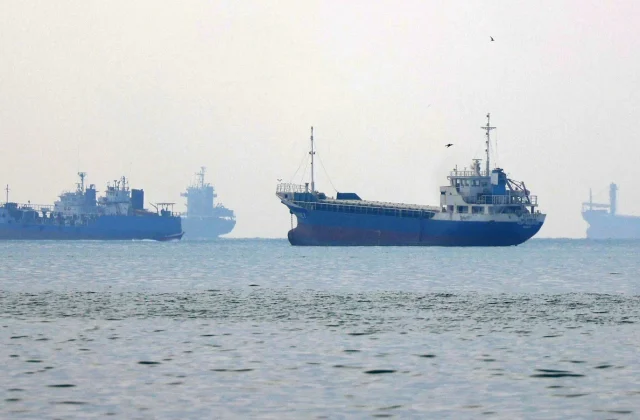
As global oil markets absorbed the news of the Saudi strikes, the US military’s Central Command said it had destroyed five Iranian crude carriers. It released video of the attacks, saying they were carried out after Iran’s Islamic Revolutionary Guard Corps twice targeted a US Navy warship with ballistic missiles over the preceding two days.
No Americans were injured, according to the United States.
“Iran continues to try to hit US naval ships and for every time they do that or try to do that, they’re going to lose tankers,” Mr Rubio told reporters during a visit to Colombia.
Iranian missiles are intercepted by Jordanian air defense systems above Damascus in Syria
Iran responded with a ballistic missile strike on a US base near the eastern Jordanian town of Al Azraq, according to a statement from the IRGC carried by state media.
Iranian state media released footage it said showed missiles being fired toward Jordan.
Iran claimed the attack caused heavy damage. Jordan, however, said its air defences intercepted 18 of the 20 missiles, while the other two landed in unpopulated areas. No casualties were reported.
Throughout the war, Iran has attacked US partners across the region, including Jordan on several occasions. One strike in July killed two US military personnel.
The IRGC also said it had attacked two US destroyers, state media reported.
The US military had not yet commented on those claims.
Iran further warned that oil tankers in ports in Kuwait and Bahrain could be targeted, according to a statement broadcast by state media.
A maritime security source said a liquefied natural gas tanker had been damaged at the Emirati port of Khor Fakkan, although responsibility for the incident remained unclear.
Brent crude oil remained below $100 per barrel, despite the disruptions
Following a month of relative calm in August, Iran and the US have resumed exchanging fire in recent days, sending benchmark Brent crude to its highest level since 23 July.
Even so, prices stayed below $100 (€85) a barrel despite the latest disruptions.
The conflict has followed a pattern of temporary lulls and sudden flare-ups. Iran remains capable of launching missile and drone attacks against neighbouring countries and threatening oil shipments through the Strait of Hormuz, even as US strikes have weakened much of its conventional military capacity and further strained its already struggling economy.
The Houthis, who hold most of Yemen’s populated territory, including the capital, have added pressure on US allies by periodically disrupting shipping on the Arabian Peninsula’s opposite side, near the entrance to the Red Sea.
Yesterday, the Houthis said they had carried out a wide-ranging operation deep inside Saudi Arabia. They claimed to have used drones and missiles against a Saudi airbase in the southern city of Khamis Mushait, along with assets belonging to the Saudi state oil company in Abha, Najran and Jazan.
NASA satellite images captured a dense plume of black smoke above the Jazan refinery and a tall column of white smoke rising from an oil distribution centre in Abha.
Saudi authorities confirmed fires at the sites and said women and children were among the 73 people wounded.
The unusually high number of reported injuries indicated that the attacks may have been among the largest against Saudi Arabia since the United States and Israel began their war against Iran in February.
Houthi attacks on southwestern Saudi Arabia have the potential to worsen the war’s global economic impact
The attacks came as Iranian tankers were struck, ending a two-day pause in US operations against Iran.
The United States said it had destroyed four IRGC crude carriers in the Gulf of Oman and a fifth close to the oil hub of Kharg Island. Iranian media had reported some of the strikes beforehand.
“American forces directed the crews to abandon ship before the vessels were struck and rendered inoperable,” the Central Command statement said.
By threatening energy infrastructure in southwestern Saudi Arabia, the Houthi attacks could deepen the war’s economic effects worldwide and disrupt Middle Eastern supplies beyond the area affected by the blockade of the Strait of Hormuz.
Saudi Arabia has spent more than a decade leading an Arab coalition fighting the Houthis in Yemen.
That conflict had eased in recent years, but the ceasefire has since collapsed.
In recent days, Saudi-backed Yemeni forces aligned with a government based in the south have launched a broad offensive against Houthi-held territory after the rebels attempted to push into government-controlled positions.
The government, which the Houthis forced out of the capital 12 years ago, has said it wants to retake all areas held by the group.
The broader Gulf conflict has become a high-stakes confrontation between the US and Iran, with both sides betting that competing economic blockades will eventually compel the other to back down.
The US Treasury yesterday announced fresh aviation-related sanctions, saying they were designed to ground Iranian airlines.
Washington is seeking to increase the volume of oil reaching global markets by directing ships through the Strait of Hormuz while using a blockade to restrict Iranian exports.
Central Command said the tankers destroyed by US forces belonged to a shadow network used to finance the IRGC and its regional allies.
Iran has for years backed what it calls an “Axis of Resistance”, a network that includes Hamas, Lebanon’s Hezbollah, Iraqi Shi’ite militias and the Houthis.
Iran’s Revolutionary Guards also claimed to have captured a US submersible near the strait.
A US official said an underwater drone had malfunctioned more than a day earlier and did not carry classified sonar or radar equipment.
CENTCOM spokesperson Captain Tim Hawkins did not say whether Iran had seized the device. He said: “An underwater drone operated by US forces malfunctioned more than a day ago.
“It was surveying regional waters in support of ongoing operations.”
He said the “defective drone was an older model that neither collected sensitive data nor carried any classified sonar or radar equipment”.
Iran’s Revolutionary Guards said they had seized a US underwater drone at the “entrance to the Strait of Hormuz in a complex intelligence and operational action”, calling it “one of the most modern, unmanned and smart submarines” operated by US forces.