Iran has warned the United States of “economic warfare” and claimed it launched an advanced missile towards US warships, highlighting the danger of another escalation just days after the two sides exchanged fire.
The six-month conflict has followed a familiar pattern of temporary lulls punctuated by sudden flare-ups. The US last reported strikes against Iranian targets on Saturday, when its forces hit three Iranian oil tankers.
- Advertisement -
Iranian state media said the Qassem Basir missile was fired yesterday.
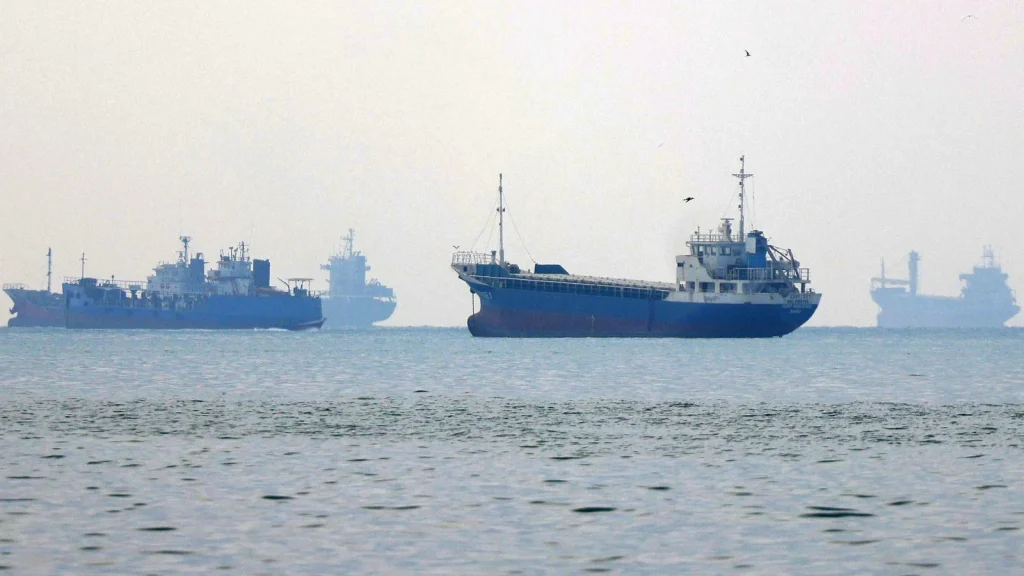
Although the US has sought to reopen the Strait of Hormuz, Iran continues to disrupt shipping through the vital passageway, which carries a significant share of the world’s oil and gas. There is still no indication of a diplomatic breakthrough that might bring an end to the war, which began with US and Israeli strikes on 28 February.
Iran has presented the Qassem Basir as an upgraded missile with greater manoeuvrability
The new restricted zone would stretch from the point where the US blockade of Iran begins into parts of the Gulf, Mohsen Rezaei, secretary of Iran’s Supreme National Security Council, told state television yesterday.
He said any vessel entering the zone would be placed on an Iranian sanctions list.
Mr Rezaei repeated the warning in both economic and military terms in a post on X. “In recent days, Washington has received a clear warning from Iran’s new missiles,” he said.
“Economic warfare will be met by a maritime exclusion zone across the Persian Gulf to the blockade perimetre.
“The operational posture toward US warships and bases has been fundamentally recalibrated.”
Mr Rezaei appeared to be referring to the Qassem Basir ballistic missile, which Iranian media said had been fired at US warships near the Strait of Hormuz.
The US military said its vessels avoided any missile strikes.
Despite extensive US bombardments that have weakened Iran’s conventional forces and further damaged its struggling economy, Tehran retains missile and drone capabilities. Those weapons allow it to threaten oil tankers travelling through the Strait of Hormuz without its permission, as well as attack Gulf states that host US military bases.
Iran has described the Qassem Basir as an upgraded weapon with enhanced manoeuvrability, the ability to evade missile-defence systems and a guidance system designed to withstand electronic warfare.
The Fars news agency said the missile was first used in combat against Israel in June 2025.
US President Donald Trump said “Iran will never have a nuclear weapon”
Some analysts believe Iran’s ability to use the Strait of Hormuz as leverage may be weakening, while tougher US economic sanctions are becoming increasingly difficult for Tehran to endure.
Before the war, roughly one-fifth of global oil and liquefied natural gas shipments travelled through the waterway. That dependence gave Iran a means of threatening tankers from Gulf states seeking to export energy, putting further pressure on oil prices as the unpopular war in the US raises political risks for President Donald Trump’s Republican Party ahead of November’s congressional elections.
“Oil prices will drop precipitously, like everything else is dropping (but more!), when we win the war with Iran,” Mr Trump said on social media.
“Three dollars a gallon, but ultimately, below two dollars a gallon. It will all happen quickly, and Iran will never have a nuclear weapon,” he added.
Mr Trump has not yet achieved the objectives he outlined when he launched “Operation Epic Fury” in February: ending Iran’s nuclear programme, stopping its ability to strike neighbouring countries and creating conditions for Iranians to remove their leaders.
Iran’s clerical rulers remain in power and are seeking to emerge from the conflict in a stronger position.
They continue to call for sanctions relief and hope eventually to collect fees from ships using the waterway.
Shipping data indicated that an average of only 10 commodity vessels a day passed through the Strait of Hormuz over the past 10 days, the lowest figure since May.
Israeli strikes on a town in southern Lebanon killed at least 12 people yesterday, according to the country’s health ministry, making it one of the deadliest days of Israeli bombardment in recent weeks.
The attacks have raised fears that Israel could launch a renewed military campaign despite the June ceasefire with Hezbollah, the Iran-backed group.
They have also added to the difficulty of ending the wider conflict. Iran insists that any lasting agreement with the US must include a halt to Israeli attacks in Lebanon.
Houthi strikes in Saudi Arabia wound 73: Riyadh-led coalition
Strikes by Yemen’s Iran-backed Houthi rebels on Saudi Arabia wounded 73 people, a Riyadh-led coalition said as it vowed to retaliate.
More than 300 people have been killed and hundreds of families displaced during days of fighting near the Red Sea coast, where the Houthis are attempting to seize territory bordering the strategically important Bab al-Mandab Strait.
Houthi media outlet Ansarollah said the rebels attacked targets in Saudi Arabia, including Abha International Airport, King Khalid air base and facilities operated by state-owned oil company Aramco in Abha and Jizan.
“The terrorist Houthi militia’s senseless attacks, the latest of which targeted civilian and economic sites”, caused “injuries to (73) civilians,” the joint forces command of the coalition said in a statement.
“The command will also take all necessary measures and actions to respond to the sources of the threat and neutralise its danger,” it added.
The strikes followed accusations by the Houthis that Riyadh had carried out attacks around Yemen yesterday, including a deadly bombardment of a prison.