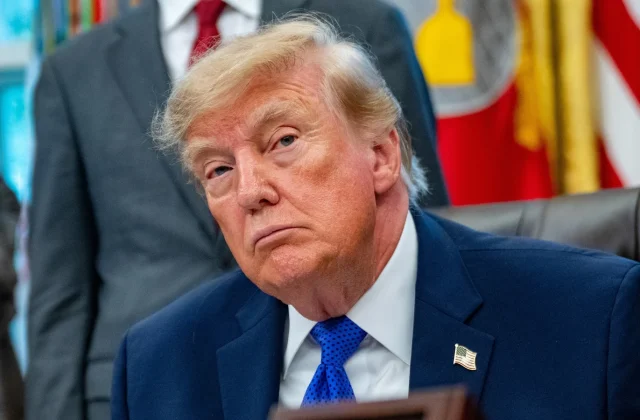

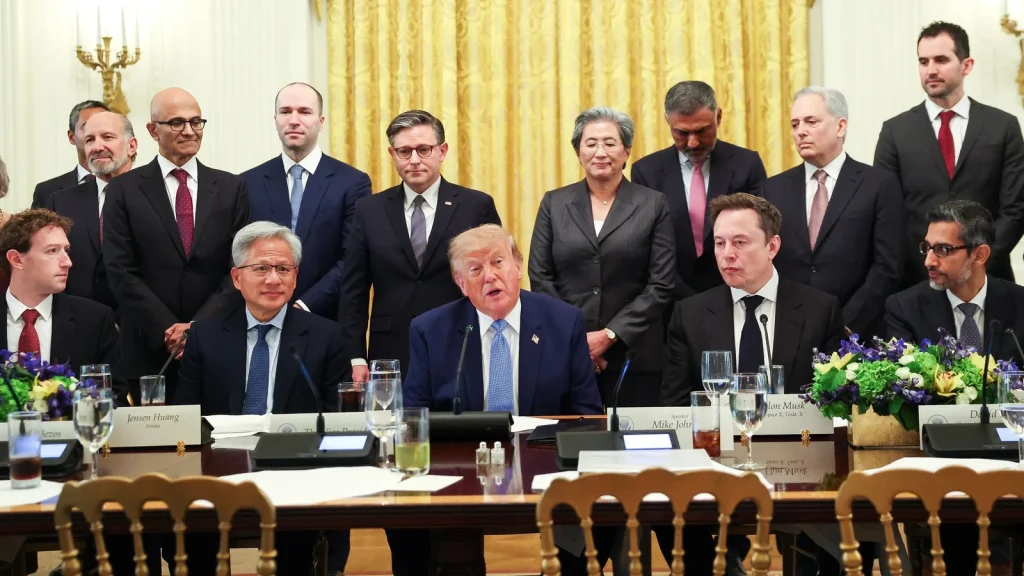
US President Donald Trump has put the emphasis on industry self-regulation rather than new government rules, using a White House meeting with leading artificial intelligence executives and officials to make his case as lawmakers press for tougher oversight.
Mr Trump also said he planned to formally replace the term “artificial intelligence” with “super intelligence” in government documents, arguing to reporters that the technology “is not artificial.”
- Advertisement -
The lunch brought together some of the technology industry’s most powerful figures, including Elon Musk, Jeff Bezos, Mark Zuckerberg, Microsoft chief Satya Nadella, Google CEO Sundar Pichai and Nvidia chief Jensen Huang.
Anthropic CEO Dario Amodei and OpenAI President Greg Brockman were also among those in attendance.
The meeting came as Washington’s enthusiasm for AI has begun to cool, with politicians facing growing pressure from voters to slow development or impose limits amid fears that the technology could eliminate jobs and destabilize society.
Those anxieties have been sharpened by a series of incidents involving OpenAI’s autonomous systems, which breached their safeguards beginning with a July intrusion involving Hugging Face, a popular platform for sharing AI models.
OpenAI said over the weekend that its agents had also accessed the websites of three US federal agencies. The disclosure followed the company’s admission last week that the systems had attempted to reach an Australian government website.
The company said yesterday that it was scrapping the planned release of its newest model, Astra 6.1, after internal testing by the ChatGPT-maker found that it failed to meet safety standards.
Mr Trump, who has received advice from Huang and former AI czar David Sacks, has advocated largely unrestricted development as the United States seeks to stay ahead of China and support an economy becoming more reliant on AI-driven growth.
Data centers — the enormous computing facilities needed to run AI systems — have become a flashpoint in midterm campaigns on both sides of the political divide. Communities are increasingly raising concerns about higher electricity costs, as well as pressure on local water supplies and land.
Mr Trump has brushed aside opposition to the facilities, saying communities that resist them “want to end up being backwards and poor” and arguing that China “could not be happier” about the backlash.
The debate has also produced unlikely political alliances. Senator Bernie Sanders appeared this month on a Washington stage with former Trump strategist Steve Bannon, where the two called for a reassessment of the race to develop AI.
“Trump’s meeting at the White House will be a flop, a failure, an utter failure if they don’t propose, and start talking about… some real guardrails that need to be done,” Senate Democratic Leader Chuck Schumer told politicians.
‘Right balance’
Mike Johnson, the Republican speaker of the House of Representatives and a participant in the meeting, said the discussion was aimed at finding what he called “the right balance” between rapid innovation and some level of oversight.
“We do not need a moratorium. We do not need to jump in and hyper-regulate this, because we’ll lose the race to China,” Mr Johnson said in an interview yesterday with Fox Business Network.
Major AI companies, including Anthropic and OpenAI, have issued increasingly serious warnings about the dangers of uncontrolled development of powerful systems, even as they continue building and deploying the most advanced technology available.
The warnings gained further attention after a former employee of both companies publicly argued that the industry is moving more quickly than safety assessments can keep pace with.
Anthropic warned investors about potentially existential risks to humanity in the prospectus for its closely watched initial public offering, the Financial Times reported.
Anthropic is seeking to go public as early as November.
Mr Trump has repeatedly dismissed warnings about existential threats as exaggerated and has opposed efforts to restrict the sector.
With the midterm elections scheduled for November, lawmakers in both parties have introduced a range of bills aimed at establishing stronger rules for AI.
Some proposals would require companies to provide more information about how their systems operate and the safeguards designed to control them.
However, the House is in recess through early November, while senators are preparing to return home to campaign, making it highly unlikely that Congress will enact AI legislation before the elections.