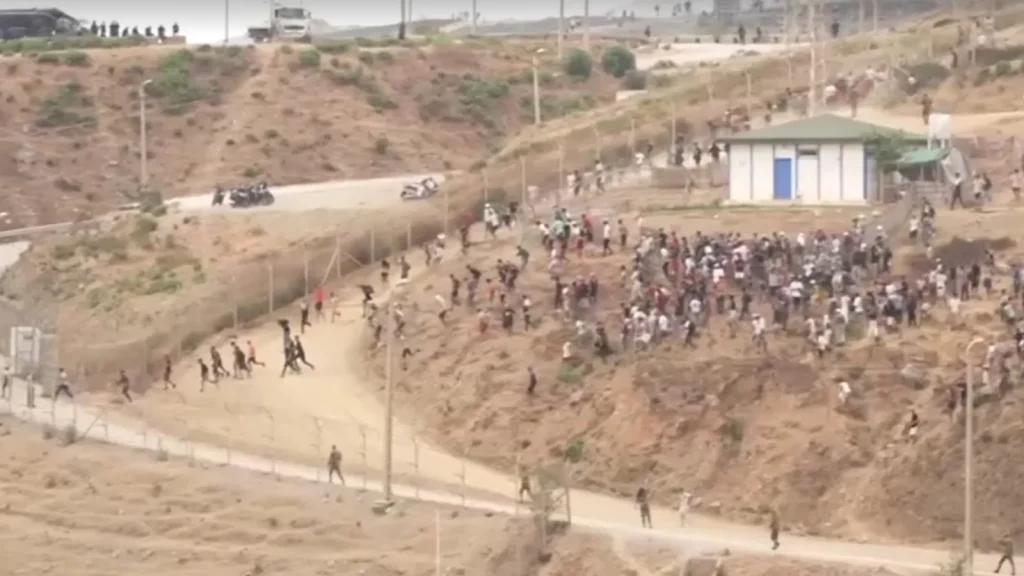
Spanish Prime Minister Pedro Sánchez said there was no “solid proof” that Morocco had organised July’s mass migrant crossing into Ceuta, even as a police report pointed to serious failures by Moroccan security forces.
At the same time, Mr Sánchez condemned what he called “unacceptable” remarks by Moroccan officials about Ceuta, marking an unusually public rebuke of Spain’s neighbour, which claims sovereignty over the North African enclave.
- Advertisement -
He also risked further straining already sensitive relations with Rabat by disclosing that his government had asked King Felipe VI to visit Ceuta and Spain’s other North African territory, Melilla.
More than 70,000 migrants entered Ceuta from Morocco on 30 and 31 July in an unprecedented surge. Scores of people died, most of them drowning while attempting to swim around a breakwater.
Yet a Spanish police report reviewed by AFP described the Moroccan security response as one of “total permissiveness”, saying it helped enable the mass crossing and that some officers directed migrants towards the water.
Pedro Sánchez also criticised ‘unacceptable’ comments about Ceuta and Melilla by two Moroccan government ministers
The number of officers deployed near the border crossing was “clearly smaller than usual”, while police “made no serious attempt” to halt the movement, according to the report, which drew on satellite imagery, publicly available videos and accounts from migrants.
Speaking in parliament to explain the government’s handling of the crisis, Mr Sánchez said no police, judicial or international body had presented Spain with “solid proof” that Morocco had planned or carried out the incident.
“If this solid proof existed, we would act accordingly,” Mr Sánchez said, adding that “this government is not afraid of confronting other foreign powers.”
‘Unacceptable’ comments
Mr Sánchez also denounced “unacceptable” statements on Ceuta and Melilla made by two Moroccan ministers, and disclosed that Spain had summoned Morocco’s ambassador on 21 August.
Moroccan media quoted Justice Minister Abdellatif Ouahbi in August as saying the country possessed “historic” and “geographical” rights to Ceuta and Melilla. He called for a “final solution” under which the territories would “return to the fold of the motherland”.
Ceuta and Melilla, home to the European Union’s only land borders with Africa, would remain Spanish “until the end of time”, Mr Sánchez told lawmakers.
Most of the migrants who entered Ceuta have since been sent back to Morocco, but thousands still remain on the city’s streets, sleeping rough and fuelling growing frustration among residents who say they have been left to cope alone.
Tens of thousands of people demonstrated in Ceuta and elsewhere in Spain over the leftist government’s response. Conservative and far-right opposition parties used the protests to intensify their attacks on Mr Sánchez.
The opposition has repeatedly questioned Morocco’s involvement while accusing Mr Sánchez of acting submissively towards Rabat.
Some analysts have argued that Morocco may have used the migrant surge to pressure Spain after Mr Sánchez visited its regional rival, Algeria, in July.
The disputed Western Sahara remains a central source of tension. Morocco controls much of the former Spanish colony, which is also claimed by the Algerian-backed pro-independence Polisario Front.
In 2022, Spain abandoned its longstanding neutral position and endorsed Morocco’s proposal for autonomy under Moroccan sovereignty, a move that infuriated Algeria.
Mr Sánchez further disclosed that the government had encouraged King Felipe to travel to Ceuta and Melilla “in the coming weeks”, an unusual public disclosure involving the royal family.
A royal visit could provoke renewed friction with Morocco. The previous trip by a Spanish monarch to the territories, in 2007, triggered a diplomatic crisis.
“Ceuta needs to be supported by the state more than ever,” Mr Sánchez said, explaining the government’s request.