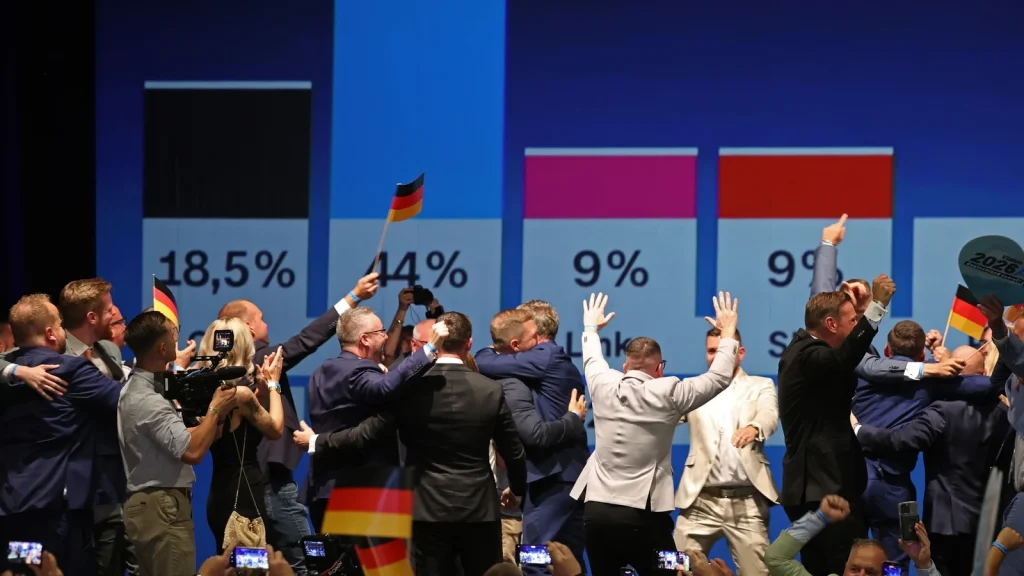
In the run-up to Germany’s election, the far-right Alternative für Deutschland (AfD) consistently drew support of about 20% in opinion polls—placing it at the center of a political challenge once considered unthinkable.
For the first time, the AfD is seriously testing the mainstream parties’ long-standing strategy of isolating the far right.
- Advertisement -
Its rise is especially striking in a country shaped by the legacy of authoritarianism and National Socialism in the 1930s and 1940s. For decades, far-right movements were broadly stigmatised, excluded and treated as political pariahs.
Political elites, established parties, the media and civil society worked together—formally and informally—to marginalise the far right and restrict its electoral reach.
The AfD was founded in 2013 by former members of the CDU, including economics professors Bernd Lucke and Joachim Starbatty, as well as conservative journalists Konrad Adam and Alexander Gauland. At the outset, it was a single-issue, anti-euro party campaigning for Germany to leave the Eurozone.
Known as the “party of professors”, it benefited from the backing of academics and former mainstream politicians. Their involvement gave the fledgling protest party an “unusual gravitas”.
Although nativist tendencies could arguably be detected from the beginning, the AfD was not initially designed as a far-right movement.
When it first contested a Bundestag election in 2013, its four-page manifesto focused solely on dismantling the Eurozone.
At that stage, the party supported political asylum for persecuted people and avoided the sharp anti-immigrant and anti-Islam rhetoric that would later become central to its appeal. Instead, it cultivated a more “bourgeois” image.
That early positioning helped create what political scientist Elisabeth Ivarsflaten has described as a reputational shield—a legacy the party could draw on to deflect social stigma and accusations of extremism.
Party adopted a more hardline position
In its early years, the AfD also sought to distance itself from far-right parties in neighbouring countries.
But a series of leadership changes between 2015 and 2017 pushed the party toward a harder line, particularly on immigration, Islam and German national identity.
By 2016, its platform had come to resemble those of populist radical-right parties elsewhere in Europe.
Today, the party can unequivocally be classified as far right.
The term encompasses the increasingly close relationship between “(populist) radical right” parties and movements, which are illiberal but operate within democratic systems, and the “extreme right”, which rejects democracy altogether. At its core, the far right is defined by nativism and authoritarianism.
Placards that show Ulrich Siegmund, lead candidate of the far-right Alternative for Germany (AfD)
Nativism is a xenophobic form of nationalism rooted in the belief that people considered non-native threaten the integrity of a supposedly homogeneous nation-state.
In Germany, that idea carries a particularly heavy historical burden. “Völkisch nationalism”, a powerful current in the 19th and early 20th centuries, was later adopted widely by National Socialism to justify deportations and, ultimately, the Holocaust.
Völkisch ideology rests on the essentialist belief that the German people are inseparably bound to the soil. Under that framework, people from outside the imagined community cannot truly belong to it.
Party radicalised its position
The AfD has developed into a far-right party through the steady radicalisation of its positions. In effect, it operated as a Trojan horse, bringing völkisch nationalist ideas into parliament and public debate—spaces where Germany’s democratic safeguards had previously kept them at bay.
The party established a political niche by demanding tougher restrictions on immigration, particularly in response to the so-called “refugee crisis”, when then-Chancellor Angela Merkel welcomed more than a million asylum seekers to Germany.
At the AfD’s campaign launch rally in January 2025, its chancellor candidate, Alice Weidel, promised “large-scale repatriations”, also referred to as “remigration”, of immigrants.
The party supports a return to blood-based citizenship, arguing that—apart from very limited exceptions for migrants deemed well assimilated—citizenship should be determined by ancestry and bloodline rather than by birthright.
It also presents the white, nuclear family as a social ideal and has pledged to remove university professors accused of advancing “leftist, woke gender ideology”.
On foreign policy, the party calls for the immediate removal of sanctions against Russia and rejects weapons deliveries to Ukraine.
Leader of the Alternative for Germany (AfD) Ulrich Siegmund at a news conference in Berlin
In recent years, the AfD has adopted a far-right strategy built around saturating the media and public debate with controversy, misinformation and inflammatory language. The aim is to command attention while pushing beyond established political norms.
A notable example came in 2018, when former AfD leader Alexander Gauland described the 12 years of Nazi rule as “mere bird shit in over 1,000 years of successful German history”.
His comment attempted to present contemporary Germany as part of a longer pre-1933 national story while diminishing the historical weight of the Nazi period.
Until recently, mainstream parties had consistently excluded the far right. The belief that democratic forces should never cooperate with it became one of the founding myths of the old Federal Republic of Germany.
At least within parliament, that principle functioned relatively effectively as part of Germany’s system of “militant democracy”.
But the political firewall known as the Brandmauer has begun to weaken.
The AfD has since celebrated the election of its first mayors at the local level.
Its progress has been driven in large part by the narrative of a “refugee crisis” in Germany. Aggressive political rhetoric about migration has boosted the party at the ballot box, while some of its positions have also been adopted by mainstream politicians.
Paradoxically, the AfD performs particularly well in rural and remote regions where migration levels are low. Its support is weaker in more globalised cities with large university populations.
Before the 2025 election, Friedrich Merz, the CDU’s lead candidate, crossed a long-standing political red line when his proposal to tighten asylum policy narrowly passed in the Bundestag with AfD support.
At the same time, German media outlets have increasingly presented AfD representatives as legitimate participants in political competition.
Once largely shut out of public debate, they are now frequent guests on political talk shows.
The party has also gained international validation from figures including US vice-president J.D. Vance and X owner Elon Musk.
The election may reveal how far the AfD’s normalisation has advanced—and what consequences that shift will have for Germany’s political future.
The central question will extend beyond the party’s electoral performance: how far will mainstream parties go in incorporating far-right ideas into their own agendas?
One fact is already difficult to ignore. Germany’s political landscape has changed, and the boundaries that once kept the far right at the margins are no longer as secure as they were.