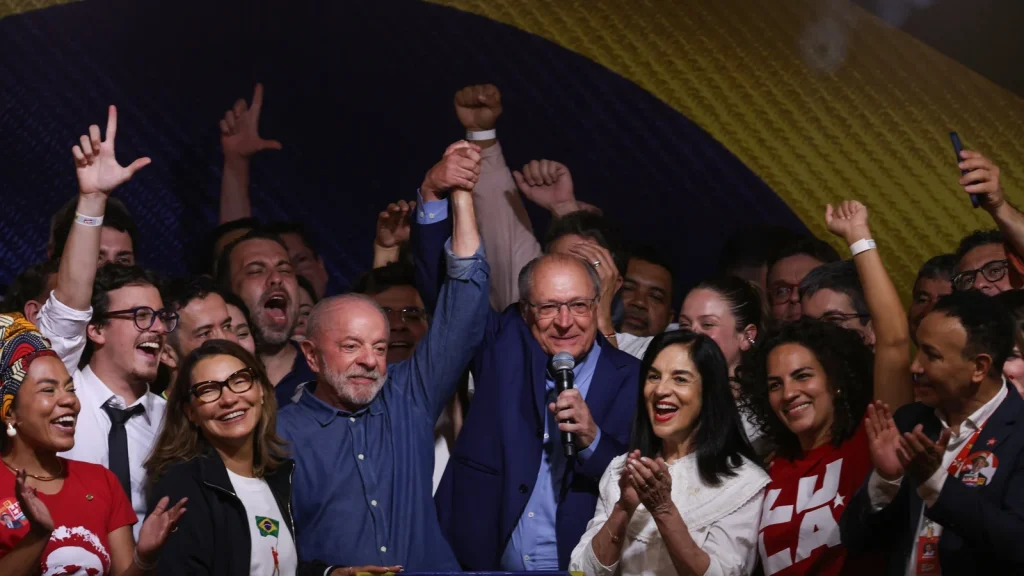
Brazilian right-wing Senator Flavio Bolsonaro has refused to accept defeat in Brazil’s presidential election, echoing his imprisoned father’s rejection of the result after leftist President Luiz Inacio Lula da Silva secured a historic fourth term.
The senator, son of former President Jair Bolsonaro, challenged a decision by a Lula-appointed Supreme Court justice to keep polling stations open for an additional two hours over alleged irregularities involving voter transport. Mr Bolsonaro said he would seek to have the election annulled.
- Advertisement -
“It is impossible to recognise the election results, given the circumstances under which things unfolded,” Mr Bolsonaro told journalists.
Lula celebrates election win
Investors responded uneasily, driving Brazilian assets sharply lower as they reassessed the country’s fiscal direction under Mr Lula.
With Mr Bolsonaro trailing Mr Lula by more than 4 million votes, analysts said the size of the defeat made it highly unlikely that an effort to overturn the result would succeed.
Flavio Bolsonaro said he would ask for the result to be annulled
His case is further weakened by the fact that his own campaign had called for polling to be extended because of heavy rain in the conservative-leaning south.
Even so, Mr Bolsonaro’s refusal to concede could trigger protests in a country where confidence in the electoral system and the independence of the judiciary has come under sustained pressure, observers said.
Jair Bolsonaro drove Brazil into a severe democratic crisis after the 2022 election, when his supporters stormed government buildings to protest the result. He was later sentenced to 27 years in prison for plotting a coup.
Leaders congratulate Lula
While Mr Bolsonaro disputed the outcome at home, leaders abroad moved swiftly to acknowledge Mr Lula’s victory.
French President Emmanuel Macron said France and Brazil had “much to build together”, while European Commission President Ursula von der Leyen declared that “democracy and multilateralism have won in Brazil”.
The Kremlin welcomed Mr Lula’s re-election, praising his role in strengthening bilateral relations and advancing BRICS. Ukrainian President Volodymyr Zelenskiy also congratulated the leftist leader on “remarkable election results” and said he hoped to deepen cooperation.
Luiz Inacio Lula da Silva started strongly in the runoff vote
The White House and the US State Department were notable in their silence, issuing no immediate comment, as was Argentine President Javier Milei.
The outcome is expected to frustrate the administration of US President Donald Trump, whose State Department had led a campaign aimed at restoring the Bolsonaros to power.
Expectations defied
Mr Lula’s win overturned polling, precedent and a broader global backlash against incumbent governments, halting a run of right-wing electoral victories across Latin America. After finishing behind Mr Bolsonaro in the first round, he succeeded in bringing enough voters behind him for the runoff.
Markets initially reacted to the surprise result by unwinding positions that had been built largely on expectations of a Bolsonaro victory.
November futures for the Brazilian real BRL= fell more than 10%, while the iShares MSCI Brazil exchange-traded fund EWZ.P plunged 26% in premarket trading. Several long-dated Brazilian sovereign bonds fell by more than 2 cents on the dollar.
Supporters of Brazil’s President and presidential candidate Luiz Inacio Lula da Silva celebrate
“The initial sell-off could moderate as election-related positions are unwound, but investors will demand convincing fiscal commitments before rebuilding exposure,” said Andres Abadia, chief Latin America economist at Pantheon Macroeconomics.
Addressing supporters at a hotel in Sao Paulo late last night, Mr Lula struck a conciliatory note.
“I won’t speak of national unity, because that doesn’t always fit the reality of this country. No one is obliged to like the elected president, but he was put in place to govern for everyone,” Mr Lula said.
During the campaign, Mr Lula pointed to his record of reducing poverty and inequality, while also citing historically low unemployment, illiteracy and deforestation. His fourth term, however, is likely to test his political skills.
Lula supporters at the Rocinha favela in Rio de Janeiro
He will need to govern with a Congress dominated by Bolsonaro allies after a surge in right-wing support reshaped the legislature in favour of his opponents.
“The challenges are countless,” said Carlos Melo, a political science professor at Insper in São Paulo.