
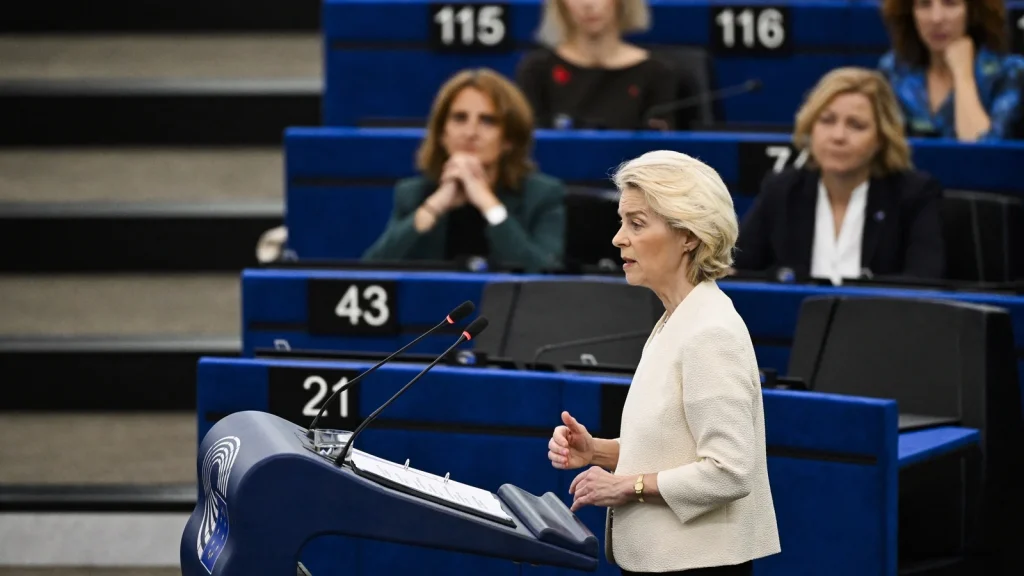
European Commission President Ursula von der Leyen has opened the door to Canada becoming the European Union’s first associate member — a status that is not currently provided for under the bloc’s treaties.
“Partnerships are a strategic choice for Europe. But they also respond to the fracture in the international rules-based system,” Ms von der Leyen said during her annual State of the European Union address in Strasbourg.
- Advertisement -
“We see the world with the same eyes: from AI to climate change, from the Arctic to geopolitics. And we have stood together: on Ukraine, on defence, on raw materials and on supply chains. But above all … Europe and Canada believe in democracy.”
Addressing Canadian Prime Minister Mark Carney, who is visiting the European Parliament as a special guest this week and is due to speak to MEPs tomorrow, the commission president said the EU must “urgently re-imagine our partnerships” around the world.
Mark Carney, pictured with Ursula von der Leyen and European Parliament President Robert Metsola (C), will address the European Parliament tomorrow
The proposal had been signalled earlier this week, when Mr Carney said he wanted to build a “unique alliance” with the EU. But confirmation that an associate-member plan is now being considered marks a notable step forward.
The bloc has traditionally been wary of flexible membership categories. EU governments also responded cautiously in May to Germany’s suggestion that associate membership could offer Ukraine a pathway towards full accession.
Ms von der Leyen said “that power does not belong to the strongest, the richest or the loudest, but to all of us”, adding: “Democracies have the freedom to choose with whom to work”.
She said the EU and Canada would deepen cooperation across a range of sectors, including manufacturing, artificial intelligence, critical minerals and energy.
“We will work on intelligent manufacturing. We will create a tech alliance. We will integrate defence industrial bases. We will make the Arctic a flagship joint project,” she said.
Mr Carney’s visit to Europe comes after a historic deterioration in Canada-US relations, following the collapse of trade talks last month and a subsequent series of retaliatory tariff measures.
Ms von der Leyen stressed that “this is a partnership not against anyone else”, apparently seeking to avoid antagonising US President Donald Trump.
EU dealing with ‘openly hostile world’
The European Union is confronting “an openly hostile world”, the commission president warned.
“A territorial war of aggression is raging on our continent; others have erupted nearby. A fight for industrial capacities is shaping global competition. And a battle of narratives is seeking to weaken confidence in Europe,” Ms von der Leyen said.
She called for greater European independence as geopolitical tensions intensify, arguing that a stronger and more self-reliant Europe is already taking shape.
In the “cold fragility of today’s world”, she said, only Europe could provide “true sovereignty to Europeans”.
The commission president also said Europe “is better able to defend itself than ever before” and “stands up for each other”, pointing immediately to non-EU member Ukraine and to Greenland.
MEPs heard of ‘attempts to drive a wedge’ between members states
While highlighting what she described as growing unity within the EU, Ms von der Leyen also warned of the serious threats confronting the bloc and said there had been efforts to “drive a wedge between us, sometimes from the outside and too often from the inside”.
She said the EU therefore faced a “clear” choice: “Do we want a strong and independent Europe that stands up for its values in this world? Or do we want to rally around our European idea that together we can decide our own destiny? Or do we let our democracies be undermined by the proxies and puppets of authoritarians?
“Whether it is the ultra-nationalists or the anti-Europeans, whether it is Russian interference or disinformation. The names may be different, but their goal is the same. They despise our values, and they want to shatter our European unity. So let’s not only fight back against that, but let’s fight together for our European idea.”
‘Really positive development’, says Harris
Tánaiste and Minister for Finance Simon Harris called the invitation for Canada to become the EU’s first associate member “a really, really positive development”.
Speaking at the European Parliament in Strasbourg after Ms von der Leyen’s address, Mr Harris said that while some countries were choosing to turn inward, “Canada and the European Union want to look outwards”.
“I think multilateralism is a really good thing, and at a time when there are so many global challenges and so many issues of shared concern, countries and parts of the world that share values should be working more closely together,” he said.
Asked whether he was concerned about possible retaliation from US President Donald Trump, Mr Harris said he had no such worries.
“As President von der Leyen said, this is not a thing that should in any way offend or upset anybody else.
“This is a positive decision that we’re making as Europeans and indeed they as Canadians, to want to work more closely together,” he said.
Mr Harris said he had invited Canada’s finance minister to Dublin later this week to attend an informal meeting of EcoFin, the EU’s Economic and Financial Affairs Council, as a guest.
Asked whether he would support a similar arrangement for the UK, Mr Harris said Ireland’s position was always that “we want to see as close as possible a relationship between the UK and the European Union”.
“That’s good for Europe. It’s good for Ireland,” he said.
He added that he had also invited the Chancellor of the Exchequer, John Healy, to attend the EcoFin meeting.
“I think the British government has been clear that they want to have a closer relationship with Europe. It’s for them in the first instance to outline what that looks like. But Ireland will always be supportive of a close relationship between the UK and the EU, and we believe it’s in everybody’s interest,” he said.
We need your consent to load this rte-player contentWe use rte-player to manage extra content that can set cookies on your device and collect data about your activity. Please review their details and accept them to load the content.Manage Preferences
”Strongest-ever support to Ukraine’
Ms von der Leyen pledged that the EU would deliver its “strongest-ever support to Ukraine” during the coming winter, which she said would be the most difficult of the war sparked by Russia’s invasion.
“Together with our partners, we will provide humanitarian aid and reinforce Ukraine’s supplies of power and heating,” she said.
“Second, we will strengthen Ukraine’s air defences.”
She said US Patriot interceptor missiles had to be supplied urgently, but warned that “we must also jointly reduce our dependence on a single supplier” by working with Ukraine to develop “an affordable, modular missile-defence system”, centred on Ukraine’s Freyja project.
Clear fiscal choices needed
Ms von der Leyen said Europe’s economy had endured the effects of the Middle East wars “better than expected” and that unemployment remained “at near-record lows”. But she said higher energy prices and borrowing costs were placing growing pressure on households and businesses.
“Clear fiscal choices will have to be made to ensure fiscal sustainability, while protecting investment. So, kickstarting Europe’s economy is our number one priority.”
She said a historic overhaul of the Single Market “can and must” be completed by the end of next year.
Turning to the energy crisis, Ms von der Leyen said the EU “cannot remain an industrial powerhouse if its energy prices are structurally too high”.
She said the crisis in the Strait of Hormuz had exposed the cost of Europe’s broad dependence on imported fossil fuels, adding that it had cost the bloc “an additional €90 billion” since it began. To secure greater economic independence, she said, the EU must concentrate on “renewables and nuclear”.
President von der Leyen said Europe’s trade deficit with China had “reached a tipping point” and that the EU was engaged in talks with Beijing aimed at rebalancing trade.
She said a new European Corporation on Critical Raw Materials would be created to help Europe “obtain and stockpile what we need” for electric cars, chips and batteries, clean technology, defence and other strategic industries.
“Not only our industry depends on this. But also our independence and security”, she added.