The scale of the Republican Party’s defeat was captured in a single text message sent by a senior party official: “a bloodbath.”
Even voters in places that have repeatedly backed US President Donald Trump turned away from the Republican Party in a night that delivered sweeping gains for Democrats.
- Advertisement -
Within an hour of the first polls closing, the contours of the result began to emerge. Major US networks projected that Georgia Senator Jon Ossoff had won re-election, giving Democrats an early boost.
Georgia had been a central priority for Democrats, who needed to retain the seat to keep their campaign for a Senate majority on track.
Chris Pappas takes the stage to give his victory speech
Ossoff was viewed as especially vulnerable because he was defending his seat in a state Mr Trump had carried in 2024.
That assessment shifted dramatically overnight as his victory became the first sign of a wider Democratic surge.
About an hour later, the trickle turned into a wave when Chris Pappas won the Senate race in New Hampshire, becoming the first openly gay man elected to the US Senate.
More victories followed, as voters rejected Republican candidates — including several endorsed by Mr Trump — in key contests across the country, among them races in the Carolinas.
The night grew even more painful for Republicans when an effort to redraw congressional districts in order to increase the party’s House representation appeared to produce the opposite result.
Democrats Pia Dandiya, Kathy Castor and Jared Moskowitz were projected by US television networks to win their races in Florida.
The contests followed a new congressional map introduced by outgoing Governor Ron DeSantis, which was designed to deliver as many as four additional Republican seats in the House. Instead, three of those seats went to Democrats.
And the extraordinary run of results continued.
Democrat Gina Hinojosa captured the Texas governorship by defeating Greg Abbott, while Democrat Rob Sand won the governor’s mansion in Iowa.
Gina Hinojosa addresses supporters at her election night watch party in Austin, Texas
Both joined a rising generation of Democrats who have worked to reach independent voters and people disillusioned by Mr Trump’s unpopular war in the Middle East and the pressure of soaring prices — including voters in states long regarded as reliably Republican.
At the John Fredericks Show watch party in Washington DC, the conservative radio host was leading a live panel discussion as the results came in. The room fell noticeably quiet when a US television network projected that James Talarico had won the Senate seat in Texas.
Yet conversations with those attending suggested that they did not hold President Trump responsible for the Republican Party’s midterm losses.
Many instead blamed Republican members of Congress, arguing that they had failed to persuade voters that the GOP was acting in their interests. Some also said the party had not passed enough legislation.
“They are a do-nothing party. Trump’s executive branch is the only one executing and doing things through executive orders,” one man said.
Another said: “I’m confident that if he was on the ballot, he would have done very well because he understands how to manipulate the masses. That’s what politics is really all about. That’s what these campaigns are all about… how to get the uninformed, idiot masses to get out and vote.”
The coalition that carried Mr Trump to victory in 2024 also showed clear signs of fracturing.
Early exit poll data pointed to sharp Republican losses among black men, Latinos, young voters, evangelical Christians and voters without college degrees.
The AP Voter Poll recorded a significant shift among younger voters and Latinos, with both groups moving away from Republicans compared with Mr Trump’s victory two years earlier.
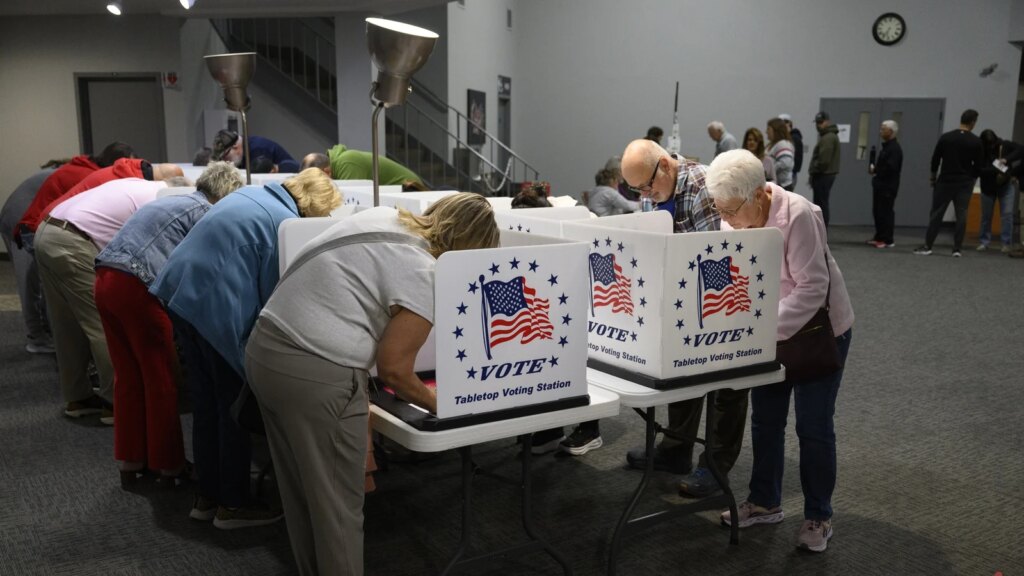
Voters queue at a polling station on the first day of early voting in Texas
In 2024, voters under 30 were roughly divided between Mr Trump and Vice-President Kamala Harris.
This time, about seven in 10 voters under 30 nationwide said they had backed the Democratic House candidate in their district.
That left a central question: how would the president respond after repeatedly insisting that he was effectively on the ballot?
After angrily criticizing Fox News’ coverage of election night on social media, he adopted a more conciliatory tone in an interview with The New York Times. Mr Trump said he would work with Democrats and would “absolutely” accept the results.
“We’ll, you know, look forward to working with them. We’ll probably work something out,” he said, although he later posted an image of a hat bearing the word “Veto”.
The next two years are likely to bring fierce legislative battles, funding confrontations and a steady exchange of accusations during congressional investigations.
For the Republican Party, the night may also bring a period of political whiplash.
President Trump turned on Texas Governor Mr Abbott, accusing him of becoming a RINO — a Republican in Name Only — over the past year.
Democrats, meanwhile, will need to deliver on the issues that helped secure their victories, above all affordability, if they are to preserve voters’ confidence and enter 2028 from a position of strength.
Kansas has elected its first Democratic senator since 1932, Adam Hamilton
Ballot workers count votes at the Ballot Processing Centre after polls close
With the cost of living weighing heavily on voters, the early focus is expected to be on reducing everyday expenses.
Democrats have pledged a “shock-and-awe” legislative sprint, promising to demonstrate within hours of taking power in January that they are moving bills forward to fulfill their campaign commitments.
The agenda includes restoring healthcare subsidies and Medicaid resources, as well as ending President Trump’s tariffs and the war with Iran.
Mr Trump had already acknowledged that Republicans were likely to lose control of the House of Representatives.
Earlier in the week, there were indications that he had become increasingly worried about losing the Senate as well — a result that would give Democrats greater authority to investigate the president and his allies.
But while President Trump has said he is prepared to work with Democrats, he also told a reporter last week that he was ready to use the powers available to him, including presidential pardons for aides and allies.
The results represent the first major national rebuke of Mr Trump’s second term, with Democrats taking control of both chambers of Congress.
The backlash was not limited to traditionally Democratic territory. Some of the largest swings came in Republican-leaning states that have repeatedly supported Mr Trump in presidential elections.
Texas elected its first Democratic senator since 1988.
Kansas elected its first Democratic senator since 1932.
The political pendulum has swung.
In states that Republicans had come to regard as dependable, voters have now handed Democrats a chance to govern.
Democrat Debbie Dingell told NBC that the results showed voters were unhappy with the country’s direction. People, she said, were not necessarily “in love with Democrats” but believed “we’ve a job to do”.
“And if we don’t deliver in the next two years they will send another loud message,” she said.