
As world leaders arrive in Turkey for COP31 this week, the countries bearing the heaviest costs of climate change will be demanding more than promises. They will be looking for support.
Honduras is among the nations at the centre of that discussion, as extreme weather and rising seas put growing pressure on communities from the Pacific coast to the flood-prone north.
Reporter Kate Varley and cameraman Bram Verbeke travelled across the Central American country to meet people living on the frontlines of the climate crisis.
Ask residents of Cedeño to describe the town they have called home for decades and one word is heard repeatedly: paradise.
Set between broad sandy beaches and dense green forests, the community on Honduras’ Pacific coast appears to have been lifted from a travel brochure.
But beneath that postcard image, the town is fighting to survive.
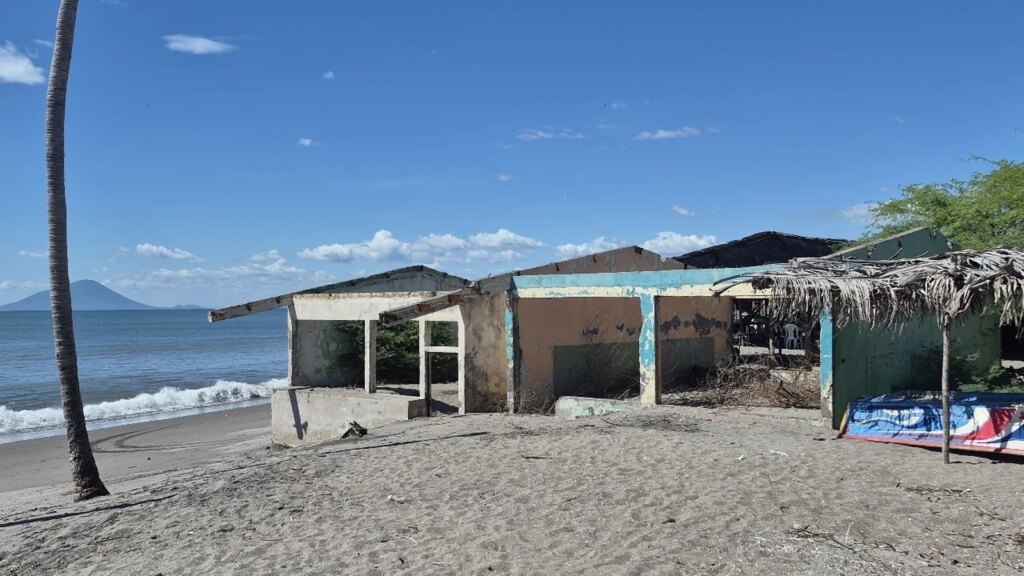
Buildings damaged by rising seas and extreme weather in Cedeño
Month after month, the sea advances into Cedeño, eroding homes and livelihoods and transforming a place once associated with beauty into one marked by fear and loss.
“My heart cries”, 48-year-old Frances Azucena Cruz tells us, pointing towards what remains of her home. “The sea took everything.”
Storm surges in May made the property impossible to live in. Much of the building is now buried under sand, leaving only the terracotta-tiled roof visible above the shoreline.
“Still here but gone”, she says through tears.
Frances Azucena Cruz
It is not the first property Frances has been forced to leave behind. A chef and entrepreneur, she once operated a 10-room seafront hotel. The tide has also claimed an earlier home and a beach shack where she sold snacks.
With her income gone, she says desperation has taken hold.
“Starting from zero at my age, it’s so difficult. I’ve lost everything. Every day it gets worse and worse.”
Frances now shares a rented home farther inland with 11 relatives, but she is unsure how she will keep paying the rent or what lies ahead.
“When I cry it’s because I feel overwhelmed that I can’t do much.
“I just want my grandchildren to be able to live and rest without the constant fear that the sea will continue to rise.”
Crumbling walls and roof fragments
Frances’ experience is echoed throughout the small community of Cedeño.
As the tide recedes, broken roof sections, collapsing walls and the empty outlines of former homes reveal how steadily the water has moved inland.
Rubble built up on a beach in Cedeño
Amnesty International estimates that Cedeño’s coastline is retreating by about six metres each year.
Residents say at least 200 structures — among them houses, cafes, restaurants and a school — have disappeared into the ocean. They say erosion has accelerated since 2015.
Honduras is already highly exposed to climate change, and Cedeño offers a stark picture of how rising seas can magnify storm surges and the loss of natural coastal barriers.
“We did not cause this harm – it was industries and climate change that led us to these effects,” says Dagoberto Majano, a community leader and member of the Local Emergency Climate Committee, as he opens an old map of the town.
He points to neighbourhoods that now lie beneath the water and describes the deep emotional and economic damage caused by the loss of land, homes and work.
“It has had more than an emotional impact, so psychological. So many people had to migrate to the United States, to Spain or to other countries.”
Dagoberto Majano said industries and climate change led to the changes in Cedeño
Migration driven by climate pressures has become a defining feature of life in communities such as Cedeño, with the United States attracting many people searching for employment and greater security.
Those who stay often depend on money sent home by relatives abroad. The World Bank says remittances account for more than 30% of Honduras’ GDP, with approximately 98% of those funds coming from the United States.
That lifeline, however, is now under strain.
Thousands of Hondurans have been deported from the United States under the Trump administration’s immigration crackdown.
One of Frances’ sons is among those deported, while another recently chose to return home.
“My children cannot support me anymore,” she says. “And when they came back there was nowhere for them to live.”
Drought, flooding, hurricanes: Honduras on the frontline
Honduras produces just 0.06% of global greenhouse gas emissions, yet experts regularly identify it as one of the countries most vulnerable to climate change.
The IMF estimates that extreme weather cost the country around 6.3% of its GDP each year between 1960 and 2022 — a burden that continues to grow.
Los Laureles reservoir with low water levels in Tegucigalpa, Honduras
Earlier this year, authorities issued a Red Alert across 75 municipalities after a prolonged drought damaged crops and worsened food insecurity. Scientists believe the exceptionally dry conditions were linked to the super El Niño weather phenomenon, which global warming is making more severe.
At the same time, Honduras is confronting the opposite threat: heavier rainfall and more destructive flooding.
In the northern district of Cortés, Marta Maldonado says she has been forced to flee her home repeatedly when heavy rain sends the nearby river over its banks.
“It used to be every 20 years… Now it’s much more often”, says the 77-year-old.
Marta Maldonado says it hard to rebuild from scratch multiple times
“It is so hard to lose everything and try to rebuild a home from scratch – to keep shovelling out mud and throwing away ruined clothes. You can’t live like that; instead, you just end up getting sick,” Marta says.
Another woman recounts spending 15 days on the roof of her home, waiting for rescue after Hurricanes Eta and Iota struck in succession in 2020, while floodwater stood around the house.
Aftermath of a tropical storm in Honduras
Glenis Iriarte had already endured severe trauma earlier in life. The storms, she says, added another layer of suffering.
“I recall staying on top of that roof and telling my daughter, ‘you will hear me now cry, you will hear me scream’ because I had to release everything that I had.
“When I came down, I thought that I could save some of my things but no, everything was lost. Thirty years worth of assets.”
Glenis Iriarte spent 15 days on the roof of her house waiting to be rescued after a hurricane
Glenis is now receiving psychological support from an organisation backed by Irish NGO Trócaire. She says her condition has improved considerably, although the prospect of another major storm still frightens her.
Early warning systems
Trócaire is also financing projects across Honduras designed to help communities prepare for floods before they arrive.
Farther upstream, cameras and sensors have been installed at several points along the River Ulúa. The monitoring network gives residents more time to respond when floodwaters begin moving downstream.
An early warning system on the Ulua River
“In the past, we only had an eight-hour window to evacuate our people,” says José Délmiz Cardona, Head of Risk Management at La Lima municipality, regarded as Ground Zero for flooding in Honduras.
“But now, in the Ulúa River basin, we have more than 72 hours of lead time, and in the Limón area, we have nearly 30 hours.
“This enables the authorities to make sound decisions, manage the situation, and issue alerts so that our people can evacuate and ensure their own safety.”
Levees and drainage channels have also been constructed along the riverbed.
For now, those measures are among the most effective tools available to Hondurans seeking to reduce the impact of a changing climate.
Yet, as in many vulnerable nations, adaptation can only go so far. The wider challenge is to address the forces driving climate change in the first place.
“What everyone wants to hear (from COP) is action,” says George Redman, country director for Trócaire in Honduras.
“There’s been enough prevarication. The impacts are real, people here are suffering.
“It’s time for the industrial north and the people who hold the solution to the problem in their hands, to act now.”