
The sight of drones packed with explosives plunging toward military vehicles, circling airfields and hitting troops is now closely associated with the war in Ukraine.
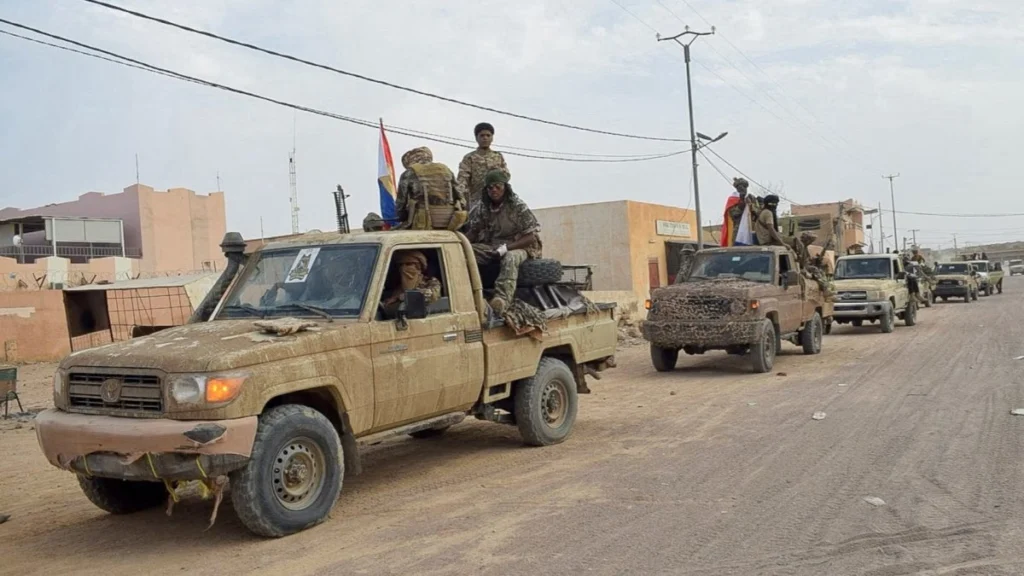
Yet the same tactics are appearing thousands of miles away in Mali, where insurgents are using battlefield methods pioneered in Ukraine against government forces and their Russian partners.
Videos recorded during coordinated attacks in April by Tuareg-led terrorists and an al-Qaeda affiliate demonstrate how low-cost first-person-view (FPV) drones are reshaping the balance of power across the Sahel, the vast belt of territory south of the Sahara.
The small, commercially available aircraft can be purchased for only a few hundred dollars, fitted with explosives and used to threaten bases, aircraft, fuel depots and other strategic sites once shielded by governments’ overwhelming air-power advantage.
The danger is spreading beyond Mali. Militants in Burkina Faso, Niger and elsewhere in West Africa are increasingly using drones for surveillance and attacks, while comparable tactics are emerging in conflict zones across the Middle East, Asia and South America.
For African governments, the trend presents a widening security problem: costly military assets and vital infrastructure are becoming vulnerable to inexpensive weapons operated by non-state groups.
Reuters reporting indicates that Ukraine’s campaign to undermine Russian military influence has reached Africa, including reported training for separatists in Mali on how to carry out drone attacks against Russian personnel.
But Kyiv’s alleged assistance is only part of the picture. The wider spread of drone technology has given militant organizations access to capabilities once largely limited to national armed forces.
“ In the past, the state always had the monopoly of the sky. It was the one thing they could control,” said Niccola Milnes, an independent senior counterterrorism and security adviser.
“Now that non-state actors can access these drones cheaply and modify them and attach payloads, it’s obviously completely upended that,” she said.
Ukrainian training brings new tactics to Mali
FPV drones carrying rudimentary explosives began appearing in greater numbers on Ukrainian battlefields in 2023, marking the start of a broader transformation in combat.
The systems were cheap, commercially available and relatively simple to convert for military use. As Ukrainian and Russian forces refined their methods, the knowledge and tactics began moving into other theaters of war.
Separatist fighters in Mali say Ukrainian personnel helped train them to operate drones.
Russia began backing Mali’s military government in 2021, deploying the Wagner mercenary group to fight jihadists and Tuareg-led separatists.
Two years later, Russia’s Defense Ministry created Africa Corps, a paramilitary organization that replaced Wagner and incorporated many of its fighters.
Also in 2023, Ukrainian instructors trained members of the separatist movement in drone operations during a 30-day course conducted outside Mali, according to Mohamed Elmaouloud Ramadane, a spokesman for the group, now called the Azawad Liberation Front (FLA).
Ramadane said the instruction helped establish the group’s specialized drone unit, but he denied that Ukrainian personnel had taken part directly in its combat operations. He would not identify the drones involved or discuss further operational details.
Reuters was unable to independently verify the identities of the Ukrainian trainers or determine who arranged the course.
Ukraine’s military and intelligence agencies did not answer requests for comment. In a Nov. 2 statement, however, Ukraine’s Foreign Ministry rejected allegations from Mali and Niger that Kyiv was aiding armed groups or meddling in regional affairs.
Russia’s Defense Ministry likewise did not respond to questions.
Ukraine has increasingly pursued Russian military assets outside its borders. On Sunday, Ukrainian forces sank a Russian naval corvette in a Libyan port with maritime drones, providing another example of Kyiv’s effort to target Moscow’s military footprint abroad.
Ukrainian Foreign Minister Andrii Sybiha defended the strike, arguing that Russia was using military deployments and logistical networks beyond its territory, including in Africa, to support its war against Ukraine.
Mali’s government did not answer detailed questions about the alleged Ukrainian role. Its foreign minister, Abdoulaye Diop, has nonetheless recognized the expanding threat posed by drones.
“The ability of our armed forces to adapt to drone attacks has therefore become a critical issue,” Diop said at an arms fair in Bamako on Nov. 9.
Low-cost weapons, expensive consequences
The FLA’s first major use of one-way attack drones came in July 2024 during fighting around Tinzaouaten, near Mali’s border with Algeria.
Ramadane said Unit 6, the FLA’s specialized drone team, deployed kamikaze drones against Malian troops and their Russian allies about 10 months after completing the training course.
Al-Qaeda-linked militants had begun testing the technology earlier.
In September 2023, JNIM, an al-Qaeda affiliate, used a quadcopter to drop two improvised explosive devices on a rival militia in Mali’s central Mopti region. Neither bomb detonated, and there were no reported casualties, according to the Armed Conflict Location & Event Data (ACLED) project.
The attacks have since become more frequent and more capable, with JNIM emerging as the Sahel’s most active militant drone operator.
Previously unpublished ACLED data examined by Reuters recorded 187 JNIM drone attacks from 2023 through mid-November. Including operations by the FLA and its predecessors, the combined figure reached 235 across four West African countries.
JNIM has mainly used drones to release explosives, although analysts said the group increased its reliance on kamikaze attacks in 2026.
Groups linked to Daesh have also integrated drones into their operations, using them for reconnaissance, battlefield coordination and strikes.
Daesh West Africa Province, for instance, has conducted 15 attack-drone operations since 2024, most of them in clashes with Nigerian forces, according to ACLED.
The group’s capabilities remain behind those of some rivals, but it has tried to strengthen its technical knowledge. U.N. experts reported last year that Daesh had sent 13 trainers from the Middle East to teach drone operation skills to affiliated groups in the region.
Reuters could not determine whether JNIM had received any of the training given to the FLA.
The supply chain for the drones is also uncertain. Security specialists believe insurgents obtain commercial models through smuggling networks and then modify them to carry explosives.
That affordability has produced a stark imbalance between those launching the attacks and those defending against them.
“The economics favour the attacker: a munition costing a few hundred dollars can threaten aircraft, fuel depots and bases that are worth millions,” said Justyna Gudzowska, executive director of the investigative and policy group The Sentry.
“The same pattern is visible in Burkina Faso and Niger,” she said.
JNIM combines drone strikes with ground offensives
Drone operations have enhanced JNIM’s ability to organize attacks across the Sahel.
The alliance was created in 2017 through the merger of four jihadist groups. It carried out 81 attacks in 2025 and another 96 through October 2026, according to ACLED.
Its fighters have increasingly paired drone strikes with ground assaults on military positions. The combination allows them to attack from several directions while making it harder for government forces to respond effectively.
In February 2025, JNIM used explosive-laden FPV drones against military positions in Djibo, northern Burkina Faso.
Two months later, the group carried out its only known drone operation in Togo, a kamikaze strike that killed five soldiers.
The scale of the threat was especially clear during JNIM’s coordinated offensive in Mali in April. The campaign included attacks that killed the country’s defense minister outside Bamako and struck the capital’s main airport.
Video later released by the group showed drones hitting Russian and Malian personnel at Sevare-Mopti airport in central Mali.
Reuters verified the footage, which showed FPV drones diving toward targets across the airport grounds. JNIM used flags superimposed on the video to identify several of the Russian personnel.
Eight other Russians were targeted on a rooftop, while seven Malian soldiers appeared to come under attack inside and around a nearby building.
The images showed how insurgents can use drones to hit military facilities without sending large numbers of fighters into direct combat.
Heni Nsaibia, ACLED’s senior West Africa analyst, said the technology had extended militant groups’ reach while limiting their exposure to government counterattacks.
“Drones also allow them to monitor military movements, conduct reconnaissance, and gather information during large-scale coordinated offensives and attacks on military bases and camps,” he said.
Despite the increase in drone use, JNIM has not displayed major technological breakthroughs. It continues to rely largely on dropping improvised explosives, including 60-millimeter mortar bombs, rather than using more advanced kamikaze systems.
A Policy Center for the New South study published in July attributed that approach to limited access to sophisticated equipment and a shortage of skilled operators.
The method also offers a practical benefit: drones that drop explosives can return to their operators and be used again.
“Unlike kamikaze strikes, which by default destroy the drone on impact, a drone dropping IEDs can return and be used again,” wrote the study’s authors, Milnes and Rida Lyammouri.
“This allows JNIM to maintain the region’s highest tempo while preserving its inventory.”
FLA demonstrates growing drone sophistication
Although JNIM has conducted more attacks, the FLA has developed some of the most sophisticated drone capabilities seen among non-state armed groups, according to Milnes and Lyammouri.
Its Unit 6 team displayed the potential of coordinated drone warfare during the July 2024 battle near Tinzaouaten, inflicting heavy casualties on Malian forces and their Russian allies.
The unit reached another milestone in March, sending roughly 25 drones in two waves against an air-defense system at the airport in Gao, northern Mali’s largest city.
According to the study, it was the first known drone-swarm attack by a non-state armed group in the Sahel.
The FLA also released video of several FPV strikes during the April offensive, including attacks on people it identified as Russian fighters in Kidal.
The increasing complexity of such operations has highlighted weaknesses in regional defenses, especially governments’ limited ability to interrupt drone communications.
Milnes said Sahel governments had not yet shown that they could effectively jam the insurgents’ systems.
The Policy Center for the New South study recorded 245 drone strikes and identified only 10 cases in which government forces used interception systems, electronic jamming or surface-to-air missiles against them.
The FLA has also begun using fiber-optic FPV drones. Rather than relying on radio frequencies, the systems transmit control signals through physical cables, allowing operators to evade conventional electronic-jamming measures.
The changing battlefield has forced Russia to adapt its operations in Mali as well.
A report released this month by the Conflict Insights Group said Russia’s Africa Corps had deployed ZALA Lancet suicide drones in an effort to seize back the initiative from insurgents.
Videos released in October also showed Shahed-style attack drones, similar to those used extensively by Russia in Ukraine and during the Iran war, striking FLA positions near the Algerian border.
African governments race to catch up
Insurgents are not the only actors expanding their use of drones. Governments across Africa are obtaining increasingly advanced unmanned aircraft for surveillance, reconnaissance, defense and offensive missions.
Many are turning to larger, long-range platforms, including Türkiye’s Bayraktar drones and China’s Wing Loong and CH-4 systems.
Türkiye’s Bayraktar TB2 and Akinci aircraft can carry guided weapons, giving government forces substantially greater range and firepower than the smaller commercial drones used by militants.
Burkina Faso recently displayed an advanced air-defense system bought from China. Analysts, however, question whether costly systems of that kind are well suited to stopping insurgents who use small and inexpensive drones.
Nate Allen, an associate professor of security studies at the Africa Center for Strategic Studies, said larger military drones would continue to matter but warned that cheaper systems could become increasingly influential in future conflicts.
“So far, it is non-state armed actors, and not Africa’s militaries, that are most effectively taking advantage of this shift,” he said.