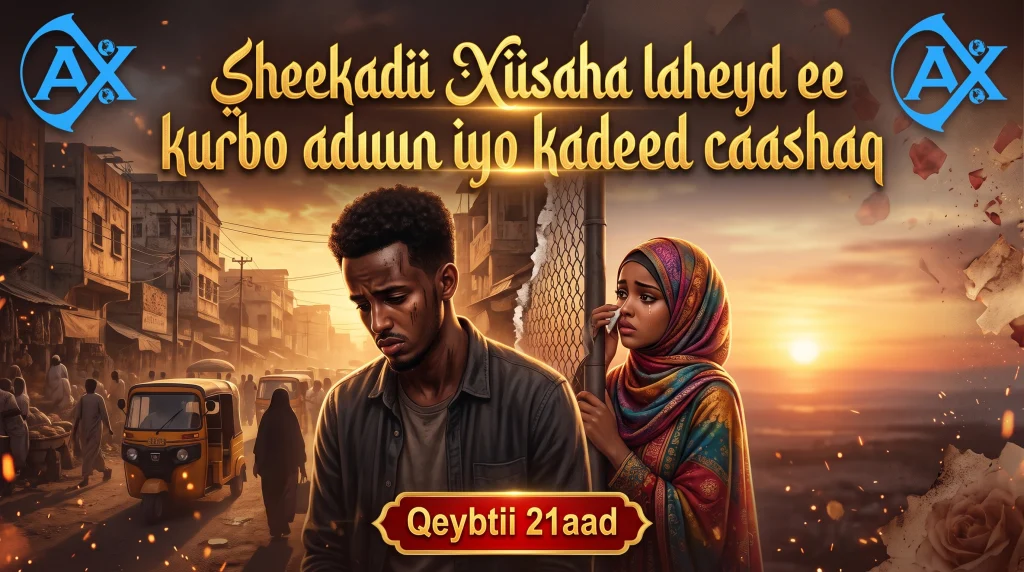
Sadiiq slowly rose to his feet, wiping away the tears streaming from his eyes, and followed with his gaze the door through which Faayow and Akram had exited. His heart felt as though an essential organ had been torn from him. The few words Akram had said to him—“Uncle, don’t cry. I will be your son”—had struck him like a double-edged sword cutting through his very being. He felt the deepest remorse and the harshest punishment life could impose: that your own flesh-and-blood child knows you only as his uncle, while you are unable to say, “I am the one who fathered you.”
Xaaji Baana let out a deep breath and shook his head, great sorrow visible on his face. Looking at Amina, he said gently:
- Advertisement -
Xaaji Baana:
Amina, my dear, you are like a daughter to me, and I understand how painful everything that happened to you has been. A person who has been wronged has every right to be angry, but my dear, when the heart turns to stone, life itself becomes unbearable. The boy is vulnerable today, and we can see the punishment for what he did in his eyes. We cannot say that a complete solution must be reached today, but please, do not close every door.
Ducaale:
What Xaaji says is true. Amina, we stand in your father’s place, and in this world everything is faced with patience and wisdom. What happened to you was no small matter; the worst thing a woman can be called was placed upon you, and we know that his mother sought to destroy your marriage. But Sadiiq did not come here today to assert his superiority or act arrogantly. He came to admit his wrongdoing and beg your forgiveness. A person who begs and cries before so many people has been brought very low.
Amina Sahra:
Uncle Ducaale, Uncle Baana, both of you are people whose advice I would normally follow, whether the matter had begun today or would end in a single day. But you do not know the pain in my heart. On the night he threw me out of the house after branding me with insults and false accusations, on the nights I wandered the streets while pregnant, there was no one to treat me or even tell me to drink some water. His mother called me every terrible name, and he did not say, “Let me speak to the girl.” Instead, he chose to make me into a wicked woman for the whole market to gossip about. Now that he has seen I am alive, that I have rebuilt my honor, and that my son did not die of hunger, he comes running and says, “Forgive me”? Forgiveness is not cheap, Sadiiq.
Sadiiq:
Amina, I did not say forgiveness was cheap, nor did I say you should return to me today. Everything you have said is true, and I was responsible for the suffering you endured. Every night you cried, my own torment began the day the truth became clear to me. My mother’s words proved to be lies, and the shame fell upon me. But Amina, God forgives His servants, and we are only human. If you hate me, does my son deserve to grow up without a father while his father is alive?
Amina Sahra:
Your son grew up without a father when he needed one most! Where were you on the day he was born, on the days he was ill, and on the days other children held their fathers’ hands? Did you not remember then that he was your son? Now that he has grown and learned to speak, you want to take pride in him? No, Sadiiq! Akram has no problem with the life he has. He has a mother who became both father and mother to him. He does not need you, and neither do I.
Muxudin:
Amina, please. You cannot resolve this through anger, so listen to us for just a moment. Sadiiq made a grave mistake, and as his friends we told him he had been foolish when he gave in to that suspicion. But this situation cannot be resolved through conflict. He is a broken man, and the tears falling from his eyes are neither false nor an act. Someone who recognizes his mistake deserves a second chance. Even if this cannot become a marriage, at the very least, let us discuss his fatherhood.
Amina Sahra:
Muxudiin, you are like a brother to me, but this matter has touched a sensitive place in my heart. Fatherhood is not merely a title; it is responsibility and care. The man who yesterday refused to acknowledge the child in my womb cannot today be given the key to my son’s heart. Let him be, and let him go wherever he wishes; let him manage his own life. As for me, I will remain here with my son. There is nothing more for us to discuss.
Xaaji Baana:
Very well, my dear. If this is how great the burden feels to you today, we will not force you into a decision you do not accept. We want whatever solution comes to arise from the heart, not from coercion. Sadiiq, my dear, go and leave today. This is not something that can be resolved in haste. Leave it to time and to God; as for the rest, we will continue trying to mediate.
Sadiiq lowered his head again, looking utterly weak. He looked at Amina, whose eyes still reflected a mixture of anger and pain. He realized that every word he said now would only fan the fire burning in the chest of the woman he loved and had destroyed with his own hands.
Sadiiq:
Amina, I am leaving as you ordered. I will not force you to do anything, and know that I will never resent anything you say to me, because you have every right. But know this: the day you forgive me and allow me to be a father to my son, my door will be open to you. I pray to God to soothe your heart and erase the pain I caused you. Farewell.
Sadiiq slowly turned and walked toward the door. Every step he took felt as heavy as a mountain. Muxudiin placed a hand on his shoulder and led him outside, trying to calm him and take him away.
After the door closed behind him, leaving Amina, Xaaji Baana, and Ducaale in the house, Amina suddenly collapsed. She sat down on one of the room’s chairs and covered her face with both hands, releasing a deep, anguished sob. All the resentment and resolve she had held together while Sadiiq was present suddenly burst forth like water breaking through a dam.
Xaaji Baana came over to her, placed a hand on her head, and said:
Xaaji Baana:
Cry, my dear, and cleanse your heart. We know your firmness was the veil you used to hide the great wound in your chest. But do not forget that patience is what preserves a person’s dignity. Today you spoke at length and expressed your pain, but we must calmly consider Akram’s welfare, both in this life and the next, as we think about the future.
Ducaale:
Amina, your tears are justified, and we feel your pain. We tell you to remain strong, as you have always been. We will discuss any future solution among ourselves without placing pressure on you.
Meanwhile, outside the house, Sadiiq collapsed inside Muxudiin’s car, resting his head against the steering wheel. Tears streamed continuously from his eyes. Akram’s words echoed repeatedly in his mind: “Uncle, don’t cry. I will be your son.”
Muxudin:
Sadiiq, calm down, my friend. Today was not the end; it was the beginning of the long road toward reconciliation. At least you saw your son, and Amina learned that you are sincere in seeking forgiveness. If she shouted at you today, it shows that there are still feelings there and that she has not forgotten you. Someone who feels nothing for you dismisses you; they do not become angry with you.
Sadiiq:
Muxudiin, how can I go on living? How can I sleep knowing that my own son called me uncle? I built my own hell, Muxudiin, and I do not know how to escape it.
Muxudiin started the car and drove his friend toward his home, but Sadiiq’s mind remained entirely in Amina’s house, amid Akram’s childhood laughter.
This was The Story: Worldly Sorrow and the Trials of Love—follow it every Friday on axadletimes.com. Written by the author Haalkoos.