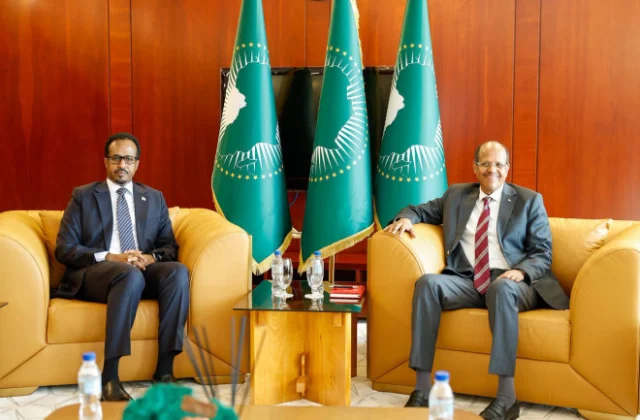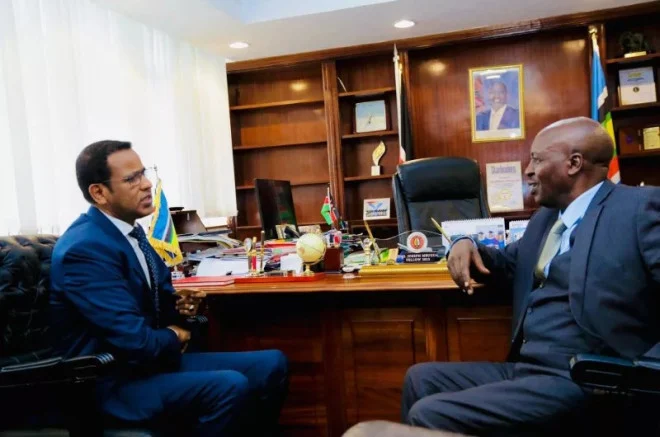
Somalia’s Ambassador to Kenya, Jabril Abdulle, held talks with Roads PS Eng Joseph Mbugua on September 3, 2026, over the operationalisation of the Isiolo–Mandera corridor under the Horn of Africa Gateway Development Project.
Kenya and Somalia are preparing to extend the Isiolo–Mandera road corridor into Somalia, a move that could create a major new channel for trade, digital connectivity and security cooperation across the Horn of Africa.
- Advertisement -
The plans followed a meeting between Ambassador Jabril Abdulle and Roads Principal Secretary Joseph Mbugua.
Following the talks, Kenya and Somalia agreed to form a Joint Technical Committee to pursue the extension of the World Bank-funded Horn of Africa Gateway Development Project into Somalia.
The two countries also agreed to hold a high-level joint meeting as preparations for implementation continue.
Ambassador Jabril welcomed Somalia’s entry into the regional initiative, saying it would strengthen links between the two neighbouring countries.
“This important project will facilitate cross-border trade, improve regional fibre-optic connectivity and unlock greater economic opportunities for communities across the two countries,” he said.
The proposed extension adds a cross-border element to a project that has been in development for several years, even as its Kenyan section has encountered security and implementation hurdles in the northeastern region.
The World Bank approved $750 million in financing for the original HoAGDP in 2020. The funding targeted the 740km Isiolo-Mandera Regional Road Corridor.
The initial plan included upgrading 365km of the corridor and constructing 30km of spur roads. It also provides for fibre-optic infrastructure along the full route, border-management systems, border posts and other interventions aimed at improving trade and access to services in northeastern Kenya.
In March, the State Department for Roads said it had strengthened security arrangements to support construction after a high-level meeting of the Roads, Interior and Defence ministries assessed the project’s progress.
Earlier, in January, Roads CS Davis Chirchir, Interior CS Kipchumba Murkomen and Defence CS Soipan Tuya met senior security and roads officials to consider a new security management plan for the corridor.
The World Bank has classified the HoAGDP as a project in a conflict-prone and fragile area, warning that insecurity presents substantial risks to construction and other activities. It has put in place a comprehensive security strategy to protect workers, infrastructure and communities along the route.
The corridor’s strategic value, however, extends beyond northern Kenya.
The World Bank’s original project documents presented the route as part of a broader network linking Kenya to Somalia and Ethiopia, while improving transport along connecting corridors into both countries.
In March, the World Bank approved an additional $290 million for the HoAGDP and $260 million for the Second HoAGDP, taking the new financing to $550 million.
Together, the two projects are expected to upgrade 508km of the 740km Isiolo-Mandera corridor, with other development partners supporting work on the remaining sections.
According to the World Bank, the investment could reduce travel time between Nairobi and Mandera from about three days to one, while lowering transport and trade costs.
The programme also includes approximately 1,270km of new high-capacity fibre-optic connectivity.
Once completed, the project is expected to ease the movement of people and goods, strengthen border management and reduce the time and expense involved in cross-border trade.
The World Bank has identified trade facilitation and regional integration as key objectives of the corridor.