Friday July 24, 2026
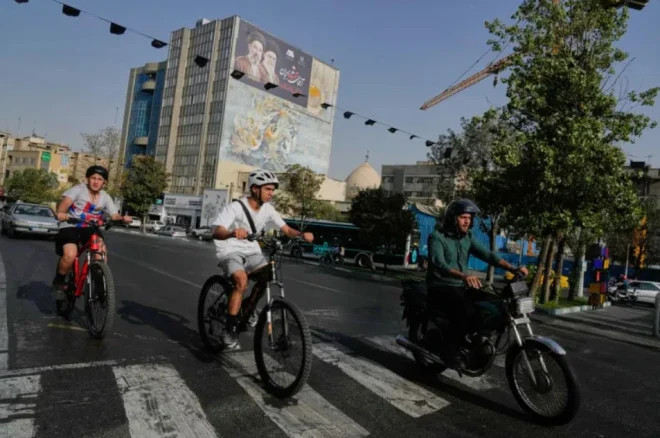
A motorcyclist passes boys riding bicycles in central Tehran on July 22, 2026 [Vahid Salemi/AP Photo]
- Advertisement -
At least four people have been killed in Iran as the United States military carried out strikes on the country for a 13th straight night, Iranian state media reported.
Early on Friday, the US military’s Middle East-based Central Command (CENTCOM) said it had struck “Iranian military command centers, drone storage facilities, communication networks, coastal surveillance sites, and maritime capabilities”.
The operation “aimed to hold Iran accountable and diminish threats from the Islamic Revolutionary Guard Corps [IRGC] to commercial shipping”, the US military said.
Iranian authorities said at least four people died in a US attack on the southwestern province of Khuzestan.
“Following the missile attack by the terrorist US enemy on areas around the city of Ahvaz, four of our compatriots were martyred and five others were injured,” the official IRNA news agency quoted provincial deputy governor Valiollah Hayati as saying.
Iranian media also reported explosions across six other provinces, among them Lorestan and Hormozgan.
The US military maintained that the Strait of Hormuz remains open to traffic despite recent IRGC attacks, saying commercial vessels continue to move freely through the waterway with US military support. The IRGC, however, insists it controls the strait and that safe passage can be assured only through coordination with Iran.
Iran’s military said on Friday that it had answered the US strikes with a fresh wave of drone attacks against US military facilities in Bahrain, Kuwait and Jordan.
In a statement published by Iran’s Mehr news agency, the army said drones targeted fuel tanks, equipment warehouses and troop accommodation at Sheikh Isa Airbase in Bahrain.
It added that aircraft hangars, maintenance facilities and accommodation sites at Jordan’s Muwaffaq Salti/Al-Azraq base were also struck, warning that action against Iranian interests would damage regional security and economic stability.
The IRGC separately claimed it had “targeted and destroyed the intelligence data centre building” in Bahrain belonging to US technology giant Amazon, according to state media. Amazon and Bahraini officials have not commented on the assertion.
Bahrain’s defence forces said on social media that air defence systems had intercepted several Iranian attacks. They accused Iran of the “deliberate use of missiles and drones to target civilians and private property”, calling it “a flagrant violation of international humanitarian law.”
Jordan’s army also reported intercepting and shooting down seven Iranian missiles and six drones, according to state media.
Kuwait, meanwhile, faced another round of strikes.
The Kuwaiti military said its air defences were actively intercepting Iranian missiles and drones on Friday.
Iran’s army said it had fired projectiles towards Ali Al Salem Air Base, a facility used by US forces.
‘Eye for an eye’
US President Donald Trump sharpened his warnings to Tehran on Thursday, telling the US news outlet Axios that he could order the largest strikes against Iran so far. His remarks followed another round of Iranian retaliatory attacks on US allies in the Gulf, including a strike on a telecommunications tower in Kuwait.
Trump said he was “considering a massive attack” that would be “bigger than ever before”.
“I am close to making a decision. We are all set for it,” Trump said.
Iranian Foreign Minister Abbas Araghchi countered that continued “mindless aggression” would force Trump to pay a “heavier price” for a deal.
Araghchi had earlier warned that Tehran would respond to any further attacks, including strikes on Iranian infrastructure, with “an eye for an eye”. US Secretary of State Marco Rubio replied on Thursday that Trump’s policy amounted to “a head for an eye”.
The exchange of threats and Iran’s latest retaliation have again raised the stakes in a military confrontation now stretching over several weeks. Iranian media say US forces have attacked sites including bridges and tunnels.
Iran’s counterattacks have reverberated across much of the Gulf, fuelling concern that the energy crisis could deepen.
The escalating hostilities have also effectively shattered an interim peace agreement signed by the US and Iran last month.
Reporting from Washington, DC, Al Jazeera’s Kimberly Halkett said Washington appeared to be weighing an escalation intended to push Iran towards a negotiated settlement.
“The US media is reporting the president is close to a decision on a potential massive attack and military preparations are in place, but the US president also, with his words on Thursday, signalled that there is something potentially looming, given the fact that he said Iran is not ready to make a deal just yet, but they may be soon,” she said.
Iranian foreign ministry spokesperson Esmail Baghaei, meanwhile, said Tehran would address recent regional developments in forthcoming discussions with China and Russia at the Shanghai Cooperation Organisation (SCO) Council of Foreign Ministers meeting.
“The current situation is a clear military aggression by the United States, a continuation of the aggression they started last year,” Baghaei told reporters on Friday, according to the semi-official Tasnim news agency.
He said the US actions violated international rules and standards, adding that countries would naturally use every available opportunity to raise such concerns.
Houthis attack Saudi tankers
Yemen’s Houthi group widened the conflict further on Thursday, opening fire on two Saudi tankers in the Red Sea. The attacks drew widespread international condemnation and sent global oil prices sharply higher.
“The situation is getting out of control. It is teetering on the edge of the unimaginable,” United Nations Secretary-General Antonio Guterres told a Security Council meeting. “One crisis feeds another. One escalation triggers the next.”
The Houthis have announced a blockade of Saudi Arabian ports, bringing instability to a second vital artery for global trade: the Bab al-Mandeb Strait.
However, Houthi spokesperson Mohammed Abdul Salam denied in a post on X on Friday that the group had closed the Bab al-Mandab Strait.
“There is no closure of the Bab al-Mandab Strait as some promote.” he wrote on X. “The position of Yemen … is limited to a maritime blockade that only affects the Saudi side, in response to its siege of Yemen and its refusal to accept any fair approach to a solution that guarantees the security, sovereignty and independence of the Yemeni people.”
The Strait of Hormuz has been effectively closed since the US and Israel began the war against Iran in late February.
Reporting from Sanaa, Yemen, Al Jazeera’s Yousef Mawry cited Houthi sources who said facilities operated by Saudi Arabia’s state oil company Aramco “could become a future target” unless Riyadh ends its blockade of Houthi-controlled ports.
Brent crude, the international oil benchmark, climbed above $100 a barrel on Thursday for the first time since May, a surge analysts warned could deliver an even heavier blow to the global economy.
“Much of the world’s spare production capacity has already been used, while strategic and commercial oil inventories are lower than when the war began, leaving the market with fewer buffers against a prolonged supply disruption,” said Janiv Shah, vice president of the Rystad Energy consultancy.