Snap Election Could Follow Four Failed Prime Ministerial Votes
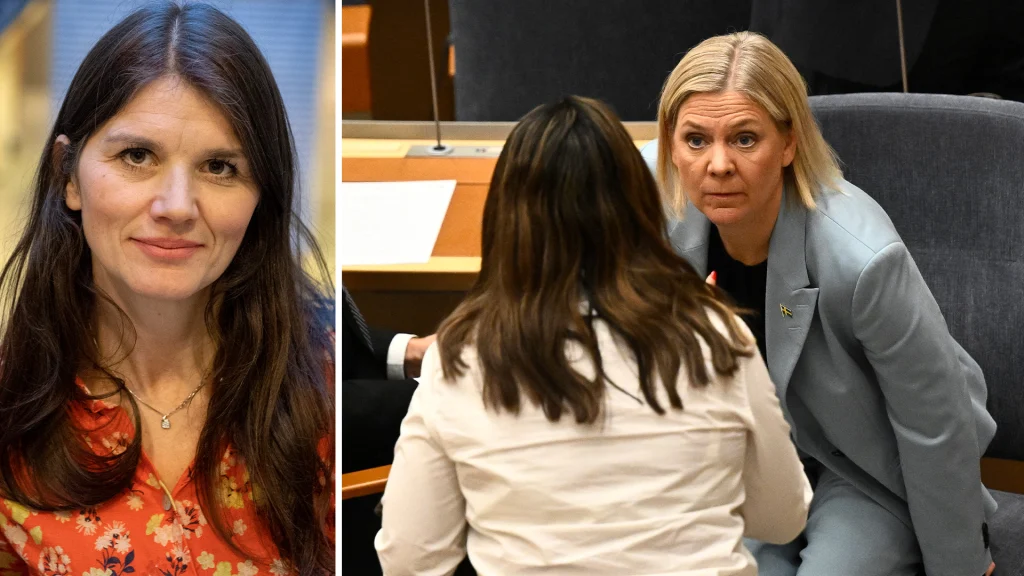
It was widely expected that Social Democratic Party leader Magdalena Andersson would fail to secure parliamentary approval in today’s vote on her candidacy for prime minister.
- Advertisement -
“The purpose is precisely to move the process forward. This is the tool available to the Speaker of Parliament: to put forward prime ministerial candidates so that we gradually move closer to the fourth vote,” said Jenny Madestam, an associate professor of political science at Södertörn University.
Four failed attempts could trigger a snap election. The Speaker of Parliament must now try to guide the parties through a political deadlock that has made it difficult to assemble a viable parliamentary majority for a government.
According to Madestam, today’s vote, in which Parliament rejected Magdalena Andersson as prime minister, was part of that process. At the same time, it highlighted how far the parties remain from reaching an agreement.
“The process puts a certain amount of pressure on the parties to find a solution,” Madestam said.
She stressed, however, that Andersson’s defeat does not in itself constitute a democratic crisis.
“Our constitution allows several attempts to be made to test a candidate for prime minister. However, the framers of the constitution probably assumed that when a candidate is put forward for a parliamentary vote, there would already be an agreed basis of support for a government.”
‘A Failure’
Nevertheless, Madestam considers it a problem that the political parties have been unable to agree on how the country should be governed.
“Voters expect the parties to resolve this,” she said.
She described the situation as a political failure, arguing that the parties’ entrenched positions have made it increasingly difficult to find a way forward.
One of the main obstacles is the deep divide between the Left Party and the Centre Party. The two parties are ideologically far apart, particularly on economic policy.
The Left Party has its roots in socialism, while the Centre Party follows a liberal tradition. According to Madestam, this makes them ideological opposites on several key issues.
“They dislike each other so much, and they strongly oppose the policies the other party wants to pursue. They cannot sit down and negotiate without having to take indirect routes,” she said.
A Centrist Alternative?
Meanwhile, there have been high-profile contacts between politicians from different sides of Sweden’s traditional political blocs. Recently, Centre Party leader Elisabeth Thand Ringqvist and Christian Democrats leader Ebba Busch were seen together in a sauna, drawing attention to the possibility of cross-party dialogue.
Madestam does not rule out the possibility that such contacts could pave the way for a new political alternative.
“It is entirely possible that these kinds of discussions are taking place,” she said.
However, she believes the political situation remains deadlocked, with no clear centrist alternative capable of securing sufficient support in Parliament to form a government.
“That centrist solution is simply not something anyone can see taking shape at the moment,” she concluded.