Mogadishu (AX) — Former Somali President Sheikh Sharif Sheikh Ahmed has condemned the federal government’s foreign-policy approach, cautioning that Somalia could undermine its own interests by being drawn into competing regional alliances.
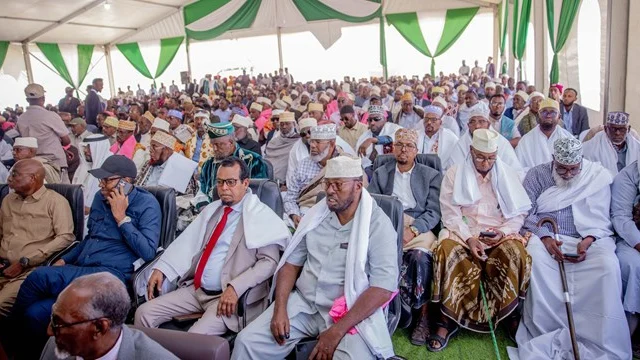
Speaking in Mogadishu on Wednesday, Sheikh Sharif questioned President Hassan Sheikh Mohamud’s recent diplomatic visits to Ethiopia and Egypt, whose regional priorities have frequently clashed.
- Advertisement -
“It is a disgrace to Somali diplomacy for President Hassan Sheikh to land in Addis Ababa and then in Cairo the very next day,” Sheikh Sharif said.
He urged Somalia to stay out of disputes involving governments or groups pursuing conflicting interests.
According to Sheikh Sharif, Somalia’s foreign policy should rest on common interests, mutual benefit, good-neighbourly relations and mutual respect.
“We do not wish to get involved in or become entangled in the disputes between various governments and groups,” he said.
The former president said Somalia’s political challenges would have to be settled through dialogue among Somalis, rather than by relying on outside powers.
He noted that Somalis had embraced dialogue in the past, including during periods he described as more difficult than the current political climate.
“Somalia has a tradition of holding elections every four years and ensuring a peaceful transfer of power,” he added.
Sheikh Sharif warned that compromise would not resolve the crisis if certain political actors remained intent on retaining power through what he called injustice, baseless accusations, theft, deceit and bloodshed.
His comments followed a call by Egypt, Eritrea, Somalia and Sudan for political and peaceful responses to regional conflicts, including Sudan’s civil war and the fighting in Ethiopia.
Egyptian President Abdel Fattah el-Sisi, Eritrean President Isaias Afwerki, Somali President Hassan Sheikh Mohamud and Sudanese army chief Abdel Fattah al-Burhan issued a joint declaration on Sunday after meeting in New Alamein City, Egypt.
Ethiopia has accused Egypt, Eritrea and Sudan of supporting an armed alliance opposed to its government. Officials from all three countries have rejected the allegation.
Earlier on Sunday, el-Sisi said cross-border challenges demanded “dialogue, not confrontation.”
The declaration appeared to challenge several policies Ethiopia has pursued in recent years, highlighting deepening tensions between Addis Ababa and some of its neighbours.
It expressed support for Sudan’s military-led government and called for a political process driven by Sudanese parties.
Sudan has been embroiled in war since April 2023, when fighting broke out between the army and the paramilitary Rapid Support Forces. Sudan and Ethiopia have also accused each other of interfering in the conflict.
The declaration further stated that control of the Red Sea should remain in the hands of coastal states, a position viewed as a response to landlocked Ethiopia’s efforts to secure sovereign access to the sea and establish a naval presence.