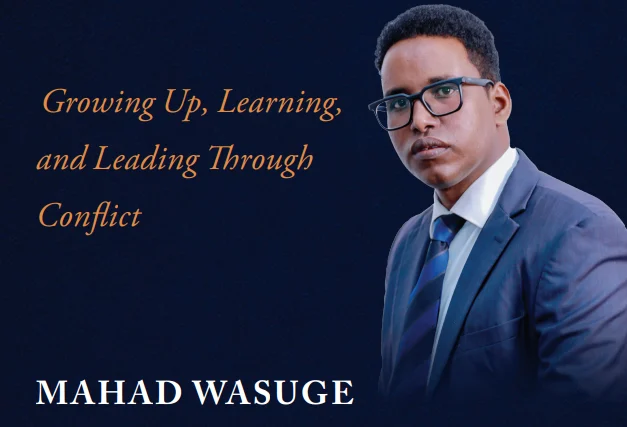
A nation’s history is often recorded through collapsing governments, changing political fortunes and conflicts that reshape society. But Somalia’s recent past can also be seen through the life of a child trying to stay in school as the world around him fragments. Mahad Wasuge’s Chaos, Courage and Change in Somalia: Growing Up, Learning and Leading Through Conflict presents that more intimate view. Tracing his path from Buulaburde to the founding of Somali Public Agenda (SPA), Wasuge illustrates what it meant to mature without reliable institutions—and how a person formed by that absence eventually set out to build one.
I began the 230-page, 21-chapter book expecting a personal memoir, but encountered something broader: a portrait of a generation. Somalis who came of age during the civil war will recognize its landscape—schooling disrupted by violence, families divided by necessity, ambitions restricted by poverty and opportunities made possible through the sacrifices of others. Wasuge’s story is distinctly his own, yet the circumstances he describes will be familiar to many.
I read the memoir through three linked themes: growing up amid conflict, pursuing education against formidable odds and leading through adversity. The book’s strength lies in the way these themes reinforce one another. Childhood experiences do not vanish when Wasuge becomes a student, researcher or institutional leader. They continue to inform his decisions, his understanding of opportunity and his determination to create room for others.
Growing Up Through Conflict
Wasuge was born in 1988 in Buulaburde, in Somalia’s Hiiraan region, shortly before the central government collapsed. As a result, his memories of childhood are inseparable from clan conflict, displacement and insecurity. He recalls violence and destruction in his hometown, as well as periods when his family sought refuge in villages elsewhere in the region.
These accounts bring the human cost of conflict into sharp focus. A family is forced to abandon its home. A school falls beyond reach. The routines that help children feel secure disappear. Choices about where to live and whether to remain in school become questions tied directly to survival.
This perspective restores daily life to a history often narrated through battles and political developments. For a child, conflict is defined partly by what it makes impossible: going to class, staying close to friends or imagining the future with any certainty. Wasuge shows how insecurity enters ordinary decisions and gradually alters a young person’s expectations.
When Wasuge was twelve, his father died, adding a devastating personal loss to an already precarious childhood. His mother took responsibility for supporting the family, initially selling secondhand clothes before opening a small shop in Buulaburde. Wasuge assisted her while continuing his education, even as school fees remained a constant challenge.
Her role is central to the memoir. Accounts of individual perseverance can too easily obscure the people whose labor makes that perseverance possible. Wasuge’s progress depended on his determination, but also on a mother who worked to sustain both the household and her children’s future. Her contribution provides the story with one of its deepest human dimensions.
Learning Against the Odds
Education became a thread of continuity in a life repeatedly unsettled by events beyond his control. Wasuge studied the Qur’an and Islamic subjects alongside formal education and English lessons. His description of private schooling in Buulaburde is telling: what sounded like a private school could, in practice, be a modest classroom where English was taught. Yet the room’s limitations did not diminish the possibilities it opened.
The memoir makes clear that the value of education is not always reflected in an institution’s size or reputation. For a young person with few choices, a small classroom can become the first step toward an unexpectedly far-reaching journey.
The path was uneven. Fighting disrupted his primary education, and financial pressure restricted his choices. After finishing primary school, he planned to continue in Mogadishu. That ambition ended when the relative he expected to live with died unexpectedly. With his mother’s backing, he pursued an alternative and moved to Beletweyne.
Relocating did not remove the uncertainty. Distance from home, scarce resources and continuing insecurity remained part of his educational experience. Wasuge describes interruptions during the period of Ethiopian military intervention in Somalia, demonstrating how national events could reach directly into schools and students’ lives. Despite these obstacles, he completed secondary school and later secured the chance to attend Mogadishu University.
A scholarship enabled him to enter university, although it did not erase the difficulties of studying in a city affected by violence. One especially memorable episode concerns his efforts to raise money for his graduation celebration at the well-known Shamo Hotel. Graduation is normally a symbol of having overcome a demanding stage; for Wasuge, even marking the achievement required initiative and help from others.
The incident reflects a pattern that runs throughout the book. Reaching one landmark does not necessarily end hardship. More often, it brings new obligations and another challenge requiring persistence.
Wasuge’s education also developed outside formal classrooms. Volunteer journalism, teaching, blogging and research allowed him to build a public voice while gaining practical experience. These activities help explain his evolution from a student pursuing knowledge into a researcher concerned with the role of knowledge in public debate.
His reflections on the Heritage Institute for Policy Studies are particularly compelling because they hold appreciation and frustration together. He credits the institute with giving him valuable practical learning and helping him pursue further education, including an online master’s course at a university in London.
He also describes occasions when work he says he had led was published without crediting him as the author. These are Wasuge’s recollections and should be understood in that context, but they raise an important issue: how do institutions acknowledge the work of young professionals?
An encounter involving journalist Mary Harper illustrates another barrier he faced. Wasuge recalls accompanying Harper to interview President Hassan Sheikh Mohamud, only to be denied entry with her by an official at the president’s office. He says the official later rejected the account of what happened.
The episode is significant because it highlights questions about whose expertise is accepted and whose presence is treated as legitimate. In Wasuge’s account, a Somali professional accompanying an international journalist faced a restriction that did not apply to her. It offers a specific example of how access and professional credibility can be distributed unequallyThe importance of these passages comes from his readiness to present competing experiences side by side. He recognizes the doors Heritage opened while also describing moments when he felt pushed aside. The result is a more complete picture of professional development, in which learning, encouragement, disappointment and concerns about fairness can coexist within one institution.
Building an Institution and a Public Voice
The creation of Somali Public Agenda represents a decisive shift in Wasuge’s story. He moved from pursuing opportunities inside established organizations to creating an organization through which he and others could participate in Somalia’s public life. With limited resources, he faced the demanding task of turning an idea into a functioning institution.
The earlier chapters gain added meaning in light of this development. Having experienced the importance of educational access, professional opportunity and recognition, Wasuge began creating a platform for research, debate and participation. His ambitions were no longer focused solely on personal advancement.
The growth of SPA also underscores the value of an independent platform. Building an institution allowed Wasuge to contribute on his own terms, establish credibility through consistent work and create openings for other Somali researchers.
The SPA chapters bring together interests cultivated over many years: writing, research, public discussion and concern for governance and public services. Institution building becomes the practical extension of those interests. Its achievement lies not only in founding an organization, but in the patient effort required to keep it active and useful to others.
A Story Many Somalis Will Recognize
Wasuge’s story is encouraging precisely because it does not hide failure. Plans fall apart, education is interrupted, money runs out and effort does not always receive due recognition. Progress comes through persistence, support from others and the ability to find a different route when the planned one disappears.
The memoir should not be reduced to the idea that determination alone guarantees success. The conditions Wasuge faced were severe, and the opportunities that reached him were crucial. Its more persuasive message is that refusing to surrender can keep another future within reach—and that an opportunity provided at the right time can influence far more than the life of the person who receives it.
Many Somalis from Wasuge’s generation will recognize aspects of themselves in these pages. Their towns, schools and professional paths may not match his, but the family sacrifices, interrupted dreams and uncertain journeys will resonate. Through that recognition, the memoir becomes more than a record of one man’s accomplishments. It preserves experiences that belong in the history of Somalia’s recent past.
Chaos, Courage and Change in Somalia is a compelling account of a life shaped by conflict and sustained through education. Its central achievement is linking personal perseverance to public service. The boy who searched for a way to remain in school eventually helped create a platform where others could learn, conduct research and be heard. That arc makes Wasuge’s memoir both an engaging personal narrative and a valuable contribution to understanding the generation that grew up amid Somalia’s upheaval and continues working toward its future.
___________________________________
Hussien Mohamed Yusuf[email protected] Hussien is Climate Change adaptation and Environmental Sustainability Practitioner based in Nairobi, Kenya